
Marketer, analyst, ex-CMO focused on the Google ecosystem (Ads, Merchant Center, GA4, GTM). Google Partner. 150+ projects, 100+ positive reviews on Freelancehunt, 12+ countries.
- I work directly, with no account managers or subcontractors
- I measure results in sales, not in-platform conversions
- Maximum expertise in the Google ecosystem — instead of “PPC, social ads and SEO, all in one”
One of the most common questions I get before we start working together or during consultations: “So what is better — Performance Max or Search?” Sometimes YouTube gets added, because competitors run ads there. Or Display, because the clicks are cheap.
To answer, I ask a question back: what is better — a hammer or a screwdriver? Strange question, right? That is roughly how the question about which Google Ads campaign type to choose sounds to me. The question is not what is better, but what fits your specific task.
Contents
Google Ads Campaign Types in 2025
Three questions that start the choice
First — does demand already exist, or does it need to be created?
If a person is already typing “buy Nike sneakers size 42” or “air conditioner repair Kyiv” into Google, that is hot demand. It is formed, and the person is ready to buy now, depending on the deal cycle. You just need to be in front of them at the right moment. Search, standard Shopping and Performance Max are made for this.
But what if nobody knows your product, nobody searches for it and there are simply no search queries for it? Then demand has to be created: YouTube, the Display Network, Demand Gen campaigns. But that is a completely different story — with different timelines, different expectations and different performance metrics.
Lately I get a lot of requests to promote AI solutions. There are an incredible number of them right now. The latest example is AI agents for finance and marketing. It seems AI is everywhere, but people do not search for these things directly. There is no demand; it has to be created. To sell something, you either create demand or sell where it already exists.
My subjective opinion: I have seen plenty of AI solutions that are not worth a penny, because they were written by the same AI and add no extra value. A Claude subscription at $100 a month covers more tasks than a separate single-niche AI agent for the same money. So if I see that a project brings no value and I do not believe it will take off, there is no point investing time in it.
Second — what is your budget?
If you have UAH 15,000 (~$330) a month (and sometimes less), spreading it across five campaign types means being everywhere and nowhere at once. Each campaign gets a tiny amount of statistics. And Google Ads runs purely on statistical data. The algorithms do not learn and stay stuck in an endless learning period.
On a small budget, everything has to be as narrow as possible and work with the hottest possible demand. How much you really need and what you can get is best calculated before launch in the ad ROI calculator. An important note: my calculator only works for niches where demand already exists. You cannot estimate the effect of display advertising with it, and any forecast for display is a shot in the dark anyway.
Third — is your data clean?
Performance Max and smart bidding strategies — Maximize Conversions, Maximize Conversion Value, Target ROAS, Target CPA — learn from your data. If purchases are counted twice, if micro-conversions sit in bidding where they do not belong, if half of the orders are cancelled later — Google does not know that. It optimizes for whatever you give it.
This is not made up — these are recent cases I published not long ago. You take an account, look at it and simply describe the cause and effect.
Launching Performance Max at the start with a small budget, without clean data and with no statistics at all, means handing Google your money and saying: “Do whatever you want — I need duplicate conversions, micro-conversions and people who never pick up their orders at the post office.”
Search ads
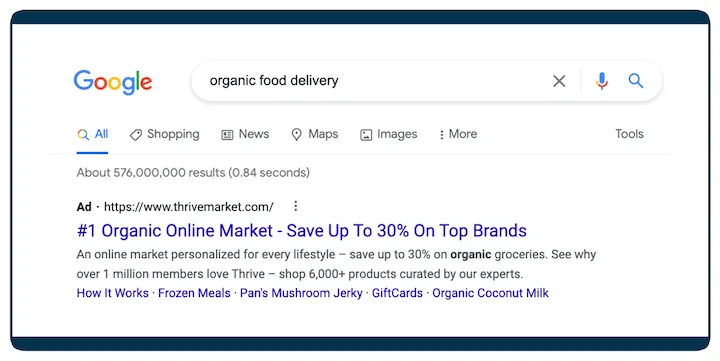
Search ads are the foundation. Google started with them, and it will most likely die with them.
The person types what they need, and you answer that exact query with an ad. There is no hotter traffic in Google Ads.
The biggest advantage of Search is control. You see the search terms, clean up negative keywords, manage bids if you use manual bidding, and know exactly what you are paying for.
The downside: Search needs constant work. Without regular analysis and search term cleanup, part of the budget is guaranteed to go to irrelevant traffic.
Who it suits: any services, local businesses, every niche where a call or a request equals money. In most B2B projects we use Search only. We do not need to run on YouTube — we need to work with hot demand even with the limited keyword pool that is very common in B2B.
Can you use Search for an online store? You can — nobody forbids it, and many do. It is a question of extra budget, staged scaling and willingness to work with this format.
In most cases Shopping or Performance Max work better than Search for a store. The reason is clear: in Shopping a person sees much more information — what the product looks like, specs, price, sometimes delivery. In Search they see only a text ad, which is not always up to date, and they do not even see what the product is. So if I were working with a limited budget, I would not launch Search for a store at the start. Not always — I have cases where Search works much better. But mostly.
In a recent case about motor oils, I explained in detail why Search was not worth it at the start there at all.
Shopping
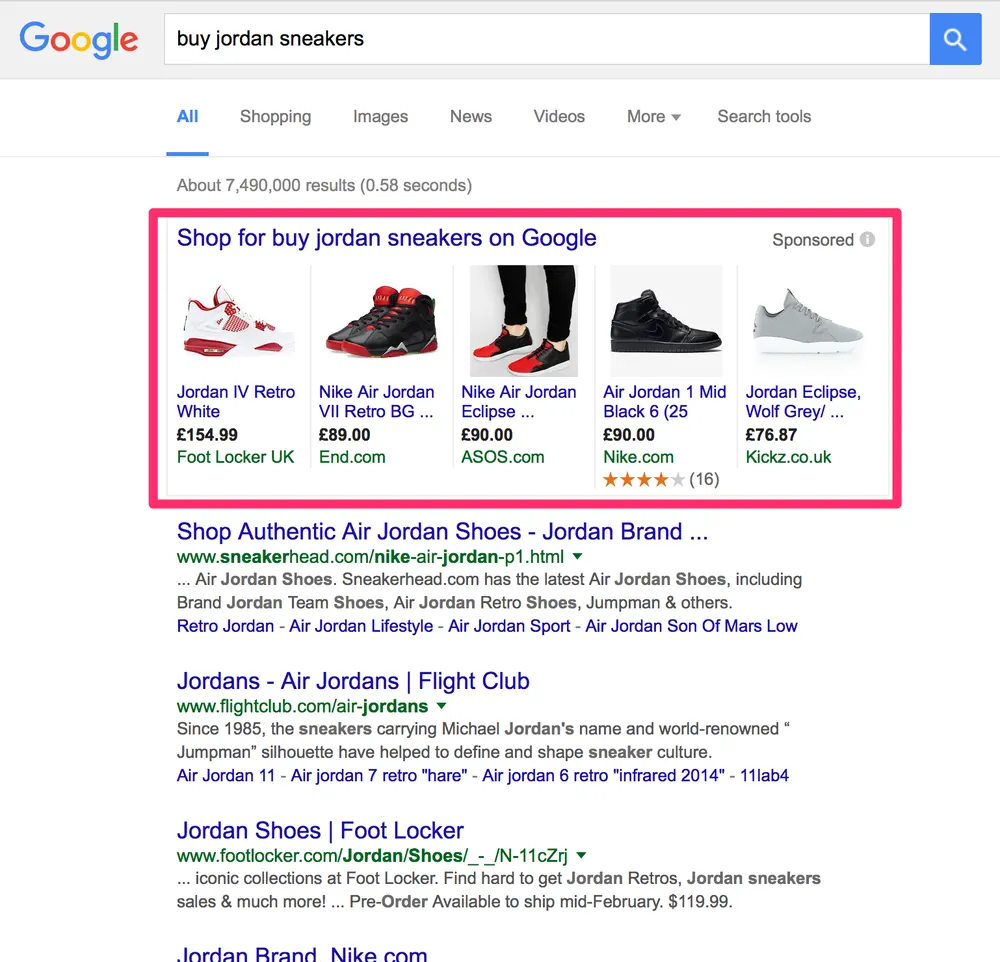
For an online store, Shopping ads are number one. A person sees the photo, price, product name and store name before clicking. When they click, they are already warmer than someone who came from Search.
But Shopping rests on two things: the product feed and Merchant Center. A broken feed means broken Shopping. A suspended Merchant Center means no Shopping at all. So for a store, work on the feed matters as much as work in the ad account.
But here is the key point: do not idealize feed work. It matters, definitely. If there is something to improve in the feed, improve it. But the feed is not a cure-all. You do not add the word “sale” to a product title or fill in the specs and suddenly the ads take off. Yes, it will improve the numbers. But if there are fundamental problems with the product, the unique selling proposition, the site’s functionality or the price, the feed will not fix that.
And one more thing: Shopping will not rescue an uncompetitive price. If your product costs 10–30% more, you will be ignored right in the results. And if the difference is big, people will click on you — just to see what kind of oddball sells the same product 30% more expensive than everyone else. And you pay for those clicks.
Shopping is a great tool, but not a cure-all that will carry your business.
Who it suits: almost all online stores with mass-market and mid-range demand. Even in some B2B niches it can be used with certain budgets.
Performance Max
Without a doubt the most popular campaign type of recent years. And, honestly, most of the mistakes I regularly see in audits come from it.
Performance Max is not a cure-all; it has many drawbacks. The main one is that it is a black box you cannot always control. In 2026 Google is lifting the curtain a little, but there is still not much you can control. This campaign type has everything: Search, Shopping, YouTube, Display, Gmail, Discover and Google Maps.
Google decides where exactly the budget goes. And Google always goes where it is easier to “draw” a conversion.
A recent example. A project runs on offline conversions from a CRM. Lots of requests started coming in through messengers, and I asked the client to set up passing messenger leads. He set it up, but without validation. Google Ads started receiving “leads” from people who just opened a messenger and wrote nothing. Performance Max, which had been running steadily for three months, quickly picked up this signal: such “leads” are much easier to find. Within two days the campaign went completely off the rails. Three months of work down the drain. And Performance Max wandered off into Display, where such “leads” are easiest to find.
 Google Ads · AnalyticsHow to Send Messenger and Email Orders to Google Ads — and Why You ShouldB2B clients message on Telegram instead of using the cart. A GTM + CRM setup to send those orders to offline conversions.
Another recent example is an audit of a sneaker store. 54% of the Performance Max budget went to YouTube. At the same time, the client complained that about half of the orders never became real sales. The most likely cause is exactly the junk traffic from YouTube.
For a mass-market niche with hot demand, Performance Max is the answer. But under certain conditions.
 Google AdsWhere Are the Weak Spots in Your Google Ads Performance Max Campaigns?10 Performance Max weaknesses: tracking, geotargeting, AI features, scaling, traffic cannibalization.
Who it suits: mass-market and mid-range online stores with clean data and enough conversions.
For lead generation I would recommend it very carefully. Or not carefully — go ahead and run Performance Max for lead gen, I will get more audits and more clients. That is irony, just in case. Performance Max will happily find you cheap leads that nobody buys anything from. Cheap, fake, irrelevant.
YouTube and Demand Gen
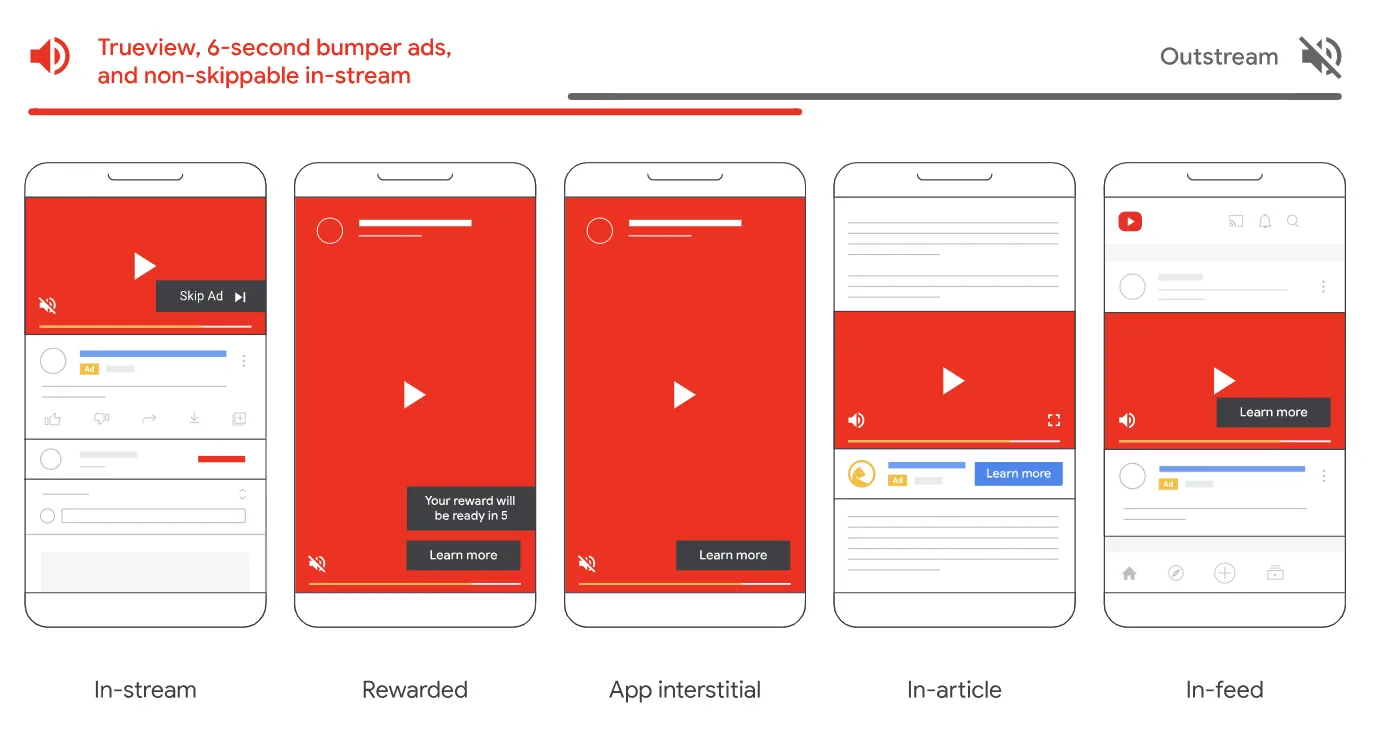
Here I combine them into one block. YouTube video campaigns are still available, but Google is actively moving them into Demand Gen, and most likely there will be no separate YouTube format by the end of the year.
What matters: YouTube does not hard-sell. If you expect sales from it the way you do from Search, you will be very disappointed. YouTube works with the upper stages of the funnel: creating demand, awareness, bringing back people who have already heard of you.
Here it is important to tell two things apart. YouTube running inside Performance Max because Google decided so, with creatives Google put together from your content on its own — you would rather not see them. Most often it is just burning money.
But YouTube as a deliberate strategy — with a separate campaign, proper videos and an understanding of how you measure results — is a genuinely powerful tool worth using at certain stages.
Who it suits: new products without formed demand, when you need to enter the market and get wide reach to introduce people to a product or brand. Premium brands. Complex solutions, where a person first needs to get to know the brand, then the product — the full funnel.
For example, premium craft whiskey at €150 in Ireland. The mid-range segment is €30. You will not sell it through Search or Performance Max. You have a whiskey with a story, but it is five times more expensive than average. Until you introduce people to the brand, tell its story and explain why it costs €150 rather than €30 like Jameson in the supermarket, nobody will buy it.
 Marketing · Google AdsHow Do You Sell €150 Whiskey in Ireland? A Hard Sell Won't WorkStrategy for promoting craft Irish Whiskey: why a hard sell fails, Demand Gen, YouTube, a 6-month roadmap.
YouTube also suits businesses that have the budget and patience for the long game. On a limited budget, it is definitely not for you.
But understand this: if your competitor invests for the long game, you will lose to them. While you fight for every sale, they invest in awareness and the brand and will overtake you over time. And you will be looking for yet another contractor.
Display Network

The Google Display Network, aka GDN, is banners on websites and in apps. The cheapest clicks and, of course, the most junk. Ads in mobile games, accidental taps, kids tapping the banner to close it. The same annoying ads that cover the whole site while you are reading the news.
I use this channel in maybe one percent of cases. I do performance marketing, and Display is not about performance. It is the same upper funnel stage as YouTube.
Who it suits: as an add-on to other campaign types, not as a foundation and not as a standalone strategy.
What suits whom
| Business type | Where to start |
|---|---|
| Online store | Shopping or Performance Max → then Search → then other networks |
| Lead generation, services | Search → carefully Performance Max → even more carefully the Display Network (remarketing only) |
| B2B | Mostly Search; if you sell products — carefully Shopping; I do not recommend Performance Max: in a narrow niche it will not collect enough statistics |
| Local business | Search + Google Maps ads, a little YouTube |
| New product without demand | YouTube or Demand Gen + brand Search |
A separate note on new products. Brand Search is needed here because you are already showing up on YouTube and in Demand Gen. In about six months, depending on the budget, branded traffic will start to appear, and you need to capture it in Search. And do not expect sales in the first week. I would not expect anything here for about six months.
This is not dogma, it is a starting point. After that, the numbers and your project’s strategy decide everything.
Common mistakes
Launching everything at once. A small budget — and every campaign type, to “test what works.” I ran into this on a motor oil project. A client with a very small budget wanted both Shopping and Search, even though Search made no sense there at all.
Running Performance Max without quality tracking. The algorithm learns from what you give it. Feed it junk data and you get junk. Only you pay for it too.
Judging YouTube by the last click. YouTube’s job is not to sell. Its job is to bring the user closer to a purchase through additional touchpoints.
Copying competitors. “Competitors run Performance Max, so we need it too.” First, you do not see their numbers and do not know whether it works. Maybe they are wasting budget just like you. Maybe their contractor cannot even set up basic tracking. Without competitors’ numbers, everything you see is guesswork, nothing more.
Believing Google will do everything itself. Google thinks about Google first and about you second. Choose what benefits you, not Google. Ads do not run themselves — they need constant attention from the person managing them.
Conclusion
There is no best campaign type. There is a campaign type that matches your demand, budget and overall strategy.
Start with the hottest demand, if it exists. Set up correct tracking to see real sales, not just in-platform conversions. Do the math. And only then expand to other networks.
CTR is not compared across campaign types: brand Search, Display and Shopping have completely different numbers. More in the article CTR in Google Ads: does it affect business metrics.
How Performance Max delivered leads at twice the cost of Search — see the overseas employment agency case study.
A new ad channel: ChatGPT campaigns, their types, goals and budgets — see the ChatGPT Ads Manager walkthrough.
Where to find me
Message me on Telegram or by email — I respond quickly. Telegram channel and YouTube are for those who want to see real cases before reaching out and understand my approach.