
Marketer, analyst, ex-CMO focused on the Google ecosystem (Ads, Merchant Center, GA4, GTM). Google Partner. 150+ projects, 100+ positive reviews on Freelancehunt, 12+ countries.
- I work directly, with no account managers or subcontractors
- I measure results in sales, not in-platform conversions
- Maximum expertise in the Google ecosystem — instead of “PPC, social ads and SEO, all in one”
The Google Ads market in Ukraine is genuinely flooded with pseudo-specialists right now. Someone watches a few courses about success, sets up two campaigns — and immediately charges like a specialist with five years of experience.
The most interesting part isn’t even the price. The most interesting part is that these people find clients who buy from them. And their ads somehow work. The key word here is “somehow”.
Contents
A Recent Audit of an Online Tea Store

The Dunning–Kruger Effect in Google Ads
The Dunning–Kruger effect is a cognitive bias: the less a person knows about a subject, the higher they rate their own competence. They can’t see their own mistakes, because that takes the very knowledge they lack. A closed loop.
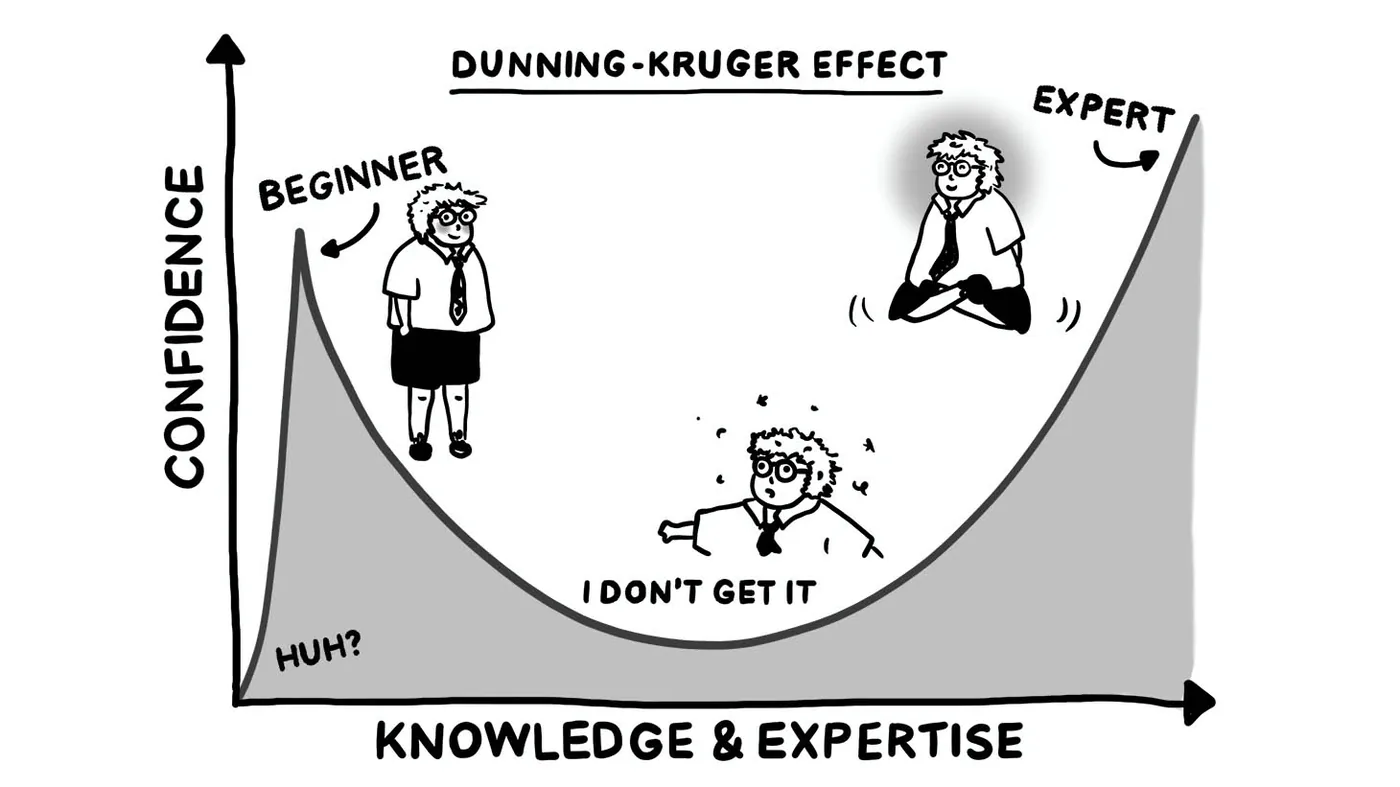
In Google Ads it shows up especially clearly. The interface looks simple: create a campaign, add ads, pick a strategy, set a budget, hit “Publish”. The account shows conversions, ROAS, charts going up. After a course, it feels like that’s the whole profession.
In reality, the ad account is just the tip of the iceberg. Underneath are tracking, attribution and the quality of the data the algorithms learn from. That’s exactly where the most expensive mistakes happen.
A beginner who honestly calls themselves a beginner and charges accordingly is fine. Everyone started that way. The problem is when someone sells themselves as an expert after a course, and the client pays an expert’s price for guesswork. I’m not shy about the word: that’s already deception.
Why the client doesn’t see it
Because not every client understands Google Ads. I’ll go further: not everyone understands even their own business. Being an entrepreneur and understanding business are not the same thing. Over the years I’ve met many people who can’t answer basic questions about what’s happening with their finances. How do such businesses exist? They just do. Until at some point problems start, and by then it’s too late.
So the client can’t check what’s behind the numbers in the report. That takes the very expertise they’re paying the contractor for.
Recently I did an audit where the ad account alone made it clear the ads were losing money. I asked for CRM access, analyzed the data — the hypothesis was confirmed. And this had been going on for over six months. The client was just leaving an agency he paid $1,000 (45,000 UAH) a month. I don’t know what they told him, but they’re obviously talented at that.
And he asks: “If we start working together, you won’t break anything?” I say: your ads have been running at a loss for six months, even before paying the contractor. Here’s your CRM, here are the numbers. A big company, a manufacturer — and they can’t do the basic math.
 Marketing · Google AdsAgency or Freelancer? Let’s Sort It OutAn honest agency vs. freelancer comparison: pros and cons, who each one fits. From someone who worked at 4 agencies.
From there the logic is simple: I pay $500 (22,500 UAH) a month, so this is a professional. And a professional can’t show false or inaccurate numbers. Yes, they can. And most often not on purpose, but because they don’t understand what they’re looking at.
What the audit found: an account breakdown
An online tea store. Ad budget — about 200,000 UAH ($4,444) a month. The contractor has been running the project for over a year at $500 a month. There seem to be sales, but the owner sees that something doesn’t add up: the contractor’s reports say one thing, the money says another. He comes for an audit.
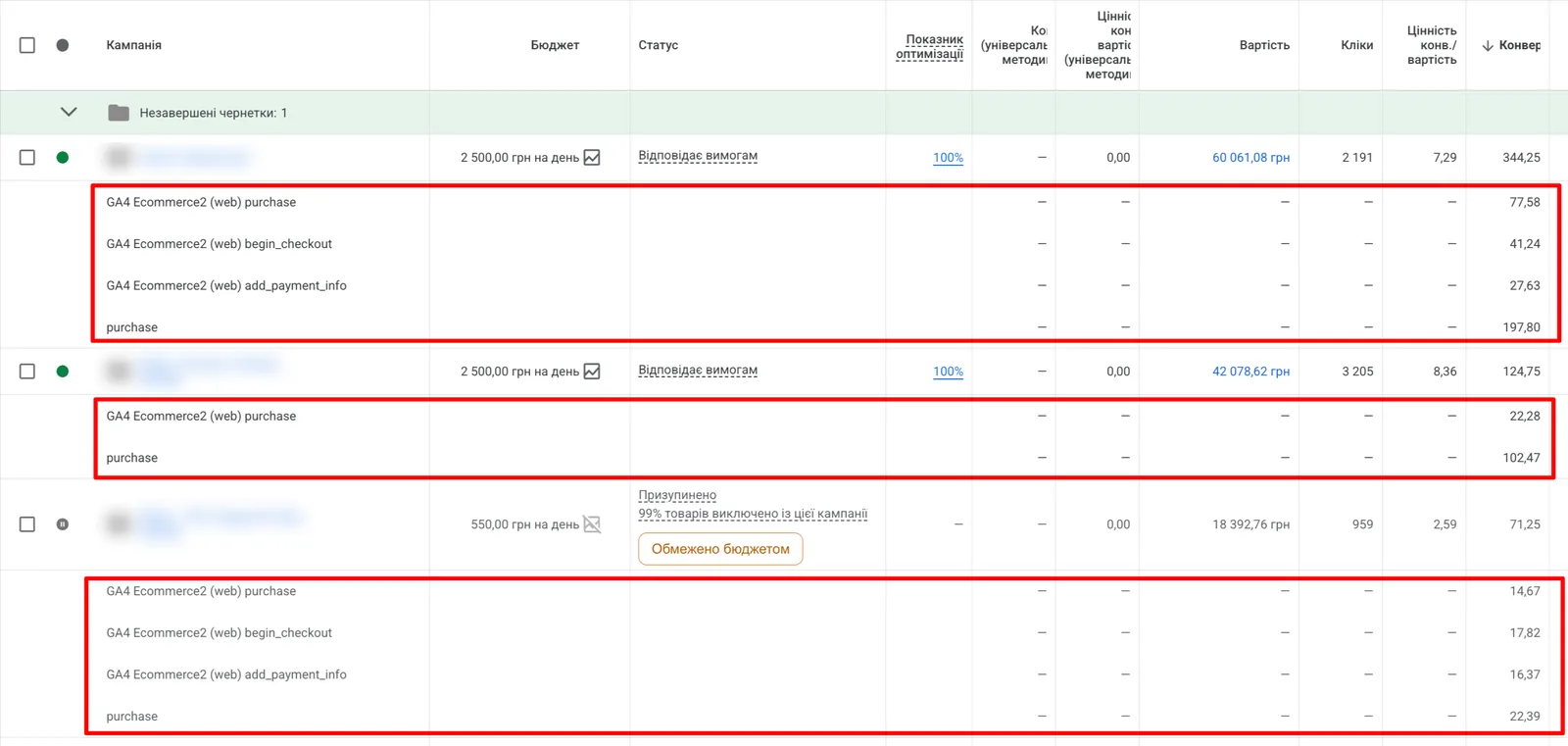
The screenshot shows three campaigns over 30 days, segmented by conversion action. That’s enough to see two of the three problems.
Duplicate purchase
Each campaign has two “purchase” actions: one imported from Google Analytics 4, the other a Google Ads tag. Both are primary, both take part in optimization. In other words, one order is counted twice.
The first campaign shows 344 conversions and a value of 438,138 UAH ($9,736) on a spend of 60,061 UAH ($1,335). ROAS is 7.29. Remove the duplicate and the micro-conversions, and you’re left with 198 purchases worth 317,372 UAH ($7,053). The real ROAS is 5.28. The cost per purchase is not 174 UAH ($3.9) but 304 UAH ($6.8).
Performance Max: the account shows ROAS 8.36, the real one is 6.07. Cost per purchase is 411 UAH ($9.1) instead of 337 UAH ($7.5).
The third campaign is the most telling. 71 conversions in the account, of which 22 are real purchases. ROAS 2.59 in the report and 1.29 in reality. A purchase costs not 258 UAH ($5.7) but 821 UAH ($18). For tea with an average order of about 1,700 UAH ($38), the campaign is losing money — yet in the client report it looks profitable.
And that’s still ROAS, not ROMI. Margin isn’t even part of the conversation here.
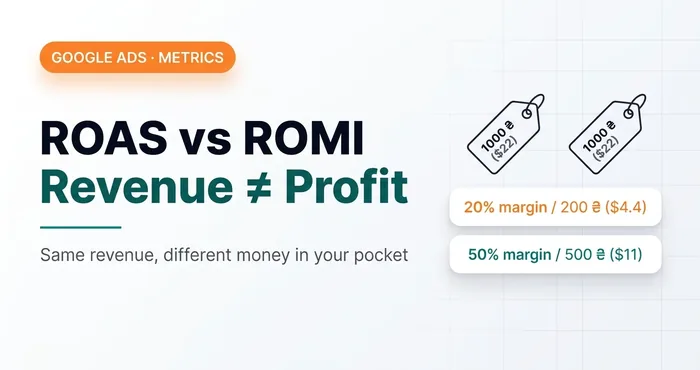 Analytics · Google AdsHigh ROAS, but No Money? The Key Difference Between ROAS and ROMI in Google Ads5 campaigns: three with almost identical ROAS show ROMI that differs twofold. Why ROAS doesn’t show real profit.
Micro-conversions in bidding
In some campaigns, begin_checkout (starting checkout) and add_payment_info (adding a payment method) are optimized together with the purchase. Micro-conversions are intermediate user actions on the way to a purchase.
Let’s be honest: sometimes they really are needed. When there are too few purchases for the algorithm to learn from, it makes sense to add a goal that precedes the purchase and optimize for it too. For example, a new store with fewer than 30 sales a month.
That’s not the case here. Hundreds of purchases a month — more than enough data for learning. Micro-conversions only teach the algorithm that someone who started checkout and left is also a success. In the third campaign, micro-conversions make up almost half of all conversions.
I found the same mistake in an audit of a pizza delivery in Kraków: there, too, micro-conversions sat in bidding next to orders.
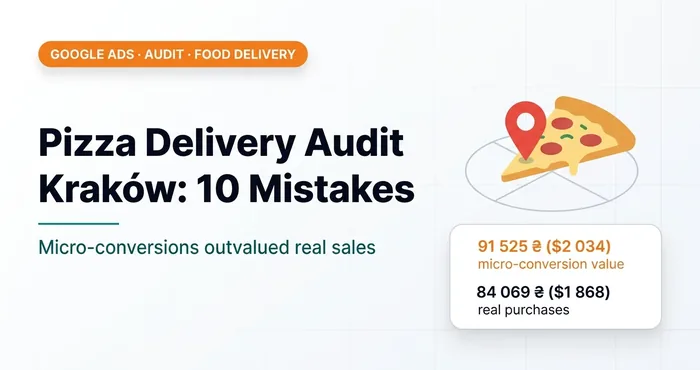 Google Ads audit · Food deliveryIndependent Google Ads audit: pizza delivery in Kraków — 10 mistakes in the accountIndependent Google Ads audit of a Kraków pizza delivery: micro-conversions, a 10 km radius, mixed brand and non-brand. 10 mistakes and what to fix.
The purchase is tracked in the wrong place
The third problem isn’t visible in the screenshot — I found it while testing the purchase event.
A person places an order in the cart, and a window pops up: “Your order has been placed” with a “Close” button. Most users see that everything is fine and simply close the tab. But the purchase event fired only after clicking “Close”, when the site redirected to the thank you page.
According to Microsoft Clarity — a session recording and heatmap service — about 50% of users never clicked “Close”. In other words, half of all purchases simply never reached analytics.
The right way is to send purchase from the “Thank you for your order” page. Or, as in this case, right after checkout, at the moment the message confirming the order appears.
What he did when sales dropped
According to the client, sales dropped sharply about six months ago. He told the contractor. What did the contractor do? Restarted the campaign: paused the old one, made a copy and told the client the algorithm was relearning and he just had to wait. Classic, isn’t it?
What changed? Nothing. Because the problem wasn’t the campaign, it was the data it learns from. The new campaign got the same duplicates, the same micro-conversions and the same purchase in the wrong place. Just without the accumulated statistics.
Restarting a campaign in Google Ads is not a cure-all. Sometimes it helps, but it’s a last resort. First you look for the cause: tracking, changes in the ad account, problems on the website (very common on custom-built sites), changes in competition. And only then do you touch anything. A restart without diagnosis is like going to the doctor and getting a prescription without an examination.
What it really costs
$500 a month isn’t the full price of a contractor like this.
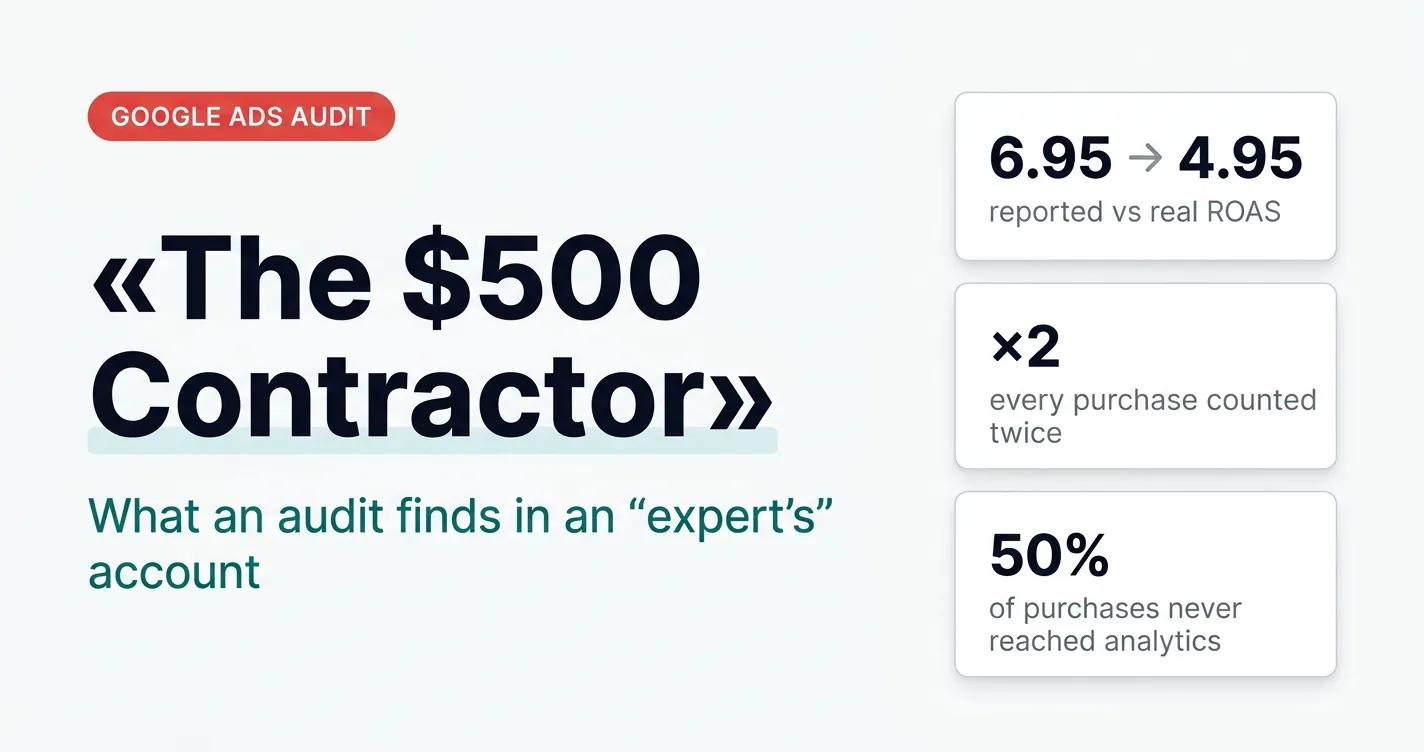
Over 30 days, the three campaigns from the screenshot spent 120,532 UAH ($2,678). The account showed a value of 837,835 UAH ($18,619) and ROAS 6.95. In reality — 596,747 UAH ($13,261) and ROAS 4.95. And what the true numbers were, nobody knows, because some orders weren’t tracked at all.
But the main loss isn’t even the misleading report. Smart Bidding — Google Ads’ automated bid strategies — spent a year learning from dirty data. It raised bids where people only started checkout, and on audiences that never completed an order. That money can’t be recovered, and after tracking is fixed, the algorithm needs time to learn again.
The most reliable protection against situations like this is to send real CRM sales to Google Ads, not website events. Then neither duplicates nor fake purchases get into learning.
05 — CRMCRM integration with Google AdsOffline conversions: real sales from your CRM flow back into Google Ads, so the algorithm learns from revenue, not leads.Questions to ask your contractor
You don’t need to understand Google Ads to ask the right questions:
- Which goal will you optimize the ads for, and why that one?
- What do you do when results drop?
- Do you send CRM sales to Google Ads?
If you’re hiring a specialist for $500 a month, they should know this, be able to do it and actually implement it. If the answer to the last question is “why bother, it’s all visible in the account (or in analytics)” — you can stop asking. Keep looking.
When to do an audit
First — when the numbers in the account don’t match the money. Everything seems fine, you do the math — there should be a profit, but there isn’t. That’s the first warning sign.
Second — 2–3 months after a new specialist starts. I mean an independent audit, not one where someone is just trying to poach you. It’s an outside view and an extra check on what your specialist is actually doing.
Third — when everything works but doesn’t grow.
03 — AuditGoogle Ads account auditI find where the budget leaks: structure, bidding, keywords, conversion tracking, website.A Google Ads audit costs far less than a month of work from such a “specialist”. And it shows what the client didn’t see in six months or a year of reports.
Why micro-conversions shouldn’t be mixed with sales — in the article what a conversion in Google Ads is.
Where to find me
Message me on Telegram or by email — I respond quickly. Telegram channel and YouTube are for those who want to see real cases before reaching out and understand my approach.