
Marketer, analyst, ex-CMO focused on the Google ecosystem (Ads, Merchant Center, GA4, GTM). Google Partner. 150+ projects, 100+ positive reviews on Freelancehunt, 12+ countries.
- I work directly, with no account managers or subcontractors
- I measure results in sales, not in-platform conversions
- Maximum expertise in the Google ecosystem — instead of “PPC, social ads and SEO, all in one”
Let me say it upfront: I’m a freelancer. So you might expect this article to be about how terrible agencies are and how great freelancers are. But no. The goal of this article is to give you the most objective picture possible, show the real pros and cons of both options, and help you make the decision that’s right for you.
“Who’s better?” is the wrong question. The right question is: what do you need, what’s your budget, and what working format are you ready for.
Important context: I worked at four agencies myself, and I still work with agencies from time to time as a freelancer. So I’m not talking about this in theory.
Contents
Agency: pros
A bigger team
This is the most obvious and most real advantage. A mid-size agency has an analyst, a designer for creatives, the specialist doing the work, a project manager, and a team lead or senior who oversees the project. A freelancer is mostly one person.
But an important caveat right away: “there’s an analyst” and “there’s a person with the title analyst” are different things. At the agencies where I worked, the analyst formally existed. But he didn’t do what I’d call an analyst’s job. Maybe I was just lucky that way. Maybe not.
Continuity
One of the strongest arguments for an agency. If something happens to the specialist — vacation, illness, leaving the company — someone else replaces them fairly quickly. A freelancer gets sick — the project stalls.
Formal relationship
Agencies usually sign a contract, issue invoices and provide regular reports. Whether that has real value for your business is a separate question. But formally — yes, everything is clean and documented.
There is one nuance, though — from what I’ve seen, agencies often care more about reporting on work done than on results achieved. But that’s my subjective opinion, so take it with a grain of salt.
Agency: cons
More expensive — always
It’s just math. A big team means a big payroll. An accountant, a lawyer, an office, a cleaner, HR — all of that is built into the price of your services. For the same expertise you pay more simply because you’re funding an entire structure.
A junior runs your project
This is the biggest and most painful downside of a mid-size agency. Unless you’re a top client with a big budget, your project is run by junior specialists. More experienced people step in only in critical situations, and even then mostly with surface-level advice like “let’s increase the budget” or “let’s change the strategy.” In other words, exactly what a junior would have done.
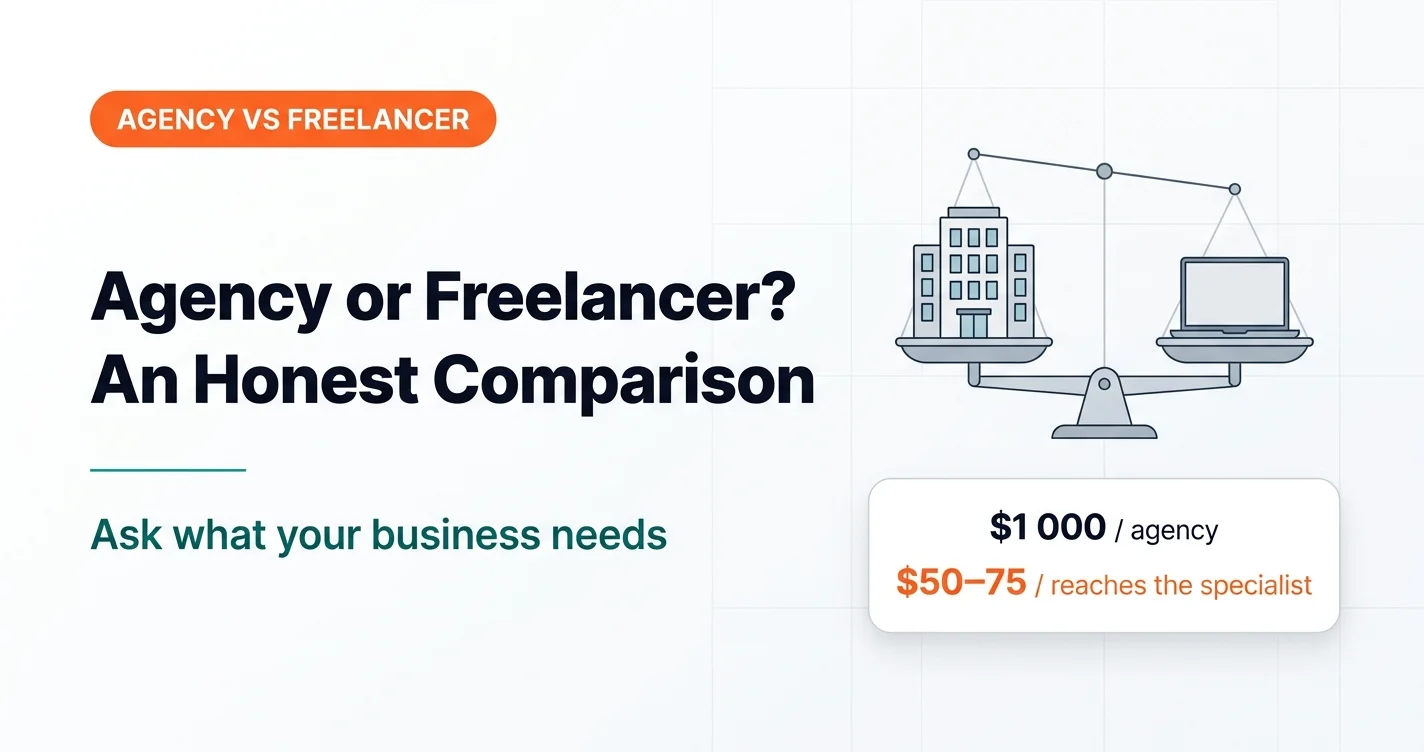
The real salary picture: a junior at an agency earns 15,000–20,000 UAH ($333–444) a month and handles 8-10 projects at once. If the agency costs you $1,000, your specialist gets 50-75 dollars of that. The person your results directly depend on. You can check these numbers yourself — they’re public and available on job sites.
Communication through middlemen
There’s a project manager between you and the specialist. They don’t always understand what the specialist wants. They don’t always understand what you want. And they often end up playing broken telephone — something gets lost, something gets distorted, something just stops.
From my own experience: when I talk to the client directly, 95% of my ideas get through and the client agrees. When there’s a middleman manager — maybe 20%. And that’s an optimistic estimate.
Less personal involvement in your project
A junior handles 8-10 projects. A project manager — even more. Your project is one of many. Today it’s you, tomorrow it’s someone else. The level of involvement and understanding of your business specifics matches that.
Freelancer: pros
Direct communication
You talk directly to the person who actually does the work. No middlemen, no forwarding messages, no “let me check with the specialist.” Decisions get made faster, changes get made faster, issues get solved faster.
Cheaper for the same or higher expertise
A freelancer isn’t funding an office and a whole team. If an agency costs $1,000, a freelancer at a comparable level may cost $500. And your project isn’t run by a junior earning $75 a month, but by the very person who took your money.
Personal accountability for results
A freelancer has no lead conveyor belt. No sales department, no lead generators, no agency marketing budget. Every client is worth their weight in gold. So a freelancer keeps clients with results, not with persuasion.
It doesn’t pay for me to tell a client “let’s give it another month, two, three.” It pays for me that they make money. Because results turn into long-term cooperation. I have clients I’ve worked with for 3-6 years. Without any sales department, without any managers, without any team leads.
Flexibility and speed
A shorter decision chain means faster changes. No sign-off from a team lead, no approval from a manager, no waiting for all of it to reach the specialist and come back. Said — done.
Freelancer: cons
Everything rests on one person
Dan Kennedy has a quote: “The worst number in business is one.” When something depends on a single person, it’s always a risk. Got sick, went on vacation, disappeared — the project stalls. It’s a real downside, I won’t downplay it.
Limited capacity
A freelancer physically can’t handle an unlimited number of projects. There’s a limit beyond which quality drops.
Less formality
Some freelancers work without being registered as a sole proprietor (FOP), without contracts, and take payment to a personal card. That’s a real downside, and I won’t defend it. A good freelancer is registered, with a contract and signed acceptance reports. It’s not hard — it’s simply a matter of taking the work seriously.
Reporting varies too. I have a client who said: “the agency sent reports every week, and you don’t.” The question is simple: did you ever ask for reports? If you need them, ask — everything is open to discussion. But agencies love writing reports mostly because reporting replaces results as the main criterion for evaluating the work.
Comparison table
| Criterion | Agency | Freelancer |
|---|---|---|
| Price | Higher — you fund the whole structure | Lower for the same level of expertise |
| Who runs the project | Usually a junior with 8-10 projects at once | The very person who took your money |
| Communication | Through a project manager | Directly with the specialist |
| Speed of changes | Longer approval chain | Said — done |
| Continuity | Replacement in case of illness/leaving | Everything rests on one person |
| Formality | Contract, reporting — by default | Depends on the specific person |
| Capacity | Can cover more areas at once | Physically limited |
| Personal stake in results | One of a manager’s many projects | Every client is worth their weight in gold |
| Breadth | Designer + SEO + paid social + PPC in one place | Depth in one area, not all at once |
Who an agency is right for
If you’re a large company with full-scale marketing — several channels, you need a single contractor managing all areas, you have a big budget and you’re ready to pay for a team — an agency makes sense. Especially if you don’t want to micromanage every link in the chain, but rather hand off strategic tasks and get results.
If you need one freelancer who “knows everything” — I’d think twice. Knowing a little about everything and knowing one thing deeply are different things.
Who a freelancer is right for
If you need deep specialization in a specific tool. If direct communication without intermediaries matters to you. If your budget is limited but you want quality work. If flexibility and fast response matter to you.
Conclusion
There’s no right answer for everyone. There’s a right answer for you — depending on your tasks, your budget and how you want to work with contractors in general.
There are good agencies. There are bad freelancers. And vice versa. Check reputation, look at real cases, talk directly and choose the one who gives you confidence that the results will come.
For an honest breakdown of what clients value in a freelancer, based on my own Freelancehunt profile, see “What My Clients Praise Me For”.
What this looks like in practice — a breakdown of a real Google Tag Manager container an agency set up for a client: “GTM Tracking for $750 a Month”.
Whoever you work with, the accounts should belong to you. How to give a contractor access without handing over ownership — in the guide to access for Google Ads, GA4, GTM, GMC and GSC.
Where to find me
Message me on Telegram or by email — I respond quickly. Telegram channel and YouTube are for those who want to see real cases before reaching out and understand my approach.