
Marketer, analyst, ex-CMO focused on the Google ecosystem (Ads, Merchant Center, GA4, GTM). Google Partner. 150+ projects, 100+ positive reviews on Freelancehunt, 12+ countries.
- I work directly, with no account managers or subcontractors
- I measure results in sales, not in-platform conversions
- Maximum expertise in the Google ecosystem — instead of “PPC, social ads and SEO, all in one”
Everyone knows a Google Ads audit is a chance to bring a client into your own management services. And most audits, especially free ones, aren't independent. Because nothing is free — the only free cheese is in a mousetrap.
When someone offers you a free audit, they want to sign you up for ad management and will do everything to get you on board. Agencies aren't the only ones doing this — freelancers do it too: everyone is fighting for their piece of the pie. So don't expect anything independent from a free Google Ads audit.
They'll show you a few points that may not mean anything at all. For example, someone recently showed me a 27-page audit of an account (not mine) as a sample. Everything was laid out with screenshots, but it was just filler — no substance.
I don't work that way. When people come to me for an independent audit, it's always paid; I don't do free audits. It starts at $50, depending on what exactly you want inspected. More on pricing in the article “How Much Does It Cost to Hire a Google Ads Specialist?”.
Key point: a free audit isn't an audit, it's a sales tool. The only audit that can be independent is one you paid for and from which the contractor expects nothing more.
Contents
The request: why sales aren't what they were last year
A client came to me: I want an independent audit, I have an ad account, and I want to understand why sales aren't what they were last year. The niche: an online store selling plant saplings.
I honestly laid everything out for her. But I didn't dig into the campaigns in detail to point out small things like ad quality or geotargeting. I showed her the real problem I ran into. And it sat above the level of the ad account.
Sure, there were things in the account that could be improved and tested more: at the time of the audit, only two and a half campaigns were running. Given that the client was unhappy with the results, testing was definitely worth it. But I don't grade the ads themselves, because there's honestly nothing there to analyze. The problem turned out to be much deeper.
Below is the audit itself, exactly as I handed it to the client.

Google Ads Audit: Online Sapling Store
Comparison period: September 1–29, 2026 vs. September 1–29, 2025. We take the same stretch of the season so the comparison is fair.
Sources: Google Ads, Google Analytics 4, competitor analysis, data from similar projects in this niche.
Summary
Main hypothesis: the number of orders dropped because the minimum order value was raised from 400 UAH ($8.9) to 500 UAH ($11). A person clicks through from an ad, can't fill a cart up to 500 UAH ($11) and goes to a competitor.
Additional factors:
- advertising got 29% more expensive on average year over year across the whole market;
- the site's order conversion rate almost halved, from 1.74% to 0.91%. This is a consequence of the minimum order.
Ruled out as the main cause:
- ad settings (there are remarks, but they're not decisive);
- tracking (works correctly);
- expansion to new placements (cost per purchase is roughly the same across all networks);
- the website (on Prom.ua, runs stably).
1. Account dynamics
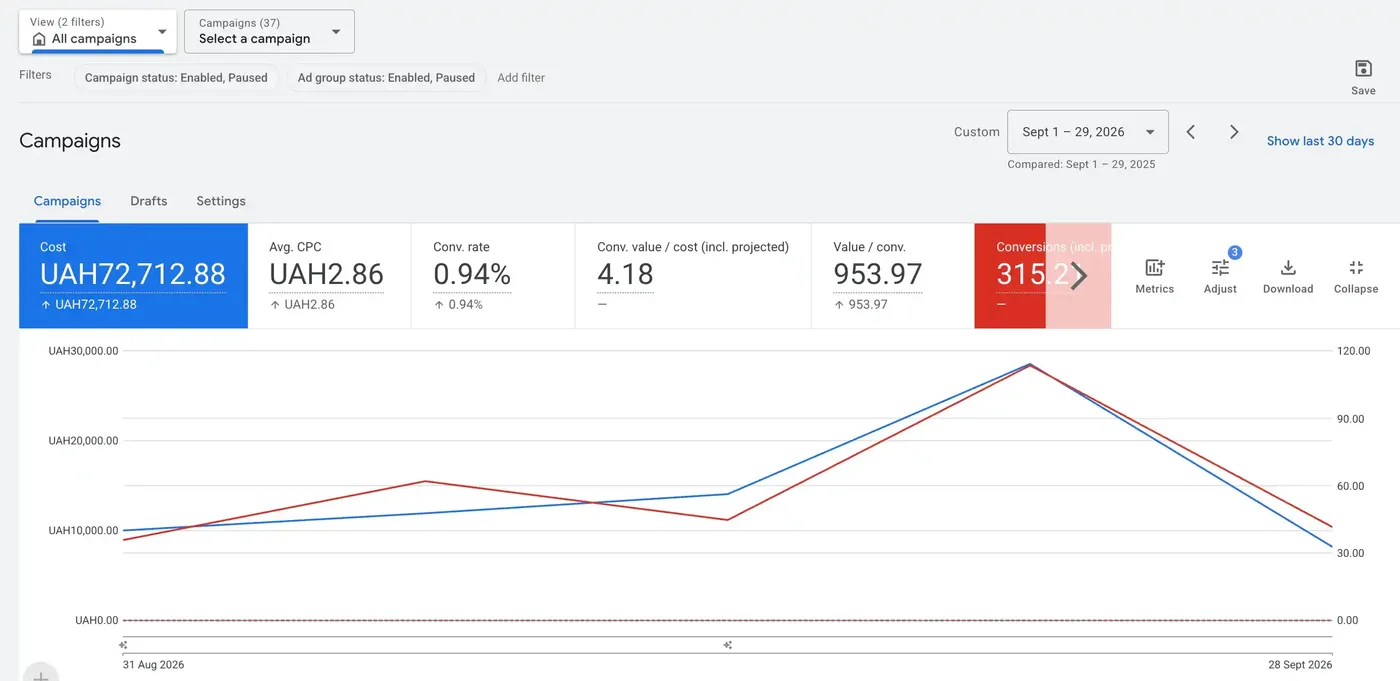
| 2025 | 2026 | Δ | |
|---|---|---|---|
| Spend | 38 839 ₴ | 72 713 ₴ | +87% |
| Avg. CPC | 2,22 ₴ | 2,86 ₴ | +29% |
| Clicks (est.) | ~17.5K | ~25.4K | +45% |
| Conv. rate | 1,74% | 0,91% | −0.83 pp |
| Value / conv. | 804 ₴ | 960 ₴ | +19% |
| ROAS | ~7,6 | ~3,8 | ≈ −50% |
Seasonality. In this niche the season peaks in spring, and autumn is already the final stretch. On similar projects we run ads until roughly mid-October and pause them until the end of February.
In the peak months, your number of orders grew almost linearly as the budget increased. That's normal for a high-demand season. Starting in September, these two lines diverge sharply: the budget keeps growing, but orders don't. Increasing the budget in this period doesn't bring new orders — you're simply buying them at a higher price.
2. Main hypothesis: the minimum order value
Order value (GA4, google / cpc)
| 2025 | 2026 | Δ | |
|---|---|---|---|
| Transactions | 300 | 259 | −14% |
| Revenue | 231 463 ₴ | 247 207 ₴ | +7% |
| Average order value | 772 ₴ | 954 ₴ | +24% |
| Median order value | 600 ₴ | 658 ₴ | +10% |
| P25 / P75 | 480 / 750 | 556 / 944 | |
| Min / max | 400 / 6 000 | 500 / 12 900 |
Order value distribution
| <500 ₴ | 500–999 | 1000–1999 | 2000+ | |
|---|---|---|---|---|
| 2025 | 118 (39%) | 138 | 34 | 10 |
| 2026 | 0 | 200 | 43 | 16 |
In 2025, 39% of orders were below 500 UAH ($11). In 2026 there are none at all, meaning this audience segment has been cut off.
What else supports the hypothesis:
- Competitors. Market leaders don't set a minimum order at all. The market average threshold is around 350 UAH ($7.8).
- The user doesn't know about the threshold. A person sees an ad in Shopping or search results and has no idea there's a 500 UAH ($11) minimum order, especially if it isn't specified in Merchant Center. They click through, can't fill the cart and leave the site — most likely for good.
- Homepage banner. The minimum order value is shown right on the main homepage banner, so some users may leave the site before even browsing products.
- The drop is synchronized across all channels (see section 3), organic included.
I understand that the math on 350–400 UAH ($7.8–8.9) orders may not add up. I wrote about this in detail in my articles on a 300 UAH ($6.7) average order and the case with orders under 1,000 UAH ($22). But that's a question of marketing strategy: a cheap first order can be used to acquire a customer and then keep working with them without paying for ads again (see recommendations).
Key point: the most expensive problems in advertising are often not inside the ad account. A single change on the website can “eat” more orders than any campaign setup mistakes.
3. Drop across all channels (GA4)
| Channel | 2025 | 2026 | Δ |
|---|---|---|---|
| Google (Cross-network + Paid Search) | 290 | 254 | −12% |
| Paid Social | 367 | 144 | −61% |
| Organic Search | 66 | 39 | −41% |
| Organic Social | 63 | 14 | −79% |
| Direct | 22 | 13 | −41% |
| Total | 825 | 470 | −43% |
The drop shows up in every channel, including organic search and organic social, where ads have no influence at all. So the cause is at the level of the website or the offer, not Google Ads.
Google dropped the least, but only because its budget is almost twice as large, so we don't use this figure for conclusions. Paid Social budgets for 2025 don't show up in analytics; they should be checked separately.
4. External factor: rising ad costs
Cost per click grew by 29%. The reason isn't how the ads are managed: I see the same year-over-year growth on similar projects. Online competition is rising because businesses that used to work only offline are moving online.
So even with everything else equal and the same budget, you'd be getting fewer orders than last year. Next season, ads will most likely get even more expensive, and the business model should be adapted to that now.
5. Calls — a “black box”
| 2025 | 2026 | Δ | |
|---|---|---|---|
| Phone number clicks | 278 | 229 | −18% |
| Purchases | 366 | 288 | −21% |
| Total actions | 644 | 517 | −20% |
| Actions / click | ~3,7% | ~2,0% | −45% |
| Cost per action | ~60 ₴ | ~141 ₴ | ×2,3 |
A click on the phone number doesn't mean a call. How many real calls there were and how much in orders they produced is unknown. It's quite possible that the most valuable orders come in by phone, but the system doesn't get this data and can't look for a similar high-value audience.
The drop in phone number clicks is in sync with the drop in purchases. That's another argument that the problem isn't the ads themselves.
6. Ad campaigns
A 0.91% site conversion rate is low for this niche. On my projects, the order conversion rate is 2.5–3%, and one of them has no minimum order at all.
A median order value of 658 UAH ($15) is small for search advertising. That's not an ad problem, it's math: with an order value like that, it's hard for ads to pay off. You can check this against your own numbers in the Google Ads ROI calculator.
Changes in Performance Max
| PMax spend | 2025 | 2026 |
|---|---|---|
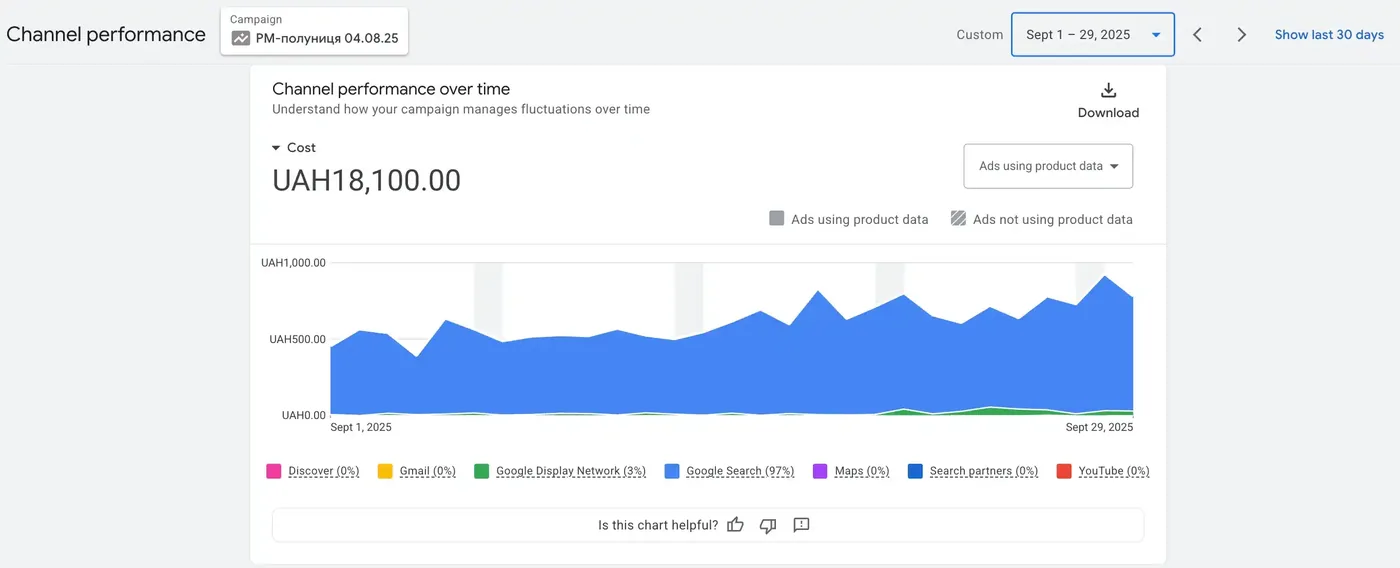
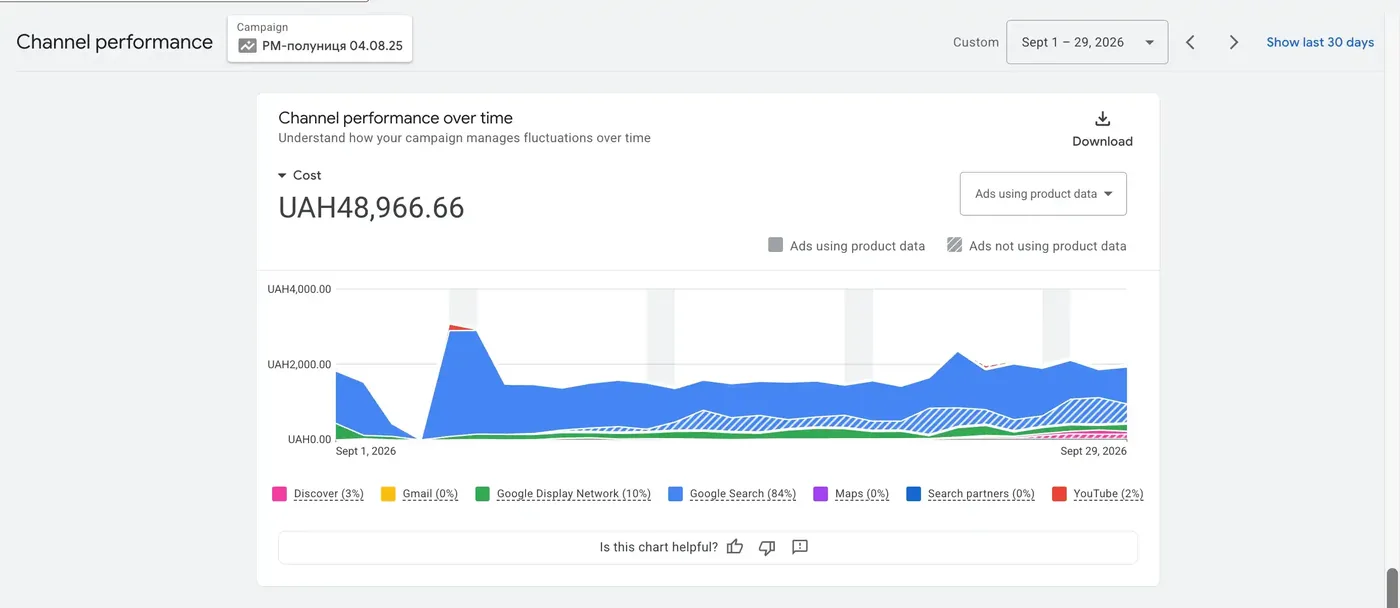
| Shopping (Search + feed) | 17 551 (97%) | 33 318 (68%) |
| Text search (no feed) | 0 | 7 932 (16%) |
| GDN / YouTube / Discover / Gmail | ~550 (3%) | ~7 700 (16%) |
In 2025, almost all traffic went to Shopping results. In 2026, the contractors expanded placements: search, the Display Network, Discover and a bit of YouTube were added. I wrote about how Performance Max distributes budget across networks in my article on the weak spots of Performance Max.
2026 placements
| Channel | Spend | Purchases | ROAS |
|---|---|---|---|
| Search without feed (text) | 7 932 | 38 | 4,8 |
| GDN (feed) | 5 018 | 21 | 3,1 |
| Discover (total) | 1 514 | 10 | 5,7 |
| YouTube (total) | 988 | 3 | 3,2 |
| Gmail + Search partners | ~150 | 0 | 0 |
Cost per purchase across the main placements is roughly the same, around 210–255 UAH ($4.7–5.7). So the placement expansion isn't the cause of the drop. Even GDN converts into orders. The search component of PMax performs almost on par with Shopping, which doesn't happen often.
Shopping (Search, product data)
| 2025 | 2026 | |
|---|---|---|
| Clicks | 5 605 | 9 265 (+65%) |
| CPC | 3,13 | 3,60 |
| CR | 2,94% | 1,41% |
| CPA | 106 | 255 |
| ROAS | 7,0 | 4,0 |
Tactical remarks (against the backdrop of the main problem, they're not decisive):
- The budget is currently higher than search demand in this period. That's why the share of GDN, Discover and YouTube gradually grows throughout September.
- The “feed only” asset group (pure Shopping, no assets) has the highest conversion rate but is currently paused.
- Current structure: two campaigns for two product lines plus a brand campaign. Standard Shopping and Search campaigns with manual bidding should have been tested.
7. Website
The site on Prom.ua works fine, no significant issues. Images don't display in some categories — check that.
Recommendations
- Test lowering the minimum order (to 350–400 UAH ($7.8–8.9)) right now. There are a few weeks left in the season, which is enough to test the hypothesis. Expected result: the conversion rate and the number of orders will grow, while the average order value may drop.
- Remove the threshold from the homepage banner or present it more softly. Specify the minimum order terms in Merchant Center.
- Build a customer base from cheap orders and bring those customers back without ads: an SMS blast at the start of the season (“new saplings just arrived”). That's far cheaper than re-acquiring them through search ads.
- Before next season, set up dynamic call tracking integrated with your CRM and send closed deals back to Google Ads (offline conversions). With a budget of ~70,000 UAH (~$1.6K) a month, this will pay off. How it works is covered in the article on end-to-end analytics.
- Tax optimization. The ad account is currently registered to a private individual, so you're paying an extra 20% VAT. This can be changed to save up to 20% of ad spend.
- Seasonality. Plan a pause or a significant budget cut from mid-October to the end of February. Raising the budget off-season doesn't bring a proportional increase in orders.
Conclusion
This is what an independent audit looks like: not 27 pages of screenshots about ad quality, but an answer to the client's question — why sales aren't what they were last year. And that answer wasn't in the ad account; it was in the decision to raise the minimum order value.
Another example where an audit found the problem at a completely different level is the case where $10,000 was spent and 0 leads came in. And why ads can't fix what should be solved by marketing, I covered in my article on the 5P model.
What such an audit looks like in practice, and what a $500-a-month contractor who counts every purchase twice really costs, see “The Dunning–Kruger Effect in Google Ads”.
What a strategic audit looks like in practice — with a video and a priority table — in the Google Ads audit of a lock store on Prom.
An example of an audit after which the account is easier to rebuild from scratch — a household chemicals store.
Where to find me
Message me on Telegram or by email — I respond quickly. Telegram channel and YouTube are for those who want to see real cases before reaching out and understand my approach.