
Marketer, analyst, ex-CMO focused on the Google ecosystem (Ads, Merchant Center, GA4, GTM). Google Partner. 150+ projects, 100+ positive reviews on Freelancehunt, 12+ countries.
- I work directly, with no account managers or subcontractors
- I measure results in sales, not in-platform conversions
- Maximum expertise in the Google ecosystem — instead of “PPC, social ads and SEO, all in one”
Does it make sense to launch Google Ads if your average order value is under a thousand hryvnias?
There’s no clear-cut answer. But mostly, if you’re not a manufacturer and you don’t have a big margin, the chances of success with such a small average order value are extremely low.
Why? Because you operate in a competitive environment, and there’s a market cost per click. In theory you can try to just launch some cheap ads, but the chances of success are slim.

I’ll show this with this case. The case is a positive one. There are several areas of work here, but I’ll talk mainly about one and share some interesting details about it.

Contents
About the project
The client is a manufacturer. They produce various covers for furniture, throws, bedding and the like.
Results over 90 days
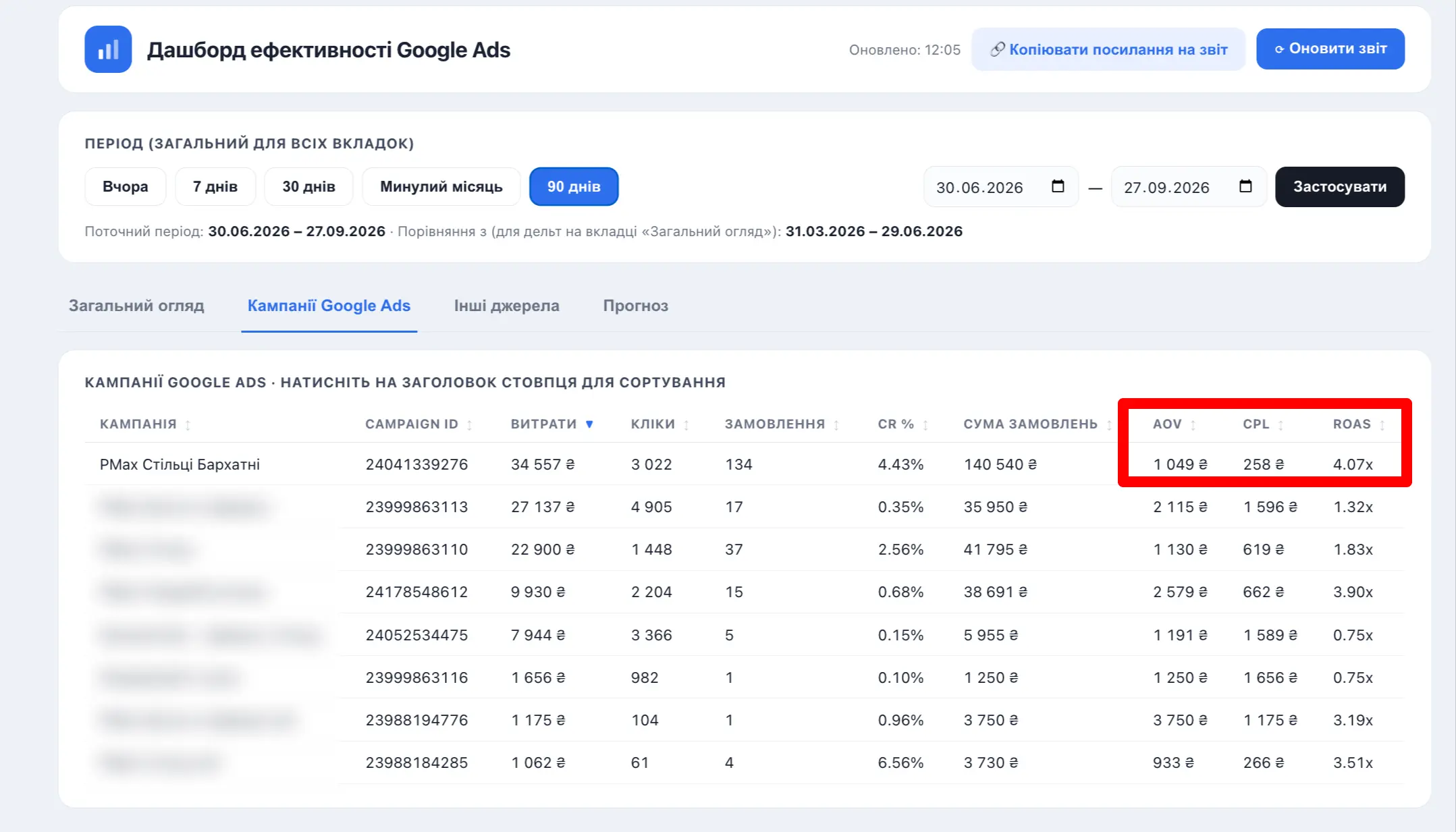
The main focus is a Performance Max campaign for velvet chair covers. Period: June 30, 2026 – September 27, 2026.
| Metric | Value |
|---|---|
| Spend | 34 557 ₴ |
| Clicks | 3 022 |
| Orders | 134 |
| Conversion rate | 4.43% |
| Order revenue | 140 540 ₴ |
| Average order value (AOV) | 1 049 ₴ |
| Cost per purchase | 258 ₴ |
| ROAS | 4.07x |
The average order value in the main area is 1,049 UAH ($23). And it only grew relatively recently — before that it was under 1,000 UAH ($22).
ROAS here is 4.07. The break-even point excluding my fees is ROAS 2. So the ads even bring a profit.
The cost of acquiring a purchase is 258 UAH ($5.7). That’s not cost per lead, that’s cost per purchase.
At the same time, the order conversion rate here is very high — 4.43%. An important nuance: these are completed orders.
What the pre-launch calculation showed
In this case, advertising makes sense. But at the project calculation stage I assumed a maximum conversion rate of 3%.
At 3%, the ads would barely pay off. At 2%, they would break even. At 1%, they would lose money.
For clarity — the same scenarios at the current cost per click (~11.4 UAH ($0.25)):
| Conversion rate | Cost per purchase | ROAS |
|---|---|---|
| 1% | ~1 144 ₴ | ~0.9x |
| 2% | ~572 ₴ | ~1.8x |
| 3% | ~381 ₴ | ~2.75x |
| 4.43% (actual) | 258 ₴ | 4.07x |
But the client said: let’s try it, let’s launch, because I have decent results with Meta ads. The conversion rate turned out to be quite high — very high. Over the last 30 days it even reaches 5%.
With numbers like these, you can advertise. But it’s right on the edge.
Key takeaway: if you’re not a manufacturer but a reseller or dropshipper with a 20% margin, you have no chance. The ads won’t even break even.
For context: with a 20% margin, you need a ROAS of 5 just to break even. It may simply be physically unattainable, because the math doesn’t add up due to the high cost per click.
Small order value = a turnover game
A couple of years ago I had a project where the average order value was just 535 UAH ($12). But the order rate was very high there, because they sold all sorts of cheap Chinese stuff at prices, roughly speaking, like on Temu. The conversion rate ranged from 5 to 7% in different periods. But that was probably three years ago, and the cost per click back then wasn’t what it is now.
And that project was profitable thanks to turnover.
Projects like this mostly work exactly this way. Roughly speaking, a budget of 30,000 UAH ($667) including the specialist’s fees doesn’t pay off at all. You need turnover.
With a small order value you need turnover — that’s how discounters work, that’s how Lidl works, that’s how Avrora (a Ukrainian discount store chain) works. With small markups they make a profit through turnover. Same here, there’s no other way.
Yes, you can also play with constrained strategies — Target CPA or Target ROAS. But how much will you bring costs down? It won’t be a game changer. If the market ROAS is, say, 4, you won’t turn it into 7 with a strategy alone. It’s physically impossible.
You can tighten things up a bit. But in this case, Target ROAS is no longer about turnover — it’s simply a cap on target profitability.
Key takeaway: I try not to take on projects like this. Especially if it’s not a manufacturer but a reseller or dropshipper. There’s no chance there.
So think, as a certain classic said, and do the math.
Where to find me
Message me on Telegram or by email — I respond quickly. Telegram channel and YouTube are for those who want to see real cases before reaching out and understand my approach.