
Marketer, analyst, ex-CMO focused on the Google ecosystem (Ads, Merchant Center, GA4, GTM). Google Partner. 150+ projects, 100+ positive reviews on Freelancehunt, 12+ countries.
- I work directly, with no account managers or subcontractors
- I measure results in sales, not in-platform conversions
- Maximum expertise in the Google ecosystem — instead of “PPC, social ads and SEO, all in one”
Let me break some stereotypes. When we see Google Ads cases, they're always about successful success. Big ROAS, great ROMI, cheap and high-quality leads. Doesn't matter whether it's a freelancer or an agency — cases always show the best.
Contents
What’s Wrong with Google Ads Case Studies? A Real Example

I have plenty of great cases. Some I already publish here, some on other platforms, some on my YouTube channel. But we all understand perfectly well: I've delivered over 150 projects, I don't even count them anymore. And 150 projects aren't 150 successful cases you can show. I collected the main takeaways from them in the article 7 hard lessons after 150+ projects.
Three types of cases
Let's split them honestly.
The first — outstanding cases that everyone shares. Great ones, with stellar metrics. They're part of marketing, a demonstration of trust and expertise — like a 932% ROAS for grills and barbecues or ROMI growth from 37% to 212% in electronics.
The second — average cases I can't show. Some are under NDA. Some are complex B2B niches where the cost per lead at the entry point doesn't matter at all, because each lead with a long lifetime value turns into millions of hryvnias in revenue over time. These cases are the core of the work. There's a result, the client sees it in internal reporting, I see it — but there's no way to show it publicly. If I show data from some Excel spreadsheet without context, nobody will trust it.
The third — experience cases. Not failures. On principle, I don't call them failures.
When you tell a client at the start “this won't work”
Two recent examples.
Selling leather goods in the US with a 30-dollar average order. I said right away: guys, no chance, with this order value we won't pull anything off in America. Cost per click is 2 dollars, margin 50% — so 15 dollars per sale on a 30-dollar order. Just to break even you'd need a conversion rate of around 15%. Online stores don't get conversion rates like that. The client: we understand everything, let's try. Okay, under those conditions I'll work.
The second — a Ukrainian manufacturer of engine oils with its own R&D department. A no-name brand, cheaper than branded Nissan, Ford and Mazda oils. I ask: are you on any marketplaces, can people find you anywhere at all besides your website? Nothing at all. I say: nobody is going to pour a no-name brand's fluid into their engine or gearbox — those are the two most expensive components in a car, and there's simply no trust in the brand. Over a 10-day test — two sales, when statistically there should have been about ten. The reason was clear to both the client and me: the trust barrier. If you don't close it, you won't sell.
About agencies with “thousands of successful cases”
I love to dislike marketing agencies that write “two thousand successfully delivered projects” and then show 20–30 cases on their website. A tiny percentage. If they were all successful, they'd all be cases. That never happens.
Experience case: high-end plumbing fixtures
There was a client we stopped working with at the beginning of May this year. We worked together for exactly a year — he came to me from an agency whose metrics dropped every year.
The screenshots show the dynamics of ad spend and revenue for the cpc channel from June 2025 to August 2026. The red line on the revenue chart marks the moment we ended our cooperation. Ad spend before and after is roughly the same. I'm showing both screenshots side by side so there's no feeling that I'm manipulating data and playing the hero against everyone else.
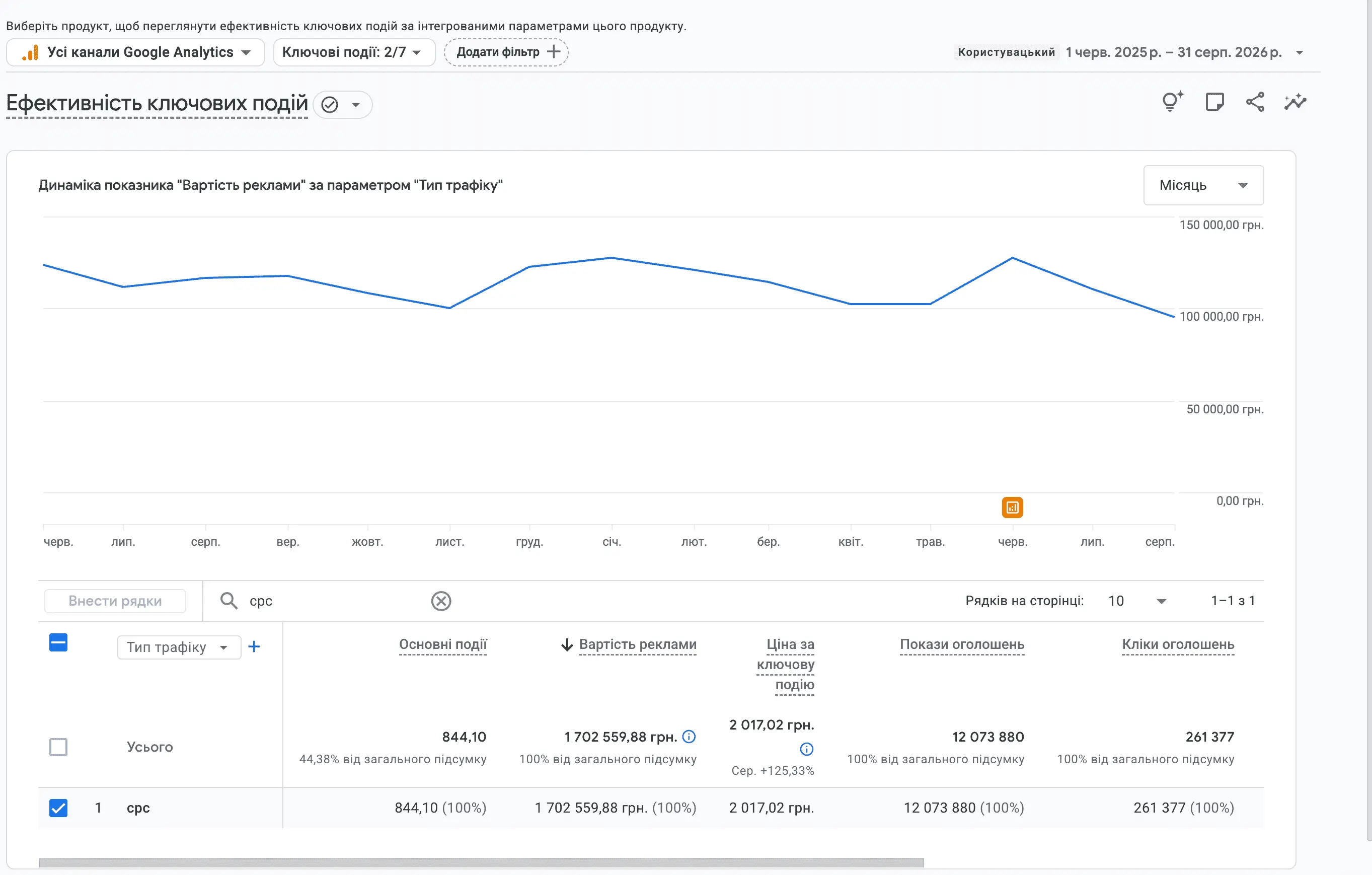
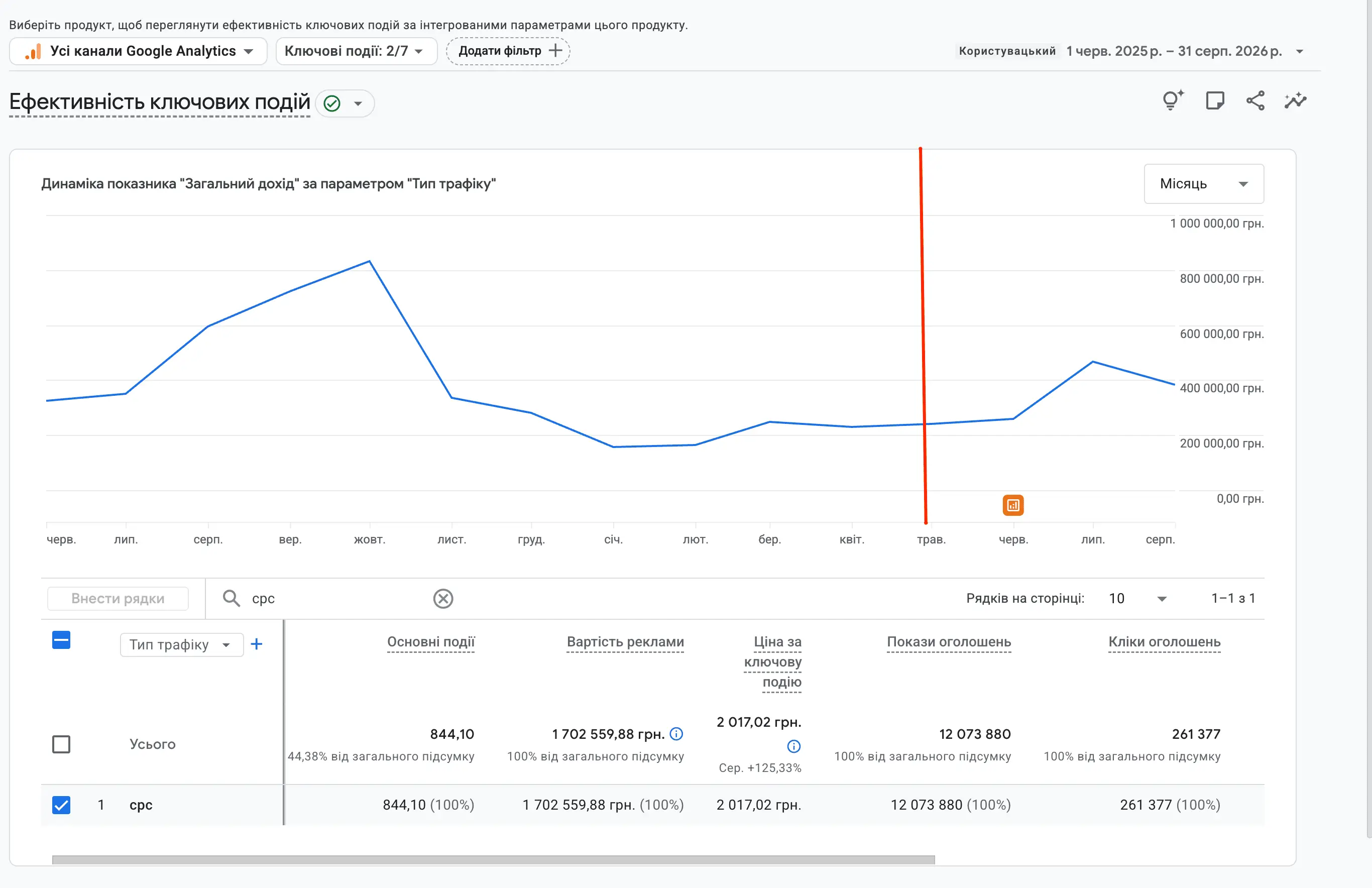
The product — expensive faucets and sinks, premium segment. But the website was built 6 years ago, and nothing in it has changed in those 6 years. Every week I said: man, let's do something with the website, with this one we'll only stagnate. The answer was always the same: “this website converted me 6 years ago, it worked, it works and it will keep working”. Even though the metrics dropped every year — even with us I only held them steady, growing them was impossible.
The product renders — terrible. Order conversion rate — 0.2%. For context: 1% is already rock bottom, anything below is below rock bottom. Technical specs for fixing the website and attribution were ignored for months. CRM access was granted only in the tenth month of our cooperation — and the attribution there was so broken that nobody fixed it either.
The product is premium — not mass market, where it's simply a question of price. Direct competitors are cheaper, but their websites look premium. This one looks like an HTML site from 2005.
He hired another agency. Four months later — at the same spend, results are worse than a year ago. I still have access to the account, but I don't even look: at agencies where ads are run by juniors for 50 dollars, there's nothing to peek at — I talked about this difference separately in the article on choosing between an agency and a freelancer. It's not about the agency — it's that the person lives in a six-year-old paradigm, while the market has completely transformed since then.
That doesn't mean it was easy with him. Over a year we managed to get him to at least add installment payments to the website and slightly fix the product pages. Once I asked: why are there two analytics setups on the website at the same time? “Well, there used to be one, it didn't work, we installed a second one, it worked — and when we wanted to remove the second one, the first one stopped working.” That's the kind of thing you have to work with. And I take no pleasure in it.
On the search for the 16th contractor
A small digression. A guy with a sushi delivery once came to me for a forecast: “I've already had 15 contractors, nobody can do anything decent.” I ask: what's your repeat rate for a second order? “Don't know.” Average order value? “Don't know.” Do you do anything besides PPC? “Well, we do some stuff — paid social, SEO, etc.” How do you engage with your audience? “Well, they order on their own.”
The guy is looking for his 16th contractor and thinks the problem is the contractors. Okay, you tried three, you tried five — it doesn't work. By the 15th you should have realized: the problem isn't them.
Key point: if you keep changing contractors and results don't improve, most likely the problem isn't the contractor. The problem is your marketing, or the lack of it.
Marketing first, then advertising. Not the other way around.
And for balance — when the approach delivers
I recently got feedback from a client whose two online stores we manage. He says: you're the only one of the 5–6 contractors he had before who doesn't work by the template “let's split the products into cheap and expensive and launch ads” — that's exactly how all the others start the first call. You do everything logically and with solid reasoning.
From the conversation with the client:
Volodymyr: “We caught the momentum and thought it would always be like this. I only believe in systematic work — that's what delivers consistent results.”
Client: “Well, before I found you, I also went through 5 or 6: Agency 1, Agency 2, Agency 3, Agency 4, Agency 5, there were some others but I don't remember anymore. And they all did the same thing. And nothing changed. On the very first call they all say the same thing: ‘well, we'll split the price lists into expensive and cheap products and everything will be fine’. But here a completely different — logically sound — approach is being taken.”
Summary
Not every case ends with a pretty ROAS in a website carousel. There are cases where you honestly say at the start “it won't work”. There are cases where you work for a year with a client who ignores every recommendation and then blames the next contractor for falling metrics. And there are cases where the approach simply works — and the client sees it.
The difference isn't always the contractor. More often, it's whether there's any marketing at all behind the ads.
How a client’s own tinkering gets in the way even of strong results — see the overseas employment agency case study.
Where to find me
Message me on Telegram or by email — I respond quickly. Telegram channel and YouTube are for those who want to see real cases before reaching out and understand my approach.