
Marketer, analyst, ex-CMO focused on the Google ecosystem (Ads, Merchant Center, GA4, GTM). Google Partner. 150+ projects, 100+ positive reviews on Freelancehunt, 12+ countries.
- I work directly, with no account managers or subcontractors
- I measure results in sales, not in-platform conversions
- Maximum expertise in the Google ecosystem — instead of “PPC, social ads and SEO, all in one”
The main lesson after more than 150 projects is simple: Google Ads doesn't sell on its own. The system does.
Over 7 years, more than 150 projects in 12 countries and a path from Marketing Director and COO to freelancing, I've understood one thing. Google Ads is just a tool that shines a light on your business model. If you have a bad product, broken or nonexistent unit economics, or a sales team that doesn't pick up the phone, advertising will only speed up your bankruptcy, burning through the budget with incredible efficiency.
But if the system works, advertising becomes the very locomotive that pulls the business forward.
Contents
- “We worked with agencies for years”
- Lesson 1. Analytics isn't about reports, it's about managing risk
- Lesson 2. Performance Max is not a cure-all
- Lesson 3. Unit economics won't work out for everyone — and that's fine
- Lesson 4. CMO and COO experience changes how you see PPC
- Lesson 5. The approaches of 2017–2020 are dead
- Lesson 6. Markets differ, but people are the same
- Lesson 7. AI won't replace specialists, but specialists using AI will replace everyone else
- Summary: there are no secret settings
- FAQ
Google Ads Doesn’t Sell on Its Own. The System Does.

“We worked with agencies for years”
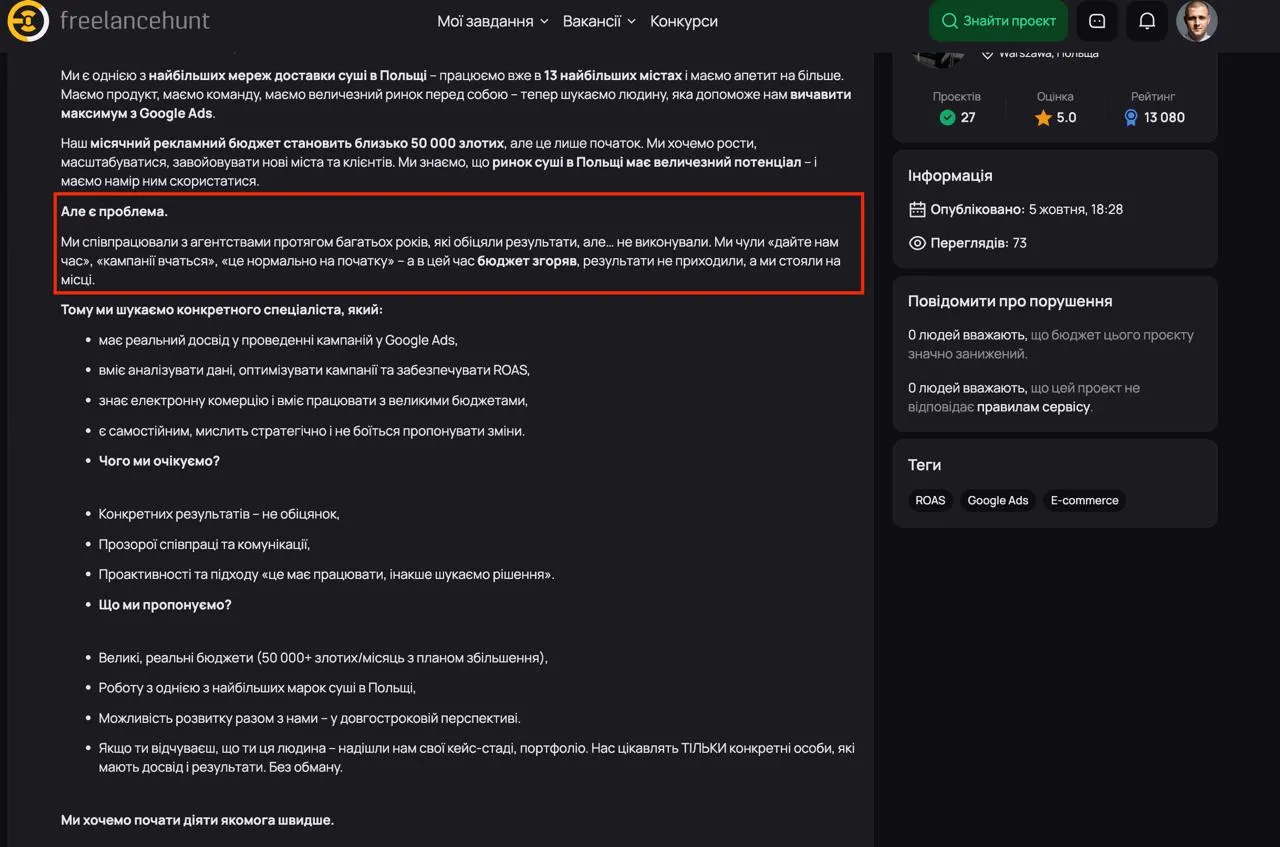
Recently on Freelancehunt a client described their task like this. They run the largest delivery chain in Poland, but there's a problem:
“For many years we worked with agencies that promised results but didn't deliver. We kept hearing: give us time, the campaigns are learning, this is normal at the start. Meanwhile the budget was burning, results weren't coming, and we were standing still.”
The fundamental problem here is most likely not the agencies. It just doesn't happen that a company tries a bunch of contractors and not a single one delivers any result at all.
I work with the food delivery niche and have already talked about a similar case. Another sushi delivery owner told me: “I had 16 PPC contractors, and none of them could do anything.” That doesn't happen. Expecting Google Ads to carry the entire delivery business model is a plain mistake.
In food delivery, as in most niches, trust is critical. But Google Ads doesn't build trust. It finds hot demand. Trust is built by other things: good service, fast delivery, a quality product, the ability to resolve conflicts. And here you can bang your head against the wall all you want — Google Ads on its own won't help.
Below are seven lessons, perhaps a bit harsh. I arrived at them through millions of dollars in ad budgets, hundreds of gigabytes of analytics and several hundred ad account audits.
Lesson 1. Analytics isn't about reports, it's about managing risk
Most business owners think analytics means a pretty Looker Studio report with charts of clicks and CTR. The owner looks at it and doesn't understand why they need it.
What a business owner cares about comes down to three questions: how much money I made, how much I'm making and how much I will make. Real analytics starts where the ad account interface ends.
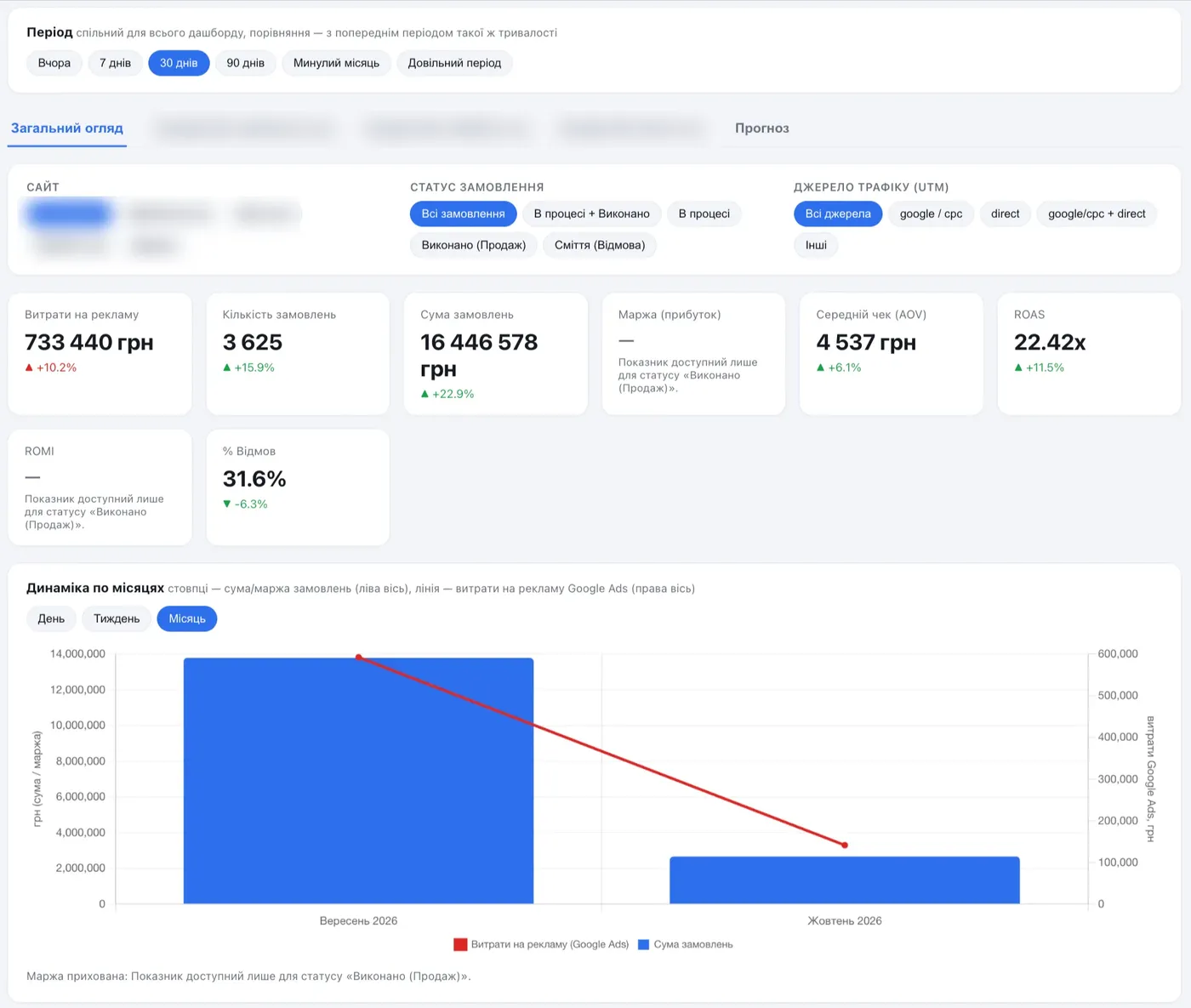
Basic tracking isn't enough. The tracking set up in 95% of ad accounts isn't analytics. A purchase on the site or a submitted form is just the first stage of the funnel. Analyzing it without seeing what happens next means scaling a potential loss. You're training Google's algorithms on fragmented data (because not everything reaches the account) or, even worse, on low-quality data.
Without a CRM you're running ads blind. The account should receive not the fact that a form was sent or a purchase event fired, but the final outcome of the deal: a qualified lead, a closed sale — depending on your funnel. For e-commerce I use a “sale” goal: success is when the customer has paid and the order has moved to sale status, not the mere fact that it was placed.
The difference is significant. Depending on the project, anywhere from 10% of leads drop off in good cases to 30% in worse ones. That means 3 out of 10 orders never get paid, yet you train the system on all of them. How to fix this — in the case study on offline conversions and the article on end-to-end analytics.
Attribution always lies. Don't look for the perfect attribution model. Use end-to-end analytics to see trends and how channels affect each other, not to credit a sale to a specific channel down to the last cent. Treat advertising as a system, not a set of separate channels. Comparing Google, which captures hot demand, with Meta, which works on brand awareness, is like comparing apples and twenty-four.
Key point: real analytics answers not “how many clicks” but “how much money did I make.” Without CRM data you're training your ads on noise.
Lesson 2. Performance Max is not a cure-all
In audits I regularly meet both clients and specialists who believe: launch Performance Max and the AI will do everything for you. It doesn't work that way. Ever.
It's a powerful tool, and I won't say anything bad about it. But for now it's a “black box”: not perfect, very sensitive, very delicate. Used incorrectly, you're simply scaling a loss.
When Performance Max appeared, the market split into two camps: those who mindlessly click “Launch” and those who shout that AI wastes the budget. The truth is in the middle. Performance Max is great at scaling what already works well, but it's merciless to beginners.
In the industrial equipment case, at the time of the audit there was a campaign running with leads at 100 UAH ($2.2) that didn't actually exist. All the ads were running on YouTube, including kids' channels. In another B2B project, also industrial equipment, Performance Max “wandered” everywhere except the target audience.
It took me about half a year to convince the client: Performance Max can be used in his niche, but carefully. We've now been working with it successfully for over a year. At every meeting the client repeats: before, I was told you can't squeeze anything out of my niche, then you came and said everything had to be rebuilt, end-to-end analytics set up, all the data collected in the CRM. And after that it started working.
He even joked: “You don't need a 100,000 UAH ($2.2K) budget and a clueless specialist, you need Volodymyr and a 150,000 UAH ($3.3K) budget.” A joke, but the point is that you have to know how to use these tools. More details in the article on Performance Max weaknesses.
Lesson 3. Unit economics won't work out for everyone — and that's fine
Let's be honest: Google Ads is an expensive tool, and it's not for every business.
Ads used to be launched on the principle of “let's put in a thousand dollars and see.” Today in competitive niches, for example in the US, the cost per click can be such that the first sale is at a loss or breakeven. The same applies to Ukraine, especially service niches: food delivery, barbershops, clinics, dental practices.
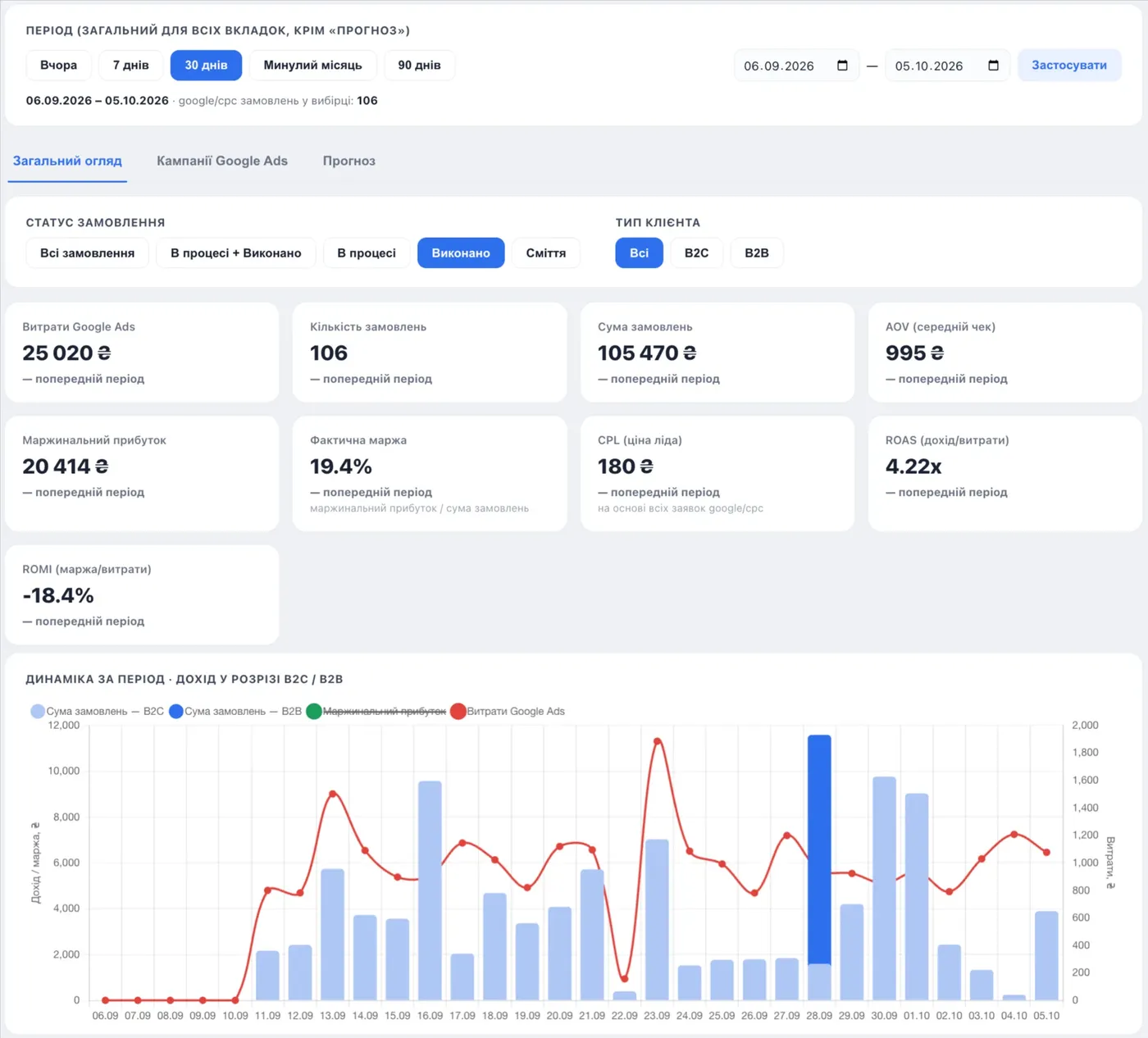
If your model doesn't involve repeat sales (working with lifetime value) or your margins are low, search advertising may simply be contraindicated for you. To find this out before launch, I built a Google Ads ROI calculator.
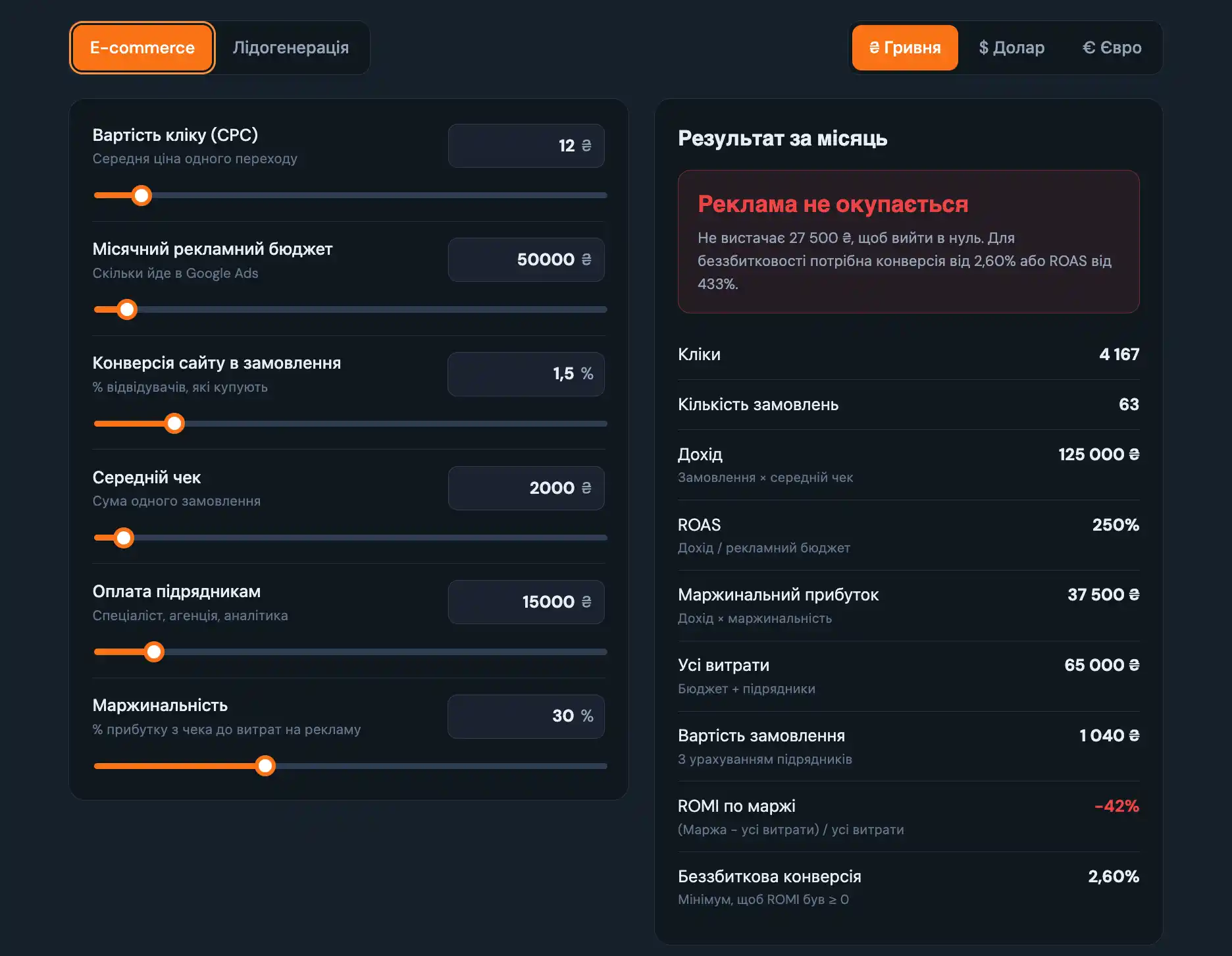
In practice I take on roughly 3 out of 10 requests. For every business I calculate three scenarios with different conversion rates. If none of them reaches even breakeven, I decline. If at least a couple of scenarios are profitable, I take it. So I turn down 70% of requests.
That's the difference between a Google Ads expert and an ad account operator. An operator, like an agency, will take any project, because their business model is built on a constant flow of clients.
Key point: telling a client “you don't need Google Ads right now” is what separates an expert from an account operator.
Lesson 4. CMO and COO experience changes how you see PPC
Why does a top-management background help in Google Ads more than dozens of completed courses? Because an ad operator, a PPC guy, a “button pusher” as I like to call them, thinks in ad account metrics. A former Marketing Director sees profit metrics.
A button pusher at best works with ROAS. A marketer works with ROMI — the metric closest to net profit. There are two points here.
Margin matters more than revenue. The same product with different margins brings different profit. When you train your ads to look for higher-margin orders, it's a real game changer: moving from a “sell anything, the pricier the better” model to a “sell what brings profit” model.
The problem isn't always the traffic. It can be the sales team's conversion rate. I've seen dozens of companies that complained about their ads, or on the contrary had a perfect CPL, but there was no money. We open the CRM and the call tracking, and there it is: 70% of missed calls never called back.
Lesson 5. The approaches of 2017–2020 are dead
Forget about a thousand keywords. Forget about the “one keyword — one ad group” approach. Forget that “buy cake” and “cake buy” are different intents. Forget about structures with dozens of campaigns at 50 UAH ($1.1) a day.
I've been doing Google Ads for over seven years, almost eight, and the platform is transforming massively right now. The focus is shifting away from micromanagement, which a few years ago included, for example, manually managing ad schedules. I wrote separately about whether that makes sense in 2026.
Simplify your account structure. You don't need 150 ad groups in a campaign. The simpler and more correct the structure, the faster the algorithms learn. Data consolidation is the main trend in modern ad optimization. The same goes for match types: Google's algorithms now work better than your five-thousand-keyword list.
Lesson 6. Markets differ, but people are the same
Working with projects in 12 countries — Ukraine, the US, Canada, the UK, Australia, Germany, Poland, Italy and others — I've arrived at a simple formula. The mechanics of demand and the decision-making process are more or less the same everywhere. The only difference is the cost of a mistake and the density of competition.
In the US, Canada or the UK, an analytics setup mistake at launch can cost thousands of dollars. There's a case where $10,000 was spent and 0 leads came in: the price of a mistake there is high because clicks are expensive. How I launch ads abroad: Google Ads for international markets.
Another example from my agency days. We took on a client with a $1500 budget in the “we buy houses fast” niche who wanted leads at $50. Meanwhile a click in that niche cost about $50. Even at the calculation stage you could tell the goal was unrealistic. But he was taken on, and a month later he left. Garbage in, garbage out.
The Ukrainian market is incredibly flexible and fast, but clients are very demanding about service, and competition in almost any niche is enormous. Because of everything happening in the country, even those who long postponed going online have done it. Competition is growing, the market is stagnating, and everyone is starting to earn less.
Lesson 7. AI won't replace specialists, but specialists using AI will replace everyone else
In Google Ads, AI only replaces the bottom layer of specialists — those who simply know how to use the interface. As in most fields, it takes the lowest tier: work that can be automated or significantly simplified.
Neural networks write copy, generate images and help with routine tasks. And Google Ads' own machine learning systems manage bids in its auctions better than any human.
But one of my clients decided to follow AI's advice and let an agent loose directly in the ad account. The agent made such changes that within a week the client felt the consequences and realized: trusting AI blindly is a bad idea.
I use AI in my work regularly and just as regularly see its mistakes. Not in routine tasks, but in more serious things:
- AI makes up facts. Models are trained on information from the internet, and it isn't always true.
- AI works with outdated data. It's 2026, and a model's latest information about a Google Ads tool may be from 2023. The tool has changed since then, and what the AI describes simply doesn't work.
The main thing: if you don't understand the subject, you can't check what AI is telling you. Clients sometimes export metrics they don't understand themselves, hand them to AI without context and come back with a ready-made solution: “Here's what AI says, let's do it.”
Case: an apartment rental project in Toronto. The client uploaded the data to ChatGPT and got recommendations. I told her straight: you can't do this, it's absurd. The answer: “We're doing it, ChatGPT said so.” I agreed — I had neither the energy nor the desire to prove anything. If a client with ChatGPT thinks they know better, let them learn from their own mistakes and their own money.
| Before the changes | After ChatGPT's changes | |
|---|---|---|
| Cost per lead | 30 CAD | 100 CAD |
Cost per lead went up more than threefold. Two weeks later the client asked to put everything back the way it was.

So what's left for the specialist? Three things:
- Data architecture: collecting and cleaning data, end-to-end analytics, sending signals about real sales back to Google Ads.
- Business strategy: unit economics, the client's positioning, the limits of their business processes.
- Control and critical thinking. AI is a blind racer in a very fast car. It goes fast, but it can't see where.
Key point: AI is speed without direction. A specialist is needed to set the direction, provide the right data and check the result.
Summary: there are no secret settings
Over 150+ projects I've learned: perfect Google Ads isn't about the secret settings that Google Ads course sellers keep talking about. In my YouTube videos and on the blog I've said more than once that results are determined by two things: analytics and quality data. There are no other secrets.
Google Ads is just one advertising tool, and advertising is just one marketing tool. Search ads don't work on their own. If even one link in the business chain drops out, the system fails:
- problems with the sales team — Google Ads won't fix that;
- problems with the offer or USP — Google Ads won't fix that;
- managers can't talk on the phone — Google Ads, unfortunately, won't fix that either.
Why ads can't carry what marketing is supposed to solve, I covered in the article on the 5P model.
If you want to check whether your system is ready for advertising, start with the ROI calculator or get in touch, contacts are on this page.
By the way, Google has finally given a bit more control over Performance Max: I show how to reduce the impact of individual placements in “New Performance Max Feature”.
Where to find me
Message me on Telegram or by email — I respond quickly. Telegram channel and YouTube are for those who want to see real cases before reaching out and understand my approach.