
Marketer, analyst, ex-CMO focused on the Google ecosystem (Ads, Merchant Center, GA4, GTM). Google Partner. 150+ projects, 100+ positive reviews on Freelancehunt, 12+ countries.
- I work directly, with no account managers or subcontractors
- I measure results in sales, not in-platform conversions
- Maximum expertise in the Google ecosystem — instead of “PPC, social ads and SEO, all in one”
“We launched Google Ads — and there are no leads.” I hear this phrase regularly, from businesses and specialists alike. Meanwhile, cases with impressive results make up only a small share of all the projects that actually get launched in advertising.
Contents
- 1. What Is the 5P Marketing Model
- 2. The Role of Google Ads: Tactics, Not Business Strategy
- 3. Product: What You Sell (and What Google Ads Can't Do)
- 4. Price: Pricing, Dumping and the Math
- 5. Place: Website, Logistics and Touchpoints
- 6. Promotion: The Only Area a Google Ads Specialist Truly Controls
- 7. People: The Sales Team as the Point Where Everything Can Break
- 8. Why “Ads Don't Work” Isn't Only About Google Ads
- 9. Summary: Where the Business Is Responsible, and Where the Contractor Is
- FAQ
Why PPC Isn’t Working: The 5P Marketing Model

Over the years I've done more than 150 full-scale projects. And only some of them are those “pretty cases” you can brag about. Some are normal, working results that the client finds acceptable. And then there's a pool of projects where the ads, to put it mildly, “never took off.”
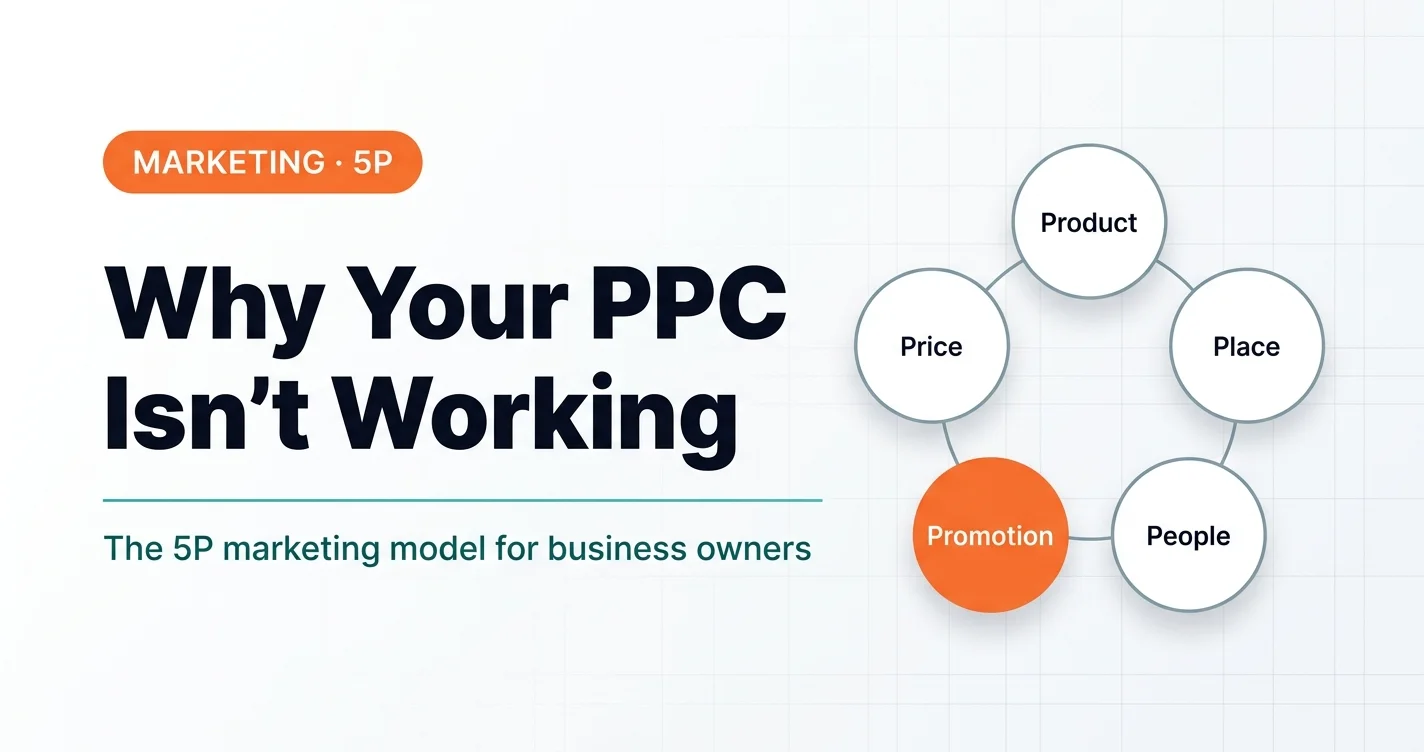
To understand why this happens, we'll have to go back to Marketing 101 and recall the 5P marketing model.
1. What Is the 5P Marketing Model
The 5P marketing model describes the core elements a business's marketing strategy rests on:
- Product — what exactly you sell;
- Price — what you sell it for;
- Place — where and how the customer gets the product;
- Promotion — how you communicate and drive traffic;
- People — who serves the customer and how.
Picture a wheel with five spokes. If even one of them sags badly, the wheel gets bent — and you won't get far on marketing like that. Google Ads is just one part of Promotion, not a magic “make money” button.
2. The Role of Google Ads: Tactics, Not Business Strategy
Search advertising (Google Ads, Microsoft Ads, etc.) is a tactical tool that executes an already existing marketing strategy.
Yes, within Google Ads itself there's an “account strategy”: campaign and ad group structure, campaign types (Search, Shopping, PMax, remarketing), work with keywords, negative keywords, audiences, bids, budgets, bid strategies, analytics and optimization based on results.
But relative to the business as a whole, Google Ads is just one way to deliver your product to your target audience. If the other P's are in bad shape, advertising won't save you.
3. Product: What You Sell (and What Google Ads Can't Do)
The product isn't just the item or service itself. It's the whole concept: positioning, USP, format, packaging, the service bundle around it.
A client comes to a specialist with a product that's already formed. And often it looks like “a store called Store” selling “goods called Goods” — no clear USP, just “shipping via Nova Poshta across Ukraine,” no different from dozens of competitors.
A Google Ads specialist's influence on the product is minimal (1-2 out of 10). At most, they can point out the weak spots and explain that without a USP things will be hard, but they can't make the business rework the product.
4. Price: Pricing, Dumping and the Math
Price is one of the critical components, especially in e-commerce. A typical case: you sell the same product as your competitors, your price is 10-20% higher, and you offer no added value the customer actually feels.
In Shopping, users see prices side by side, and here advertising is far from all-powerful: if you're simply more expensive “because we feel like it,” conversion will suffer.
What a Google Ads specialist can do: monitor competitor prices, recommend price ranges, sales and promos, explain why with prices like these Shopping/ads may not pay off. What they can't do is change your pricing policy in place of the business owner.
5. Place: Website, Logistics and Touchpoints
Place isn't only a physical location or warehouse. For an online business it's also the website and landing pages, load speed, UX, filters, product pages, forms, callback, call tracking, and how convenient it is to receive the product.
Formally, the website is the business's area of responsibility. But in practice, roughly 50% of search advertising success rests on the quality of the landing page.
If the page is inconvenient, slow or not mobile-friendly, has no clear trust signals, contacts or delivery terms, and users struggle to find the product or service they need — then even a perfectly set up Google Ads account won't “pull through” the conversion.
The specialist's influence here is greater than over Product/Price/Place in the physical sense, but it's still through recommendations, not direct control.
6. Promotion: The Only Area a Google Ads Specialist Truly Controls
Promotion, in its Google Ads part, is what the specialist is responsible for 10 out of 10: account and campaign structure, correct targeting, bid strategies and budgets, work with Search, Shopping, PMax, remarketing, analytics, optimization, turning off what doesn't work, aligning creatives, ads, feeds, Merchant Center and so on.
That's what you can genuinely hold a Google Ads specialist accountable for. But not for prices above market with no explanation, a website that doesn't convert and looks like it's from 2010, or a sales team that “drops” leads.
7. People: The Sales Team as the Point Where Everything Can Break
People are those who work with your leads: sales managers, call center operators, administrators who respond to inquiries and messages.
A very typical story: the ads bring in enough inquiries, the cost per lead is reasonable, the traffic is targeted — but the lead-to-sale conversion rate drops month after month because the sales team can't keep up, doesn't want to, or doesn't know how to handle inquiries properly.
A marketer can flag a low conversion rate, ask for access to call tracking and listen to the calls, give constructive feedback on how the managers work. But they can't hire, train or fire the managers. That's the operational and strategic responsibility of the business owner.
8. Why “Ads Don't Work” Isn't Only About Google Ads
If you have a mediocre or non-existent product, prices that don't hold up against the market, a weak website and inconvenient logistics, chaos in the sales team — then even a perfect Google Ads setup won't create a USP for you, won't make people pay more for no reason, won't fix a broken website and won't teach your managers to sell.
In that case, advertising only highlights the problems, it doesn't magically solve them.
9. Summary: Where the Business Is Responsible, and Where the Contractor Is
In short:
- Product — the business's responsibility;
- Price — the business's responsibility (a marketer can give recommendations);
- Place (logistics, pickup points, website) — the business's responsibility, but the marketer should be involved in discussing the website;
- Promotion (Google Ads) — the Google Ads specialist's area of responsibility within the ad account;
- People (sales team and service) — the business's responsibility; the marketer can only highlight the problems.
Google Ads doesn't create a successful business from scratch. It scales what you already have: either a working model or a set of systemic problems.
If you want search advertising to “work,” you need to look not only at the ad account but at all 5 P's — product, price, place, promotion and people. Otherwise every contractor will seem “bad” to you, and the result will be disappointing.
Here is what that looks like in practice: the ads work, but leads get lost at the phone because nobody marks missed calls — see “Three Months Treating the Ads. The Front Desk Was Sick”.
Where to find me
Message me on Telegram or by email — I respond quickly. Telegram channel and YouTube are for those who want to see real cases before reaching out and understand my approach.