
Marketer, analyst, ex-CMO focused on the Google ecosystem (Ads, Merchant Center, GA4, GTM). Google Partner. 150+ projects, 100+ positive reviews on Freelancehunt, 12+ countries.
- I work directly, with no account managers or subcontractors
- I measure results in sales, not in-platform conversions
- Maximum expertise in the Google ecosystem — instead of “PPC, social ads and SEO, all in one”
Long tail keywords are a once-popular strategy where Google Ads campaigns were built around long, very specific queries like “buy oxygen cylinder for home kyiv cheap.”
Contents
- 1. What long tail keywords are and where the myth came from
- 2. How to check whether the “long tail” works for you
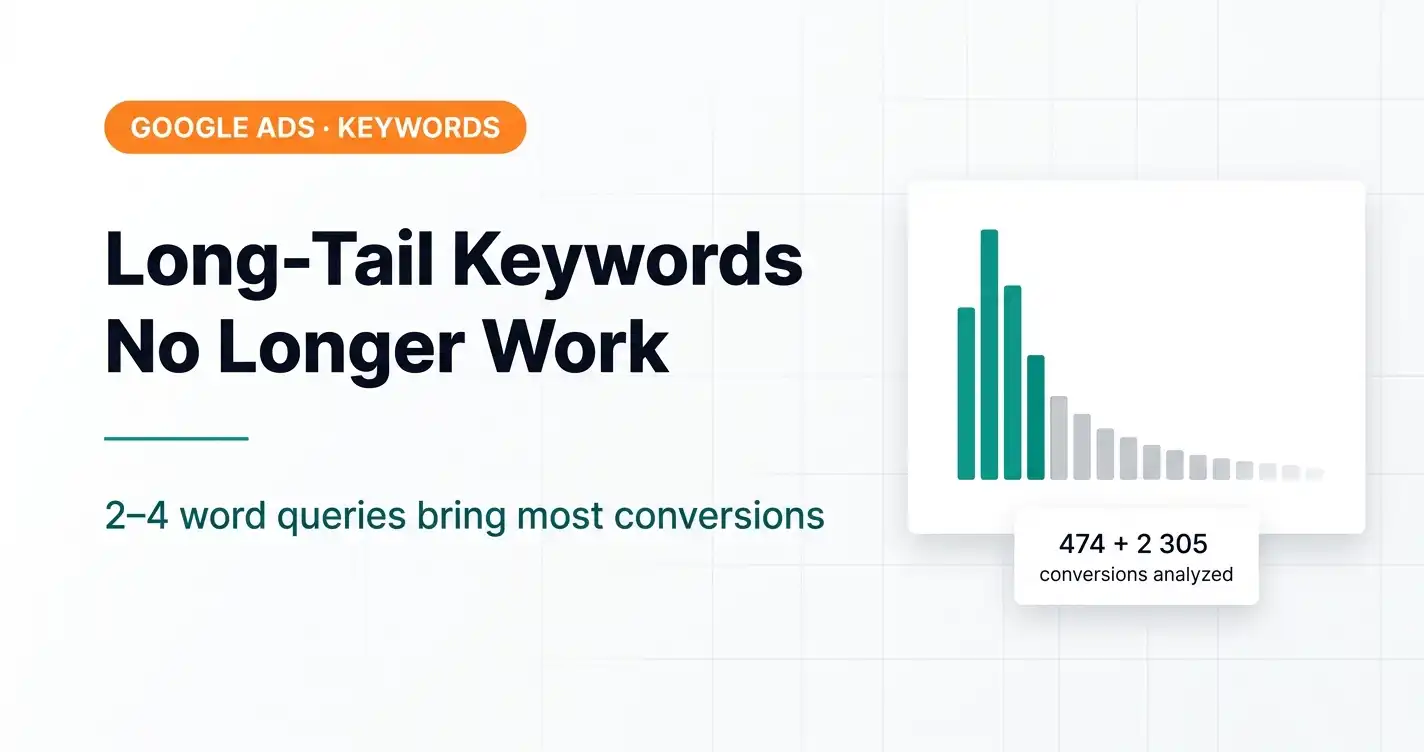
- 3. Case 1: oxygen cylinders. 474 conversions
- 4. Case 2: a different niche, 2,305 conversions
- 5. Why long tail no longer “saves” you in 2026
- 6. What to look at instead of the “long tail”
- 7. How I work with keywords in Search today
- 8. Conclusions
- FAQ
Long Tail Keywords vs Short Keywords: Which Actually Drive Sales?

In 2018–2020 this really could give you an edge: less competition, lower cost per click, more targeted traffic. But in 2026 this approach in its classic form is practically dead.
In this article we'll look at why the “bet everything on long tail” strategy no longer works, what real statistics from two ad campaigns show, which types of queries bring most conversions today, and how to build your keyword list in 2026 without romanticizing the “long tail.”
1. What long tail keywords are and where the myth came from
Long tail keywords are search queries with many words (usually 4–5 or more) that describe a very specific user intent: “oxygen cylinder buy for home kyiv price,” “order orthopedic mattress 180x200 reviews,” “buy child car seat 0-36 kg isofix ukraine.”
The old logic went like this: longer query → more precise intent → higher conversion rate; less competition → lower cost per click; so you need to “throw in” as many long phrases as possible.
In 2026 this logic no longer scales: user behavior has changed — people search with shorter queries, more often “on the go” from mobile; Google itself actively expands matching even for exact match; machine learning works on large volumes of data, not on dozens of narrow queries.
So instead of myths, let's move on to the numbers.
2. How to check whether the “long tail” works for you
The method is simple and repeatable for any account:
- Export search terms for a sufficient period into Google Sheets.
- Keep only the terms that brought conversions.
- Add a column with the query length (number of words).
- Build a pivot table: query length → number of conversions; share of conversions for each length group; median cost per conversion for each group.
I did this for two different projects in different niches and got a very similar picture.
3. Case 1: oxygen cylinders. 474 conversions
Niche: oxygen cylinders and accessories. Data: 474 conversions over a long period, which already gives statistical significance.
What the pivot table by query length showed: 2-word queries brought about 44% of all conversions; 2–3 words together — about 68% of conversions (two-thirds of all leads); 1-word queries — roughly 5–6% of conversions (and they're not as “terrible” as people usually make them out to be); long queries of 5–9 words — roughly ~10% of conversions.
In other words, if you focus only on the “long tail,” you'll be working with 10% of the potential at most, ignoring the bulk of the traffic.
I also checked the median cost per conversion: long keywords (5+ words) do often have a slightly lower median cost per conversion, but the difference isn't dramatic enough to sacrifice lead volume.
4. Case 2: a different niche, 2,305 conversions
The second project is a different niche, a different business, but the picture is similar, and there's even more data: 2,305 conversions.
Distribution by query length: 1-word queries — about 15% of conversions (yes, one-word queries work too); 2–4 words — roughly 80%+ of all conversions; long queries of 5+ words — about 6% of conversions.
Median cost per conversion: the long tail (5–9 words) often brings cheaper conversions, but the volume of such conversions is very small; the main money comes from 2–4-word queries.
Two projects, different niches, large volumes of data — and the conclusion is the same: the backbone of sales sits in short and mid-length queries, not in “super-detailed” phrases of 6–9 words.
5. Why long tail no longer “saves” you in 2026
Users search more simply. Most people type 2–3 words, not a “9-word novel,” into the search bar.
Google expands matching on its own. Even for “exact match” the system pulls in variations close in meaning. You'll be catching a wider range of queries anyway.
Machine learning loves volume. Proper bid strategy optimization needs hundreds of conversions, not a few leads from a handful of low-volume keywords.
Relevance matters more than length. How well a keyword matches the user's intent and the page is far more critical than how many words it has.
6. What to look at instead of the “long tail”
Instead of fetishizing query length, it makes sense to focus on more down-to-earth things: keyword relevance to the business, the offer and the landing page; account structure (logical groups, split by intent, product types, margin); page quality (site conversion rate, a clear offer, trust, UX); negative keywords and cleaning out junk queries; the actual conversion and its cost, not “what some online course once said.”
A thoughtful specialist makes decisions not on gut feeling, but based on the numbers in the ad account and analytics.
7. How I work with keywords in Search today
A practical model that works well in 2026:
- The core is 2–4-word queries. They usually bring 70–85% of conversions.
- I don't automatically throw out one-word queries. I test them and look at the conversion rate and cost. In some niches they perform great.
- Long tail (5+ words) is an addition, not a strategy. I add them, but I don't build the whole ad logic around them.
- Decisions only after enough data. I don't draw conclusions from 5–10 conversions; the benchmark is dozens or hundreds.
- Focus on business metrics. What matters isn't a “pretty” CTR or the number of words in a keyword, but cost per lead, ROMI and repeat sales.
8. Conclusions
The “let's pour in a hundred long keywords and it'll take off” strategy stayed back in 2020.
The reality in 2026 is this: most leads come from 2–4-word queries; one-word keywords can bring up to 15% of conversions in some niches; the long tail (5+ words) usually brings 6–10% of conversions — at a slightly lower cost, but with tiny volume; the key is to work with statistics, not myths and old screenshots from courses.
If you're still planning to build Google Ads “on long tail alone,” it's worth doing the same analysis in your own account at least once — and seeing where the money is actually made.
Separately, on how dynamic keyword insertion raises Quality Score but hurts traffic quality — see “Dynamic Keyword Insertion (DKI) — a Cause of Irrelevant Leads”.
How much search volume long-tail keywords really have in your niche — check the free keyword research tool.
Where to find me
Message me on Telegram or by email — I respond quickly. Telegram channel and YouTube are for those who want to see real cases before reaching out and understand my approach.