
Marketer, analyst, ex-CMO focused on the Google ecosystem (Ads, Merchant Center, GA4, GTM). Google Partner. 150+ projects, 100+ positive reviews on Freelancehunt, 12+ countries.
- I work directly, with no account managers or subcontractors
- I measure results in sales, not in-platform conversions
- Maximum expertise in the Google ecosystem — instead of “PPC, social ads and SEO, all in one”
I went through the whole account. The audit is short because there are three fundamental problems. After them, there’s no point in reviewing individual settings: at some point everything has to be torn down and set up again.
Google Ads account audit — household chemicals store
Contents
Problem 1. Dirty and incomplete data
The chosen goal sees less
Purchases are tracked in two ways: through the Google Ads tag and through GA4. The one used for optimization is the tag, and it shows fewer conversions than GA4. Not a very common story. But the fact is: the system is knowingly fed 10–15% less data. Accordingly, decisions are 10–15% wrong too — both the algorithm’s and the specialist’s.
Calls about who knows what
Calls are in the goals, but what’s behind them is unclear. Someone checked on an order, someone offered a loan, someone asked when it will ship. There may not be a single sale there. Yet the system uses them for optimization.
A cart is not a sale
97 cart purchases in 30 days. Some of them fall through:
- wrong details entered;
- never picked up from the post office;
- order cancelled;
- payment method didn’t suit.
There’s no average percentage — every project is different. But the system treats all 97 as sales. And starts looking for, among others, people who don’t pick up their parcels. Fresh signals matter more to it, so when cancellations grow, it will bring even more of them.
Why a cart and calls are not the same as a sale — I explain in detail in the article what a conversion in Google Ads is.
How I fix it
CRM integration with Google Ads. Depending on the task, either actual sales (from both the website and the phone) or qualified leads are sent. On lead generation projects I split leads into qualified, unqualified and priority (for example, B2B). Unqualified ones don’t take part in optimization. Each campaign type gets its own goal. Online stores work the same way — I’ve already described several such cases:
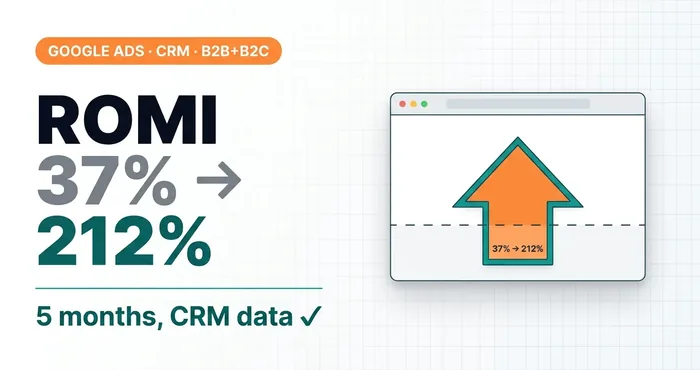 Google Ads case study · CRM integration · B2B + B2CFrom ROMI 37% to 212% in 5 months: how CRM data changed everythingAn electronics online store, B2C/B2B: CRM integration, call tracking, messenger attribution. ROMI from 37% to 212%.
To be blunt: this is as amateur as it gets. In 2026 you can’t let the system learn from dirty data while also missing part of it.
Problem 2. Target ROAS without data
All campaigns are on Target ROAS. But there aren’t enough conversions for this strategy, and calls and purchases are lumped together on top of that.
Google used to say one conversion a day was enough. On projects where I have dedicated Google consultants, I asked how current that is. The answer: it isn’t. For Target ROAS to work, you need at least 3–5 conversions a day per campaign. I check this across my own projects — it holds. With less data, a smart strategy simply doesn’t have enough to find an audience at the target ROAS.
Problem 3. Nobody manages the account
14 days without a single change. There’s always something to do in advertising — at the very least, cleaning up traffic.
I open the search terms of any campaign:
- “descaler”, “glue remover”;
- instructions;
- “Epicentr” (a retail chain), “chemicals store”;
- “how to remove tape from a window”.
Informational and irrelevant queries at UAH 10 ($0.22) here, UAH 10 there — and it adds up to a significant amount. In a month I didn’t see a single negative keyword. Open any campaign yourself and have a look.
First tracking, then traffic quality. Neither is being worked on here.
Bonus: brand in general campaigns
Brand queries run in the campaigns: the store name and its variations. They shouldn’t be there.
Brand queries always convert better: the person is already looking for you specifically. Right now they’re mixed with everything else, and that breaks optimization. The system sees a brand query with a ROAS of, say, 1000% against a 250% target, “over-delivers on the plan” and starts spending the budget on junk queries. And it can’t “find” more brand traffic, because that depends on brand awareness, not on ads.
How it should be:
- a separate Search campaign for brand only;
- brand fully excluded from all other campaigns;
- then you see the real performance of your ads.
The main thing: the ads are probably losing money
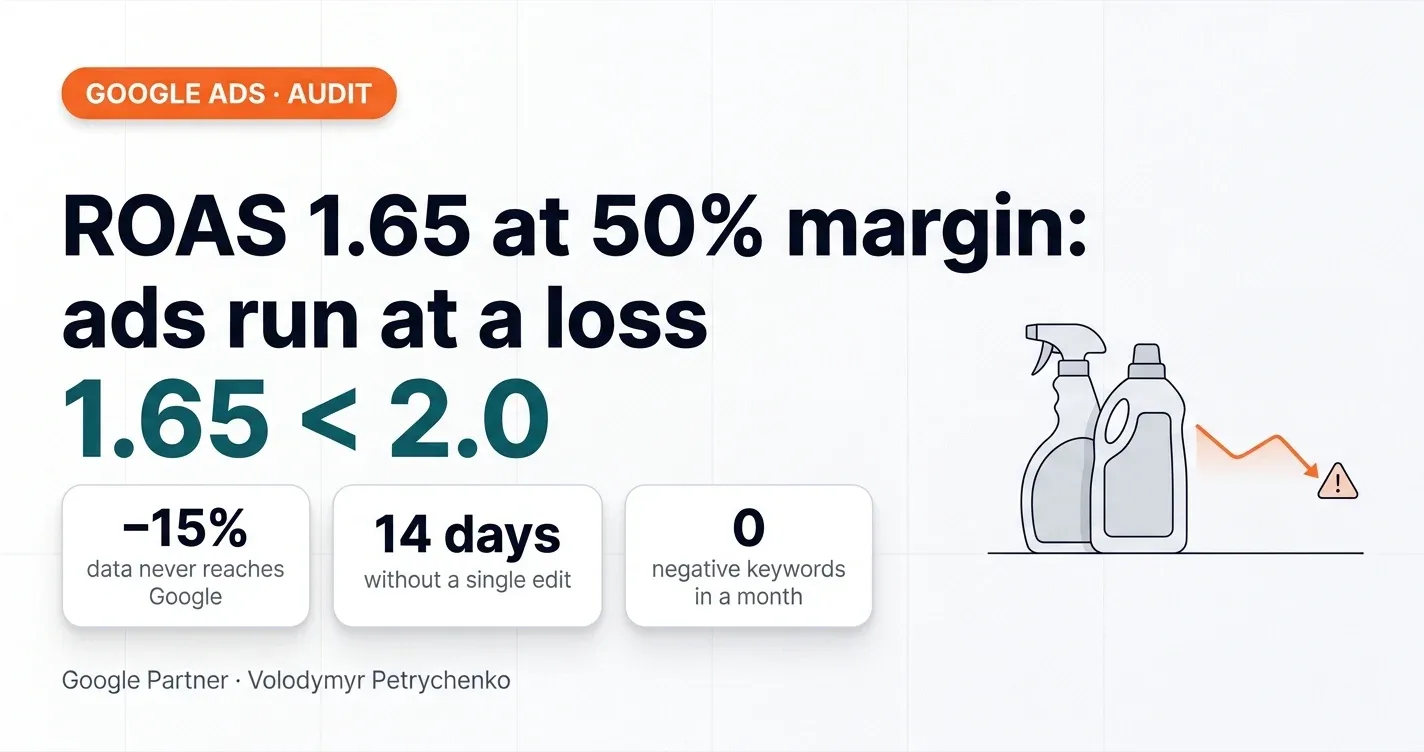
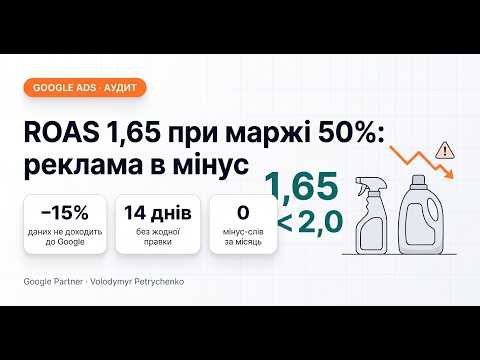
According to the owner, the store’s margin is about 50%. Then the minimum break-even ROAS is 2 (excluding taxes and agency fees).
| Metric | Value |
|---|---|
| Margin | ~50% |
| Break-even ROAS (excluding taxes and agency) | 2,0 |
| Actual campaign ROAS | 1,65 |
| Approximate ROAS including agency fees | ~4 |
A ROAS of 1.65 is a loss already at the product level. Budgets are small, and the agency fee is probably comparable to the monthly ad budget. So the real ROAS you’d need to see to break even is around 4. That’s my estimate, but the order of magnitude is clear. And that’s on dirty data, where some “sales” never happened.
You can calculate your own break-even point in the Google Ads ROI calculator.
Audit summary
| Issue | What to do |
|---|---|
| The goal chosen for optimization uses the tag and sees less than GA4 | Check and switch, then move to CRM |
| Calls and cart counted as sales | CRM → Google Ads integration, actual sales |
| Target ROAS without enough conversions | Merge campaigns, change the strategy |
| No negative keywords | Regular search term cleanup |
| Brand in general campaigns | A separate brand campaign, brand excluded from the rest |
| ROAS below break-even | Recalculate the target ROAS from margin |
Fundamentally — tear it down and set it up again, taking everything above into account.
03 — AuditGoogle Ads account auditI find where the budget leaks: structure, bidding, keywords, conversion tracking, website.
Where to find me
Message me on Telegram or by email — I respond quickly. Telegram channel and YouTube are for those who want to see real cases before reaching out and understand my approach.