
Marketer, analyst, ex-CMO focused on the Google ecosystem (Ads, Merchant Center, GA4, GTM). Google Partner. 150+ projects, 100+ positive reviews on Freelancehunt, 12+ countries.
- I work directly, with no account managers or subcontractors
- I measure results in sales, not in-platform conversions
- Maximum expertise in the Google ecosystem — instead of “PPC, social ads and SEO, all in one”
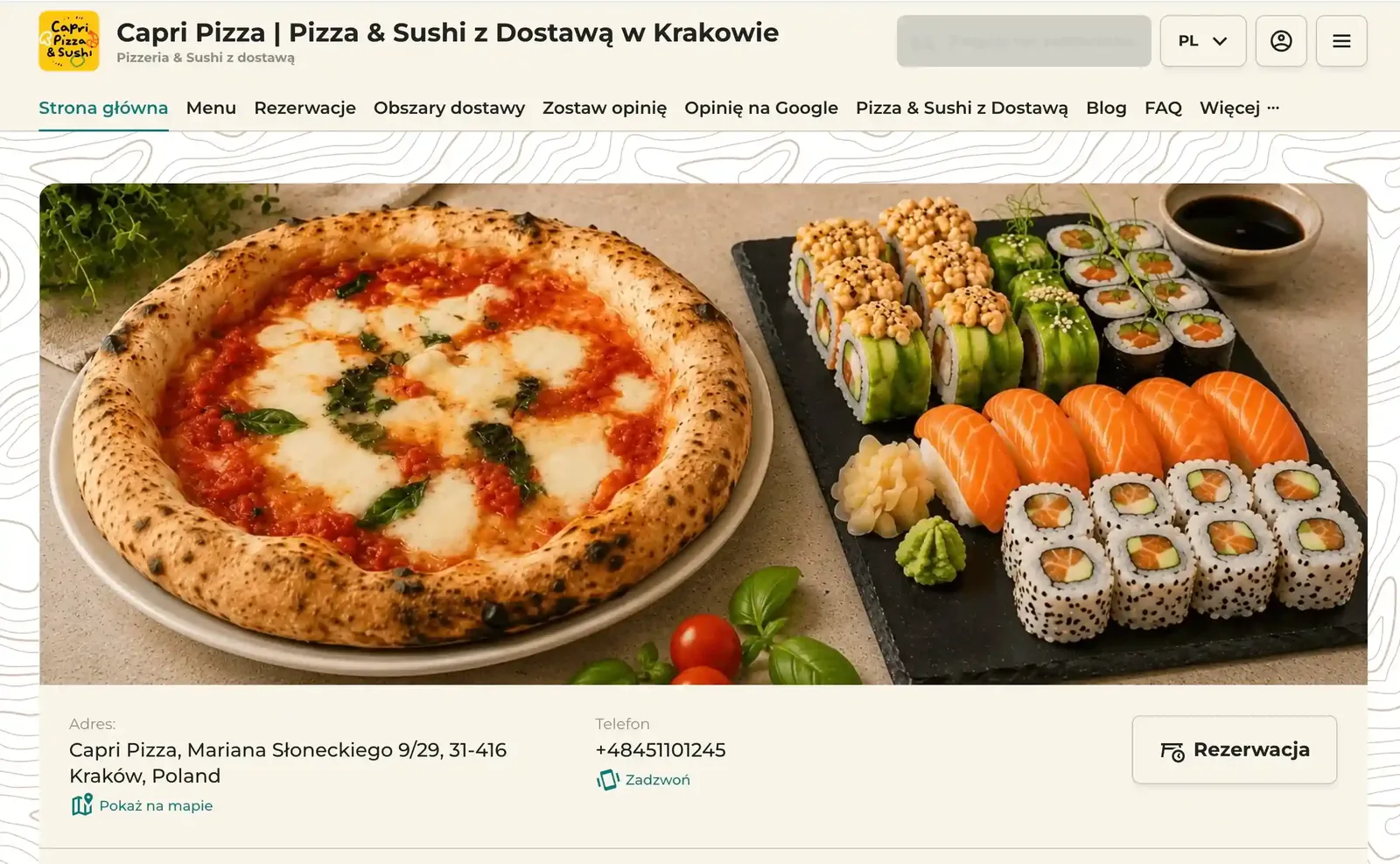
A breakdown of a real audit: a local pizzeria with delivery in Kraków, pizza and sushi, orders through the website. The audit has two parts: mistakes in the ad account itself and what needs to be done outside it. In the account I found 10 fundamental problems typical of the food delivery niche. How I work with projects in Poland and other countries: Google Ads for international markets.
Contents

Key takeaway: for food delivery, search advertising is not self-sufficient. Google Ads should solve two tasks: acquiring new customers and protecting the brand from being intercepted by competitors. Retention and repeat orders are handled by working with the existing customer base. The business should be measured by customer LTV, not by one-off purchases and not by a single “cost per conversion” across the whole account.
I have been working in the food delivery niche for over 7 years, with one client for 6 years (a food delivery case with CPL 42 UAH ($0.93)). The structure I describe below was shaped by real tests.
What was in the account
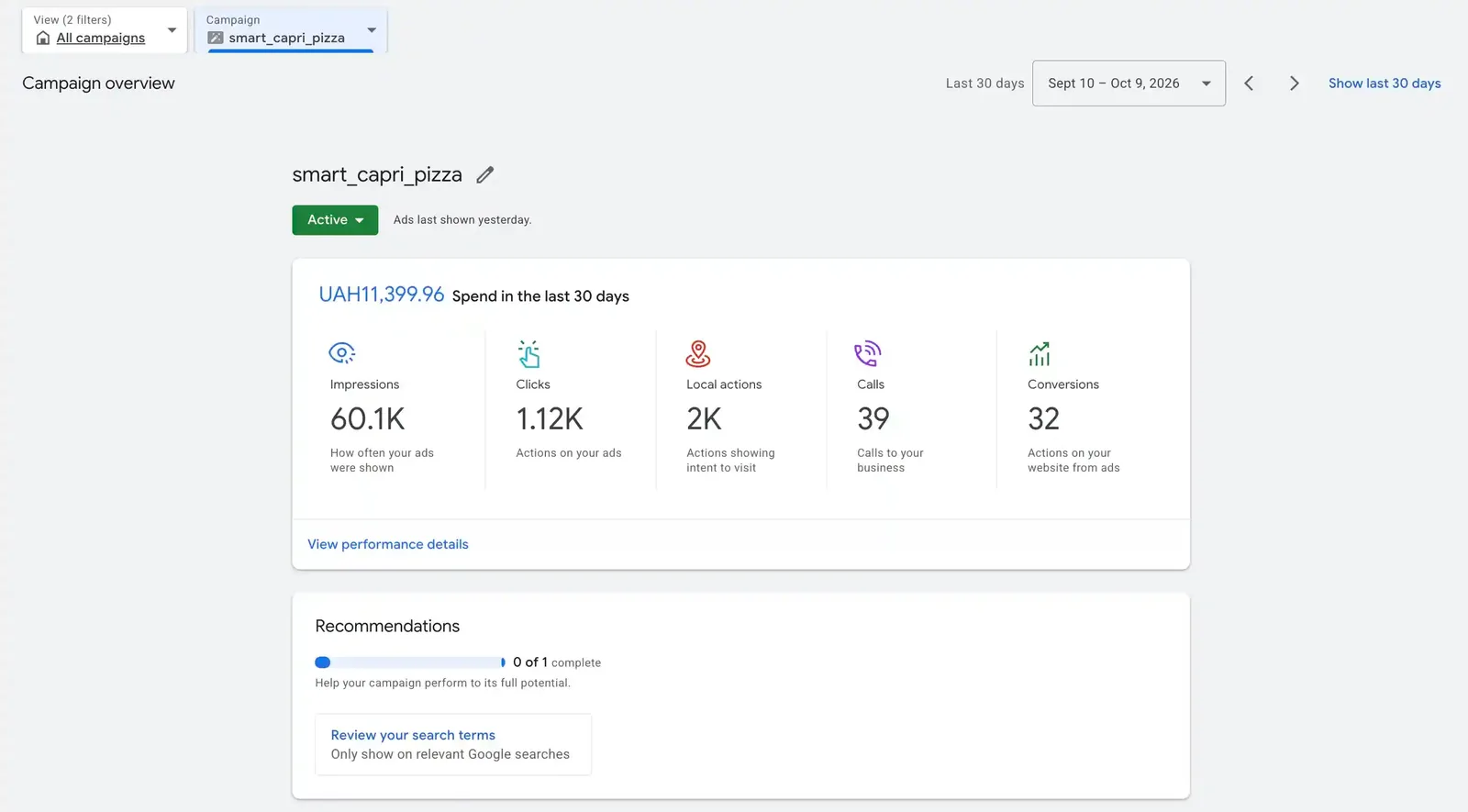
- campaign types: two Performance Max campaigns (pizza and sushi) + a Smart campaign with the “Maximize clicks” strategy;
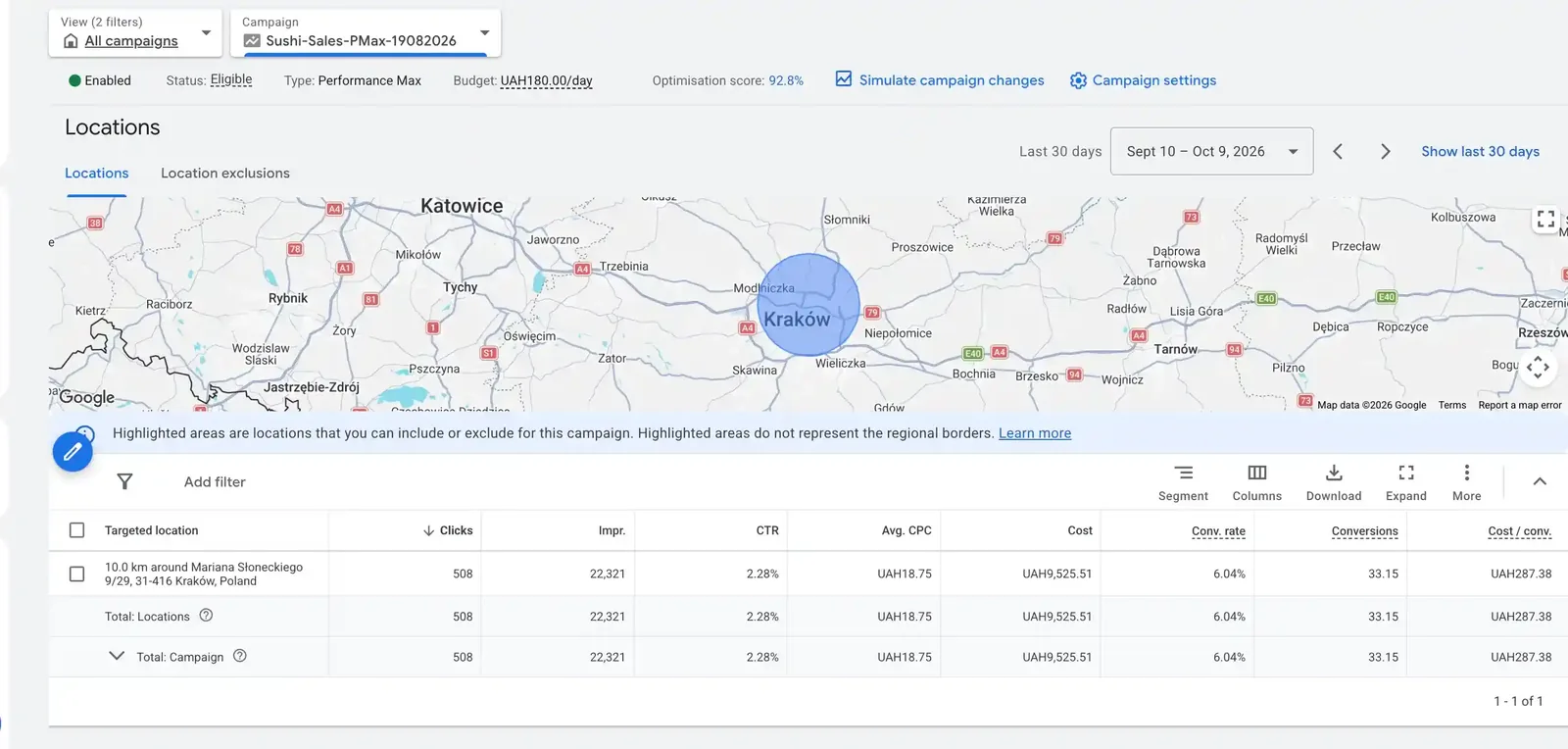
- ad radius: 10 km around the restaurant;
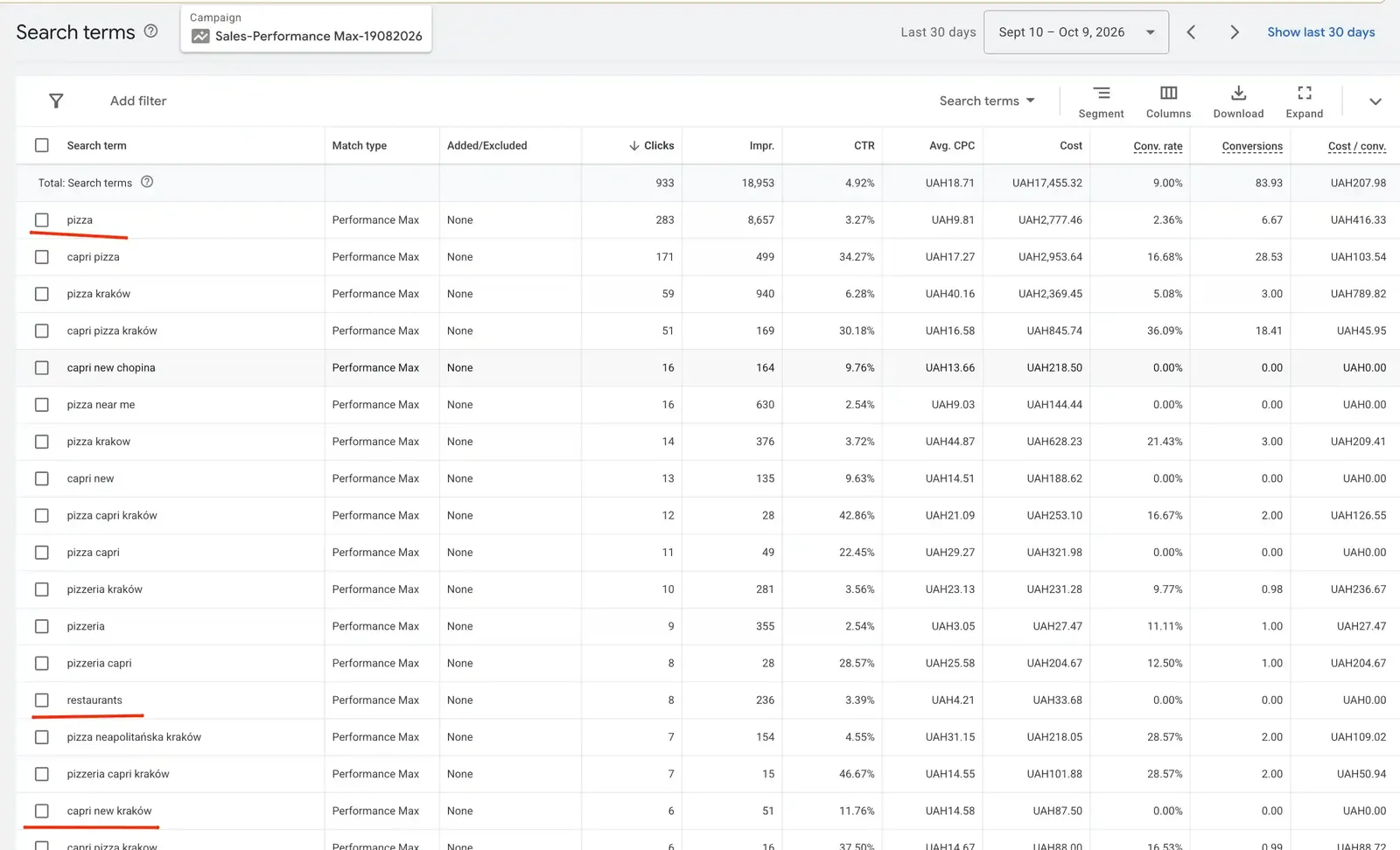
- all search terms — brand, generic, competitors, “restaurants” — in one place;
- spend was significant at first, then dropped sharply;
- phone orders and pickup, according to the owner, make up about 15–20% of orders;
- other channels: Meta Ads (roughly purchase-focused) and SMS campaigns.
10 mistakes in the ad account
1. Micro-conversions in campaign training (critical)
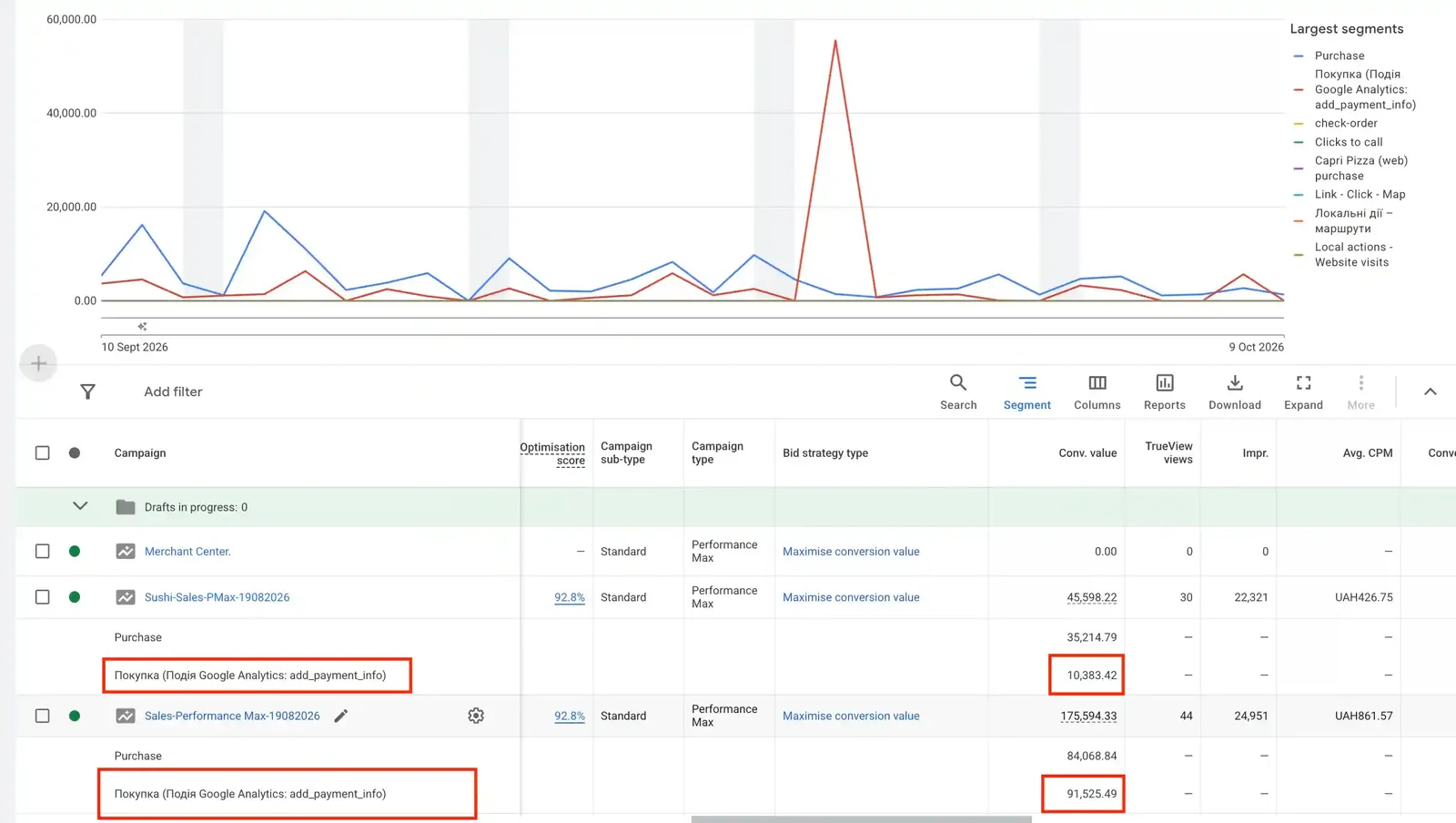
The add_payment_info event — a step toward checkout — was used to train the algorithms. The system learns from people who started placing an order and abandoned it, that is, from those who never became buyers.
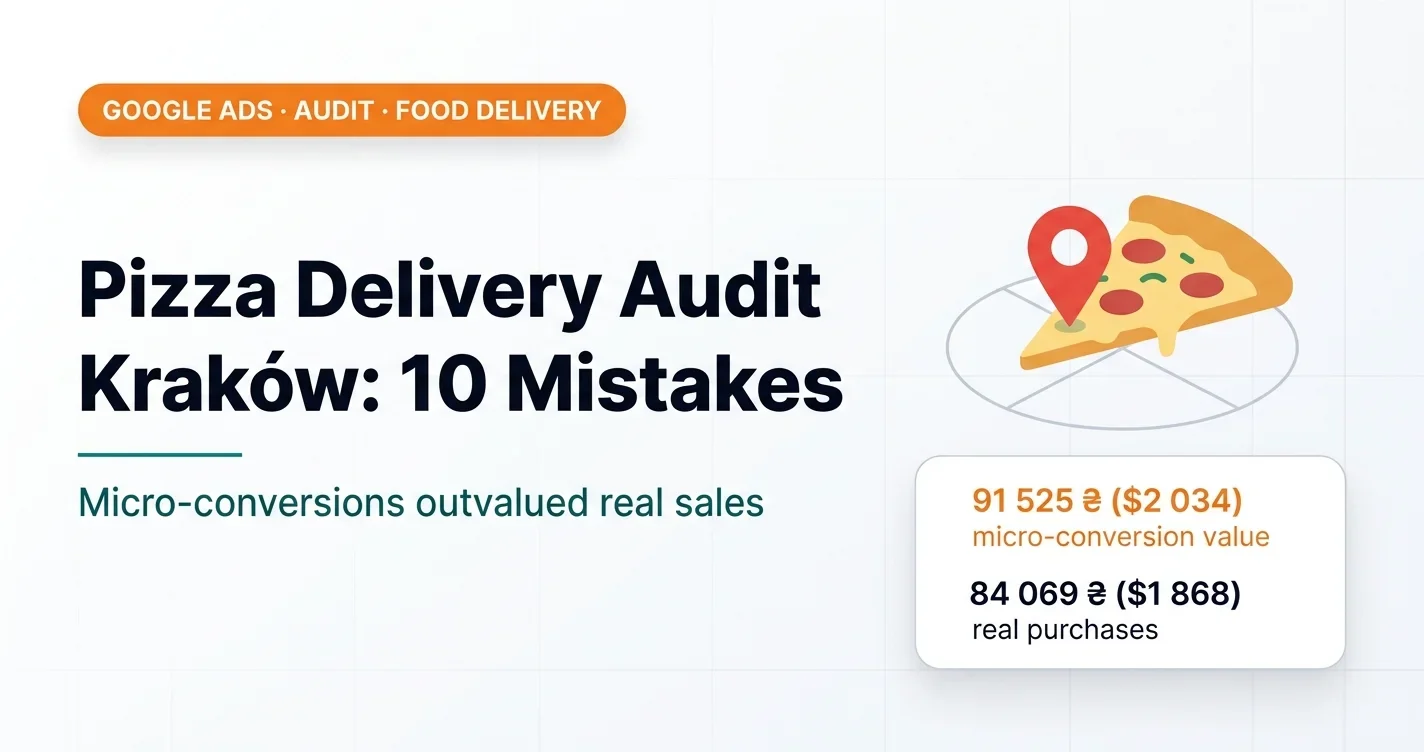
The chart shows a sharp spike: add_payment_info got into conversions together with a value. It looks like someone (possibly a competitor) started placing an order for about 50,000 UAH ($1.1K) and did not finish, and the system counted it as a large conversion. In the pizza campaign, the value of micro-conversions (91,525 UAH, $2,034) is even higher than the value of real purchases (84,069 UAH, $1,868). Spikes like this break algorithm training.
What to do. Keep only purchase (purchase) as the primary conversion. Move micro-conversions to secondary. Do not track phone orders and pickup for now: a CRM + call tracking + Google Ads integration is not justified at this share of orders.
A nuance: the website runs on a platform known for incorrect event tracking. I checked the intermediate events and they work, but the purchase itself needs to be checked separately. A tracking error always hits hardest, because tracking is the foundation of advertising. Without correct tracking, there is no point analyzing the rest. More on this on the conversion tracking setup page.
2. Performance Max only
Performance Max is not a cure-all and not “set it and forget it”. It is one of the tools, and it needs constant work. For food delivery, I combine three campaign types:
| Campaign type | Role |
|---|---|
| Local campaigns | The foundation for this business |
| Search campaigns | Hot search traffic |
| Performance Max | An additional tool, not the basis |
3. Smart campaign
Smart campaigns have effectively not been a relevant tool for 4–5 years, and they cannot be fine-tuned. Here it also used the “Maximize clicks” strategy — not a smart strategy. Over years of tests, smart bidding strategies work better. Recommendation: pause it permanently and replace it with other campaign types.
4. A 10 km radius
For a local business with a limited budget, 10 km is a fundamental mistake. Delivery formally covers the whole 10 km, but in distant zones the minimum order is already from 109 zł, and there are few such orders.
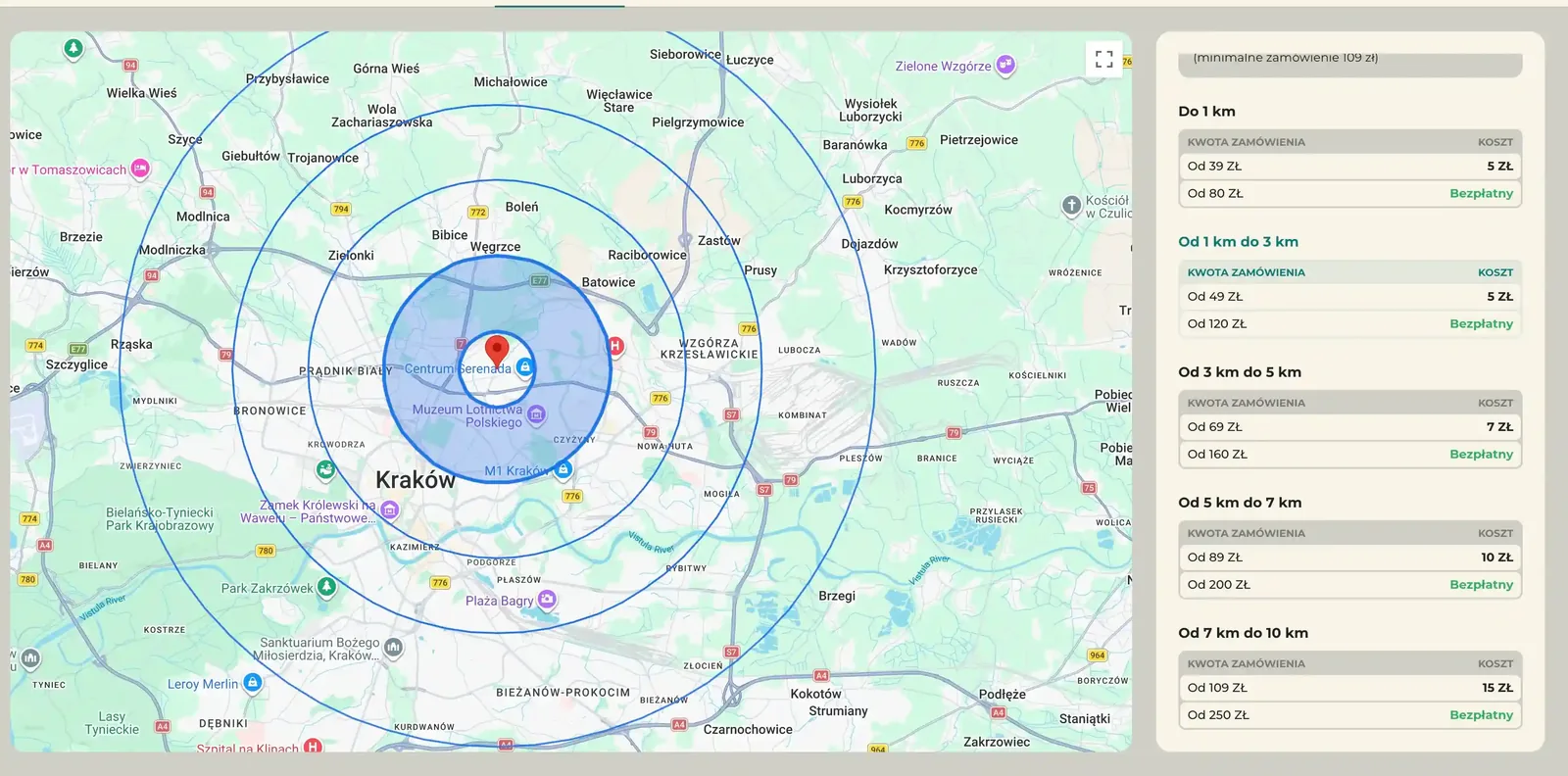
I ran two studies on my own projects:
- I mapped the locations of actually fulfilled orders for a restaurant chain: the closer to the location, the more orders.
- I ran ads in concentric rings and compared acquisition costs: the closer to the restaurant, the cheaper the order and the higher the conversion rate.
Why: in food delivery, three factors decide — awareness, trust and speed. A hungry person does not want to wait. Residents of distant districts often simply do not know about the restaurant, and stronger local players operate there, so advertising is more expensive.
What to do. Limit the radius to about 3 km and work as focused as possible. The same goes for audience targeting: narrow, not broad. Calculate the payback of distant orders separately — the order value is higher there, but these are not mass orders.
5. All search terms in one campaign
Brand queries, generic queries (pizza, pizza near me, delivery), competitor queries and “restaurant”-intent queries are all mixed in one place. Their intent differs, so they need to be separated: brand separately, non-brand separately.
Example — the pizza query: the lowest CTR (3.27%) and a cost per conversion of 416 UAH ($9.2). Not the most expensive, but not cheap either. The query is too broad: a person may be looking for delivery, a recipe, frozen pizza or a cooking class.
6. Competitor queries
I do not recommend them. The acquisition cost for them is always higher than for other queries. It makes sense only when your brand is stronger than the competitor’s and you can convince the person to try you. What to do: add these queries as negative keywords. After that you will see how much money went to competitors and what results it brought.
7. Irrelevant “restaurant” queries
The place is small, with minimal seating for waiting and order pickup. It is not a restaurant in the sense people are searching for. Restaurant-intent queries should be excluded.
8. No brand campaigns and no transparent unit economics
Because the queries are mixed, it is impossible to see the real acquisition cost. A single cost-per-conversion figure for the account says nothing. Spend on brand and non-brand queries needs to be counted separately — only then will it become clear how much a new customer from search ads actually costs and whether the math works.
There is a side effect too. Performance Max sees that brand queries convert well and looks for similar ones. But there is a limited number of such queries — they depend on brand awareness. So the system goes into networks with colder traffic, while you need to work with hot traffic, primarily search.
9. Bidding strategy
Both Performance Max campaigns used “Maximize conversion value”. For food delivery, I recommend “Maximize conversions”. This is not a product business in the classic sense: what matters more is not the size of the first order but the cost of acquiring a customer and the subsequent funnel. ROAS strategies will bring more expensive but most likely one-off orders.

The logic is this: acquire a customer, take them through the funnel and get the most out of the entire lifecycle. One-off purchases in food delivery do not pay off over time.
10. Auto-applied recommendations turned on
Turn them off. It hands control over to the system: add keywords, turn on features, do whatever you want. Google Ads does not work on its own, and simply increasing the budget does not solve the problem.
Bonus: Merchant Center for prepared meals
Google generally prohibits advertising prepared food through Merchant Center. It can be worked around, but a suspension is only a matter of time. And a Merchant Center suspension can lead to a suspension of the ad account with no way out: you would have to create a new account and collect statistics from scratch (how such suspensions work — on the Merchant Center unblocking page).
And the problem here is not the campaign type. If a person does not know the brand and does not trust it, the conversion rate will be equally weak in both Shopping and search campaigns. The foundation is brand, trust and awareness.
Account fix checklist
- only
purchasein primary conversions, removeadd_payment_info(especially with a value); - check that purchase tracking works correctly on the website platform;
- pause the Smart campaign;
- narrow the radius to ~3 km;
- split campaigns: brand / non-brand;
- add competitor and restaurant queries as negatives;
- launch local and search campaigns, keep Performance Max as a supplement;
- switch to the “Maximize conversions” strategy;
- turn off auto-applied recommendations;
- do not use Merchant Center for prepared meals;
- count acquisition cost separately for brand and non-brand.
Strategy beyond the ad account
For food delivery, Google Ads is not self-sufficient. On my projects I use about 10 different sources for acquiring and retaining customers. More on the niche’s nuances in the article on promoting food delivery with Google Ads.
Two tasks of Google Ads
- Acquiring new customers. It will cost more, and that is normal.
- Protecting the brand from being intercepted by competitors.
Beyond that, it is a matter of overall strategy and working with the existing audience. Right now the client has three channels: Google Ads, Meta Ads (roughly purchase-focused, more expensive than Google) and SMS campaigns.
SMS campaigns: what to improve
| Problem | Solution |
|---|---|
| Informational messages “about nothing” | Do not send them: people stop responding |
| Regular SMS | Try RCS: more text, an image, higher conversion, more metrics, including opens |
| Link shorteners with “gibberish” | Remove them, they scare people off. A paid shortener plan with your own domain |
| Unknown what works | Track every campaign, otherwise it is activity for the sake of activity |
| No performance measurement | A separate promo code for every campaign or segment |
| Sending to everyone | Segment the audience |
Sending frequency
First, look at the average order frequency. If a customer orders once every 3–4 weeks, sending weekly is pointless and irritating. A person’s pizza budget (for example, once a month) cannot be increased with messages.
Reactivating “dormant” customers
Single out segments that have not ordered in 60 and 90 days and work with them separately, with separate offers. Bringing a customer back is cheaper than acquiring a new one through search or social ads.
LTV instead of one-off purchases
A delivery business relies on customer lifetime value, not on one-off orders. Calculate how much a customer brings over the whole time they interact with the brand. Pay close attention to those who ordered once and never came back: working with them is much cheaper than acquiring new customers through Google Ads. Google Ads will not fix the lack of a strategy after the first order, so the math should not be calculated based on the ad account alone.
Local awareness
People should know about the pizzeria specifically within the ~3 km radius we focus on first. Awareness, trust and delivery speed determine conversion more than any campaign setting.
Conclusion
There is no “one big mistake” in this account — there is a set of decisions that together keep the ads from working: the system learns from micro-conversions, runs on a 10 km radius, mixes the brand with competitors and “restaurants”, and the owner sees a single cost-per-conversion figure that explains nothing. Fixing the account is the first step. The second is building work with the customer base, because in delivery the money is made on repeat orders.
This is what an independent audit looks like: specific mistakes, screenshots, numbers and an action plan. If you want this kind of review of your account, details are on the Google Ads audit page.
What else an audit finds in contractors’ accounts — duplicate purchases, micro-conversions in bidding and a purchase tracked in the wrong place — I break down using a tea store example in the article on the Dunning–Kruger effect in Google Ads.
Another audit where Performance Max gave more than half the budget to YouTube and purchase value wasn’t passed at all — the sneaker store audit.
Where to find me
Message me on Telegram or by email — I respond quickly. Telegram channel and YouTube are for those who want to see real cases before reaching out and understand my approach.