
Marketer, analyst, ex-CMO focused on the Google ecosystem (Ads, Merchant Center, GA4, GTM). Google Partner. 150+ projects, 100+ positive reviews on Freelancehunt, 12+ countries.
- I work directly, with no account managers or subcontractors
- I measure results in sales, not in-platform conversions
- Maximum expertise in the Google ecosystem — instead of “PPC, social ads and SEO, all in one”
I decided to dilute the B2B cases with a bit of B2C. And I’m leading with my trump card — this is my longest-standing client. We started working together in early January 2021, right after the COVID lockdowns, when the zone restrictions were still in place but there was no longer full isolation. The client is a food delivery chain, or more precisely, a pizza delivery chain.
Contents
Old-timers will remember those days: back then we still used Universal Analytics, not GA4, which is the standard now. We started on Universal Analytics — and this was one of the first projects where I switched to GA4 as soon as it came out. I understood that change was inevitable, Universal Analytics would go away sooner or later, and it was better to learn the new analytics in advance.
Not just search advertising
Here I don’t just do search advertising — it’s more generalist marketing, and I set some things up with my own hands. That goes back to the old days when I did basically everything, before I fully focused on Google Ads.
The company also has a mobile app. I previously published a separate case study on how changes in Google Tag Manager and on the website increased app installs 2.5x.
Why the dashboard only starts in late 2024
A fair question: why has the cooperation been going since 2021, but the ad account only since late 2024? We moved from another ad account for specific reasons: there was no access to the payments profile, and we needed to make changes to it. Who had that access was anyone’s guess.
We made the move gradually, not all at once — it took about 2–3 months. I moved some campaigns to the new account step by step, while others kept running on the old one. Any migration between accounts should be gradual — and this is an example of how to do it without losing ad performance.
I know the niche from the inside
Food delivery and the restaurant business is probably the niche I know best of all the niches I work with. If I could write a dissertation on restaurant or food delivery marketing, I’d do it easily. The reason is simple: for over 7 years I worked in hospitality in C-level roles — Chief Operating Officer and Chief Marketing Officer. I know this niche completely from the inside: how it works, what the math is, what the nuances are. That knowledge lets me build the right marketing for promotion in Google Ads.
The numbers for the period
According to the dashboard screenshot for December 1, 2024 to September 13, 2026, 2,171,657.71 UAH ($48,259) was invested in advertising (invested, not spent — marketing is always an investment). The cost per lead came to 41.26 UAH ($0.92).
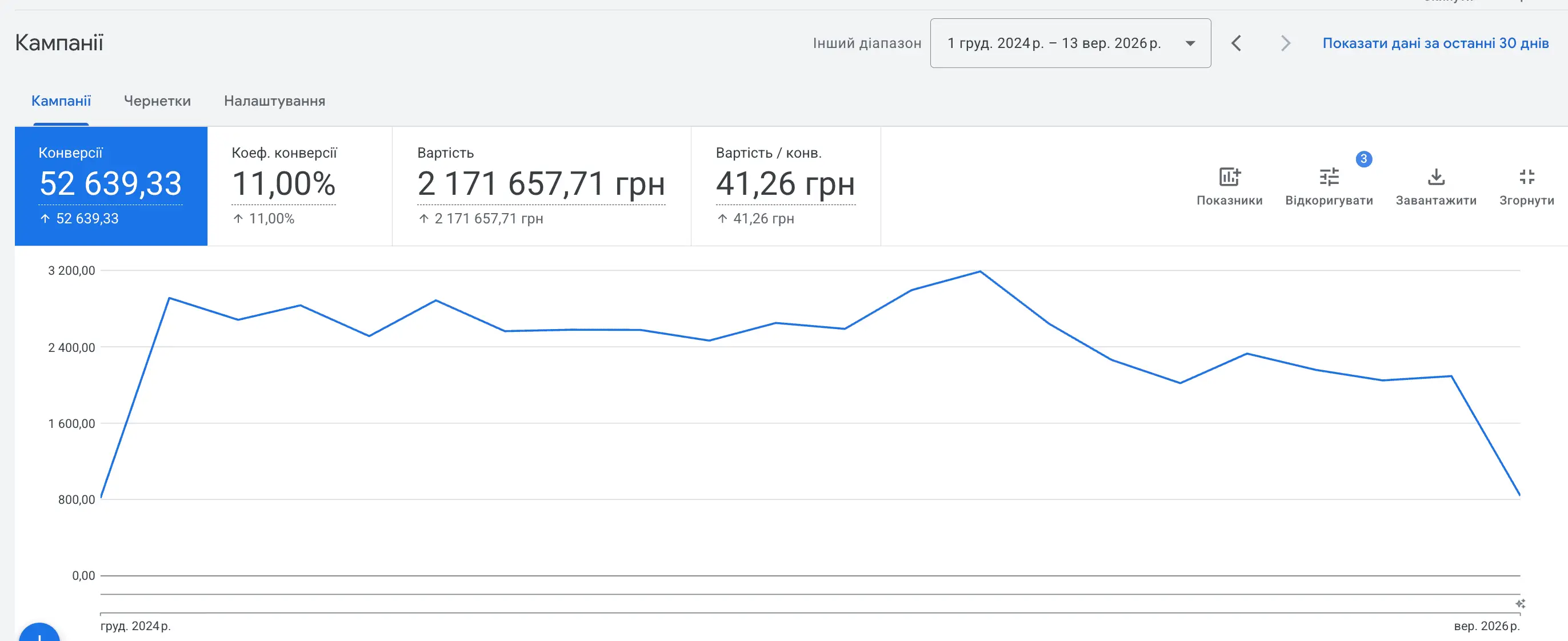
The case looks really great if you present it without any context.
Important: this does not include the campaigns promoting the app — they have different goals and different metrics, and lumping everything together is a bad idea. Conversions here include phone calls, callbacks and direct purchases on the website. In-app purchases are not counted.
Why CPL is not the key metric here
This is one of those businesses where the first purchase is practically never profitable. In food delivery and the restaurant industry, the first delivery almost never fully pays back the advertising. Looking at CPL here, as in the B2B metal processing case I wrote about literally today, is wrong — you need to look at customer Lifetime Value. It’s the only metric that matters in this niche, because competition here is extremely high.
Key takeaway: despite super-good ad numbers, it’s important to look at customer Lifetime Value, not the cost of acquiring any single purchase. This applies beyond this niche, but here it’s critical.
Even though in 2026, as in 2025, a lot of restaurants and delivery services are closing — people’s incomes aren’t growing as fast as prices, plus the domestic situation in the country takes its toll — this niche remains one of the most competitive I’ve ever worked with.
How data gets manipulated in Google Ads case studies
The first screenshot I showed is real data. Nothing is made up. But it’s very easy to tweak with a basic image editor or right in Google Ads itself, by presenting the case without context. That’s already manipulation.
So what exactly is the manipulation here, since the section is called that? These numbers include campaigns together with brand campaigns. Brand campaigns are always cheaper — the cost per click is lower, and the conversion rate on brand queries is extremely high. In this case it ranges from 30 to 40% on the brand campaign alone, at a fairly low cost per click of about 10 UAH ($0.22).
Here’s the trap: if you ask a PPC specialist to put together a media plan, and they show you a case like this and build a forecast on it, you’ll be disappointed in the advertising pretty quickly. Because this case also includes brand campaigns in the math.
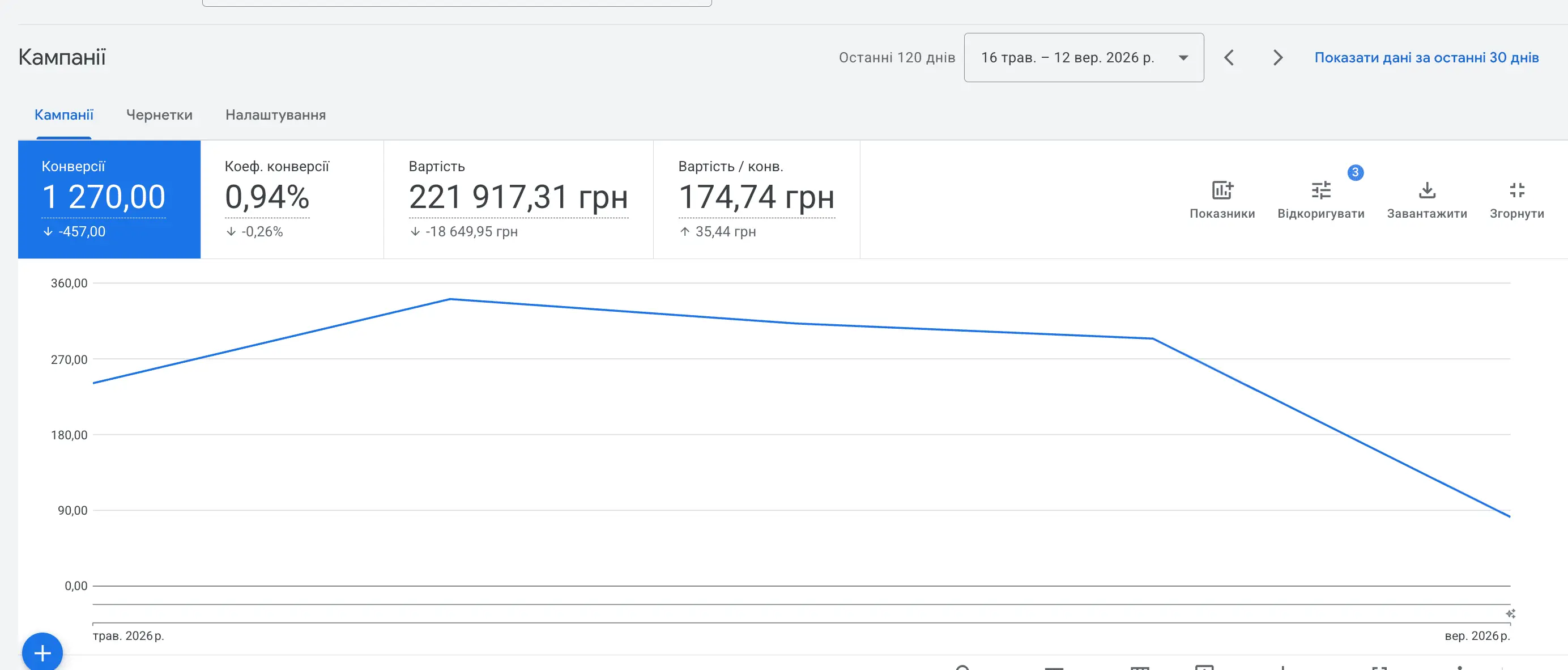
The second screenshot is a cleaner number, excluding brand campaigns. I took a 120-day period because there were changes in the campaigns, and over that window the data is already clean. In this case the cost per lead on non-brand queries is 174 UAH ($3.9). The client’s own brand queries are fully excluded here, and competitor brand queries are mostly not included either.
About targeting competitor brands
A separate point: targeting competitor brands mostly doesn’t work, in this niche or others. There are clear exceptions — especially in food delivery, if you target the main query of a competitor with a weaker brand in the same price category. Then it makes some sense, but the conversion rate is still low and the cost per lead is correspondingly high. When people search for, say, “Domino’s pizza”, they’re looking for Domino’s, not hoping to see you.
If you want them to see you, you have to work across every stage of the funnel to stay top of mind. Search advertising isn’t self-sufficient here; what matters is how you work with other channels. Everything possible is in play here: the app, in-app push notifications, SMS campaigns, SEO, social media, social ads, offline advertising. A full marketing mix — that’s how any normal company that wants to stay on the market for more than 2 years should operate. We’ve been working together for 6 years now, and the company itself has been around even longer.
Even the 174 UAH ($3.9) figure is not something I use as the basis for a forecast when I run numbers for new clients in this niche. Why? Even without direct brand queries, it still reflects some of the brand’s strength. Roughly speaking: a person searches for pizza delivery and sees three offers in the results — they know one company and not the other two. They’re more likely to buy from the one they know. That’s how marketing works. I wrote more about calculating ad performance for food delivery in Google Ads in my article on media planning for sushi delivery.
Summary
The 41.26 UAH ($0.92) cost per lead looks impressive on the cover, but the real value of this case isn’t in that number. It’s in the fact that in 6 years with the same chain, there was never once a need to invent reasons why CPL “isn’t the metric” — because the client understands that they’re not selling a lead, they’re selling repeat orders for years to come.
That’s exactly why an approach that at first glance contradicts performance marketing logic worked here: we don’t chase the cheapest lead, we keep the full marketing loop running — the app, push notifications, SMS, SEO, social media, offline. In such a competitive niche, search advertising on its own solves nothing; it’s just one of the channels that brings a person to a brand they’ve already seen somewhere.
And the main lesson for anyone evaluating other people’s Google Ads case studies before launching their own project: ask what exactly goes into the final number. 41 UAH ($0.91) and 174 UAH ($3.9) come from one and the same ad account; the only difference is whether you remove the brand. A good case without context easily turns into a marketing myth.
Whether to limit ads to delivery hours and how to make that call based on data — I cover it in the article on ad scheduling in Google Ads.
Where to find me
Message me on Telegram or by email — I respond quickly. Telegram channel and YouTube are for those who want to see real cases before reaching out and understand my approach.