
Marketer, analyst, ex-CMO focused on the Google ecosystem (Ads, Merchant Center, GA4, GTM). Google Partner. 150+ projects, 100+ positive reviews on Freelancehunt, 12+ countries.
- I work directly, with no account managers or subcontractors
- I measure results in sales, not in-platform conversions
- Maximum expertise in the Google ecosystem — instead of “PPC, social ads and SEO, all in one”
Almost every audit people bring me starts with a table where CTR is highlighted in yellow, sometimes even crimson. And a note: “low CTR here, needs to go up.” The logic is perfectly clear: people click more often, so the ad is better, so Google will give you a cheaper click. What’s true here and what’s a myth — I break it down in this article.
Contents
The bottom line first: there are so many variables between a high CTR and more sales or profit that using CTR as your main metric makes very little sense. And that’s putting it mildly. I haven’t analyzed this metric as a KPI for many years.
This is what my regular working dashboard looks like — business metrics only.
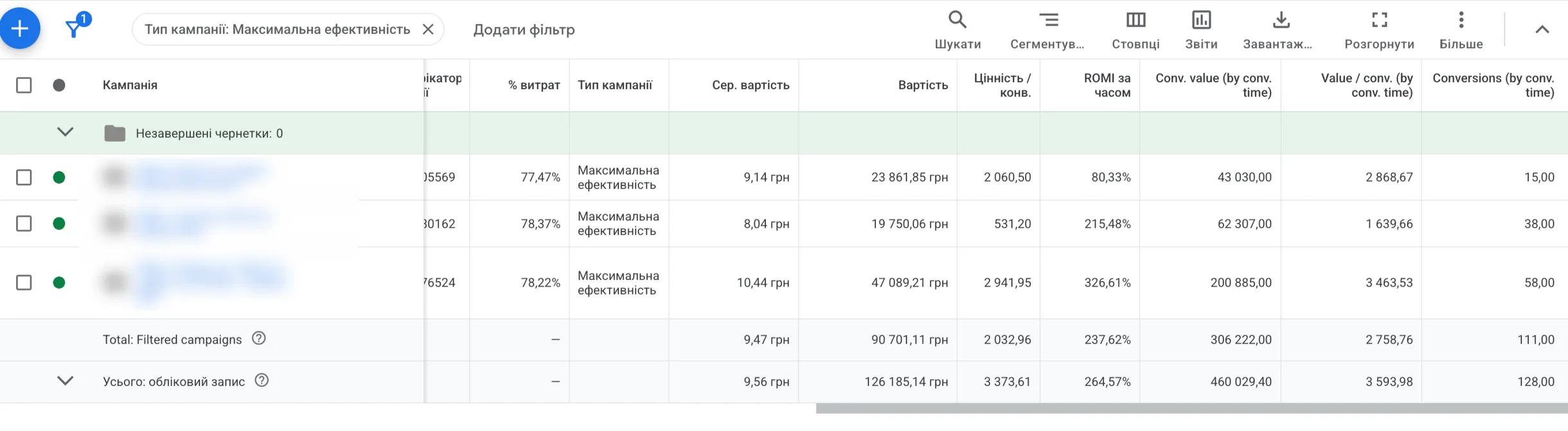
There’s a belief that the higher the CTR, the lower the cost per click. I looked for research on this, but found nothing after 2020. The myth is everywhere, but there’s no outside confirmation. I went through all my accounts to see if I’d spot some insight on CTR. Nothing either, because it’s an ad account metric, not a real business metric.
What CTR is and why people love it so much
CTR (click-through rate) shows what share of people who saw your ad clicked on it. A thousand impressions and 50 clicks give a CTR of 5%.
Where the love comes from, I can tell you right away: from Meta ads. There, young Meta Ads wizards somehow magically determine before launch how well an ad will “land.” In other words, they find a correlation between CTR, meaning how attractive the creative is, and the result. As a reminder, I recently ran a study that included Meta Ads: every metric there looks great except the main one — cost per sale and conversion into a real deal. Probably that’s exactly the consequence of analyzing CTR instead of sales.
And people love CTR for its simplicity. I’d call it a pseudo-metric, because we’re talking about performance marketing, not ad clickability. It calculates itself, no conversion setup through “scary” GTM required. You add something to an ad and you already see some change.
But CTR measures interest in the ad, not in buying. That’s the key thing to lock in your head.
Why CTR on its own tells a business nothing
A click ≠ money
CTR is the ratio of clicks to impressions. And clicks don’t equal money. Take two ads with 1,000 impressions each:
| Ad A | Ad B | |
|---|---|---|
| CTR | 8% | 4% |
| Clicks | 80 | 40 |
| Cost per click | UAH 8 ($0.18) | UAH 10 ($0.22) |
| Spend | UAH 640 ($14) | UAH 400 ($9) |
| Site conversion rate | 1% | 3% |
| Orders | 0,8 | 1,2 |
| Cost per order | UAH 800 ($18) | UAH 333 ($7.40) |
Ad A has twice the CTR and a cheaper click. And yet its order costs 2.4 times more. If I optimized for CTR, I would switch off the best ad in the account.
Clickbait works in Google Ads too
The easiest way to raise CTR is to promise more than you can deliver. For example, you write “free consultation” when there isn’t one. CTR goes up, and most likely so do conversions. But bounces grow with them, and conversion into real deals drops.
I do the opposite. I often deliberately put the price, minimum order or other markers in the ad to filter out a certain audience. CTR drops, but it cuts off traffic that wouldn’t buy anyway — and that you’d still be charged for.
Smart Bidding doesn’t think about clicks
For some reason this gets ignored. With Maximize conversions, Target CPA, Target ROAS or Maximize conversion value, the algorithm looks for auctions where a conversion is more likely, not a click. That may mean a less visible position or queries with lower CTR but stronger intent. Campaign or account CTR may drop as a result, and that’s normal.
Brand and different campaign types break the averages
CTR has to be analyzed separately for each campaign type. Brand campaigns get a CTR of 20–40% because the person is searching for you specifically. Comparing them with the Display Network, YouTube or even Shopping is like comparing apples and twenty-four.
 Google Ads · MarketingGoogle Ads Competitor Analysis: a Service With Zero Practical Value95% of Google Ads “competitor analysis” is a look at someone else’s storefront with no performance numbers. Here’s where it actually makes sense.
Does CTR affect cost per click after all?
As of 2026, I haven’t found a single study that clearly shows a direct effect of CTR on cost per click. Most likely it exists, but it isn’t as straightforward or as strong as people think. If the market’s average cost per click is UAH 100 ($2.20), improving CTR won’t get you even to UAH 90 ($2).
You can run your own study, but with 99% probability it will fail. Without accounting for other metrics and without knowing how Google’s algorithms work inside, you won’t have a study — just a dataset with no confirmation.
How it works in Google
Ad Rank includes the bid and quality. One of the three components of Quality Score is expected CTR. In effect, you pay the minimum needed to hold your position against the competitor below you. So at the same position, a higher expected CTR gives a cheaper click. That’s the real mechanism.
Low Quality Score for Keywords in Google Ads: a Death Sentence or Business as Usual?

But back to what I said above: as CTR grows, so can the share of irrelevant traffic, bounces and junk leads. Decide what matters more to you — a higher CTR or the real cost of a deal.
What research shows
The most cited academic paper on this topic dates back to 2009: Ghose & Yang, Management Science. Over six months, the authors analyzed several hundred keywords of a large US retailer on Google and modeled the relationships between CTR, conversion rate, cost per click and position.
The first thing to understand: that was 2009, and it’s 2026 now. What worked then doesn’t necessarily work today. But a few conclusions still hold.
- When ranking ads, Google takes into account both the bid and past CTR, but the bid carries more weight. How much more, nobody knows: this data is locked down tight so no one can manipulate it.
- Expected CTR is also affected by landing page quality, which people often forget. In the study, a one-unit improvement in landing page quality was associated with up to a 22.5% increase in conversion rate and a lower cost per click. In other words, website fixes make more sense than ad tweaks.
- The top positions with the highest CTR aren’t necessarily the most profitable. Profit is often higher in middle positions, most likely because the click is cheaper there.
There are other studies of ad position too, including a field experiment. They show that the first position has both higher CTR and higher cost per click. That’s perfectly logical: you’re seen first, and you pay more for it. As the position drops, both metrics fall, while conversion rate doesn’t depend significantly on position.
Frankly, that’s the whole point, which could have been written in the article’s first sentence and left at that. But then nobody would read it.
The paradox that breaks analytics reports
Hence the main catch. If you export a report, say, by keyword and build a correlation between CTR and cost per click, you often get a positive relationship: higher CTR, more expensive click. Not because CTR makes the click more expensive, but because position raises both metrics at once.
If you compare at the same position, the picture flips: higher CTR, cheaper click. Without this filter, conclusions from reports will be exactly the opposite of reality.
And once again: I haven’t found any fresh public research on the link between CTR and cost per click specifically under Smart Bidding and Performance Max, where we mostly work.
When CTR is actually worth analyzing
CTR is a good diagnostic metric if you look at it in a narrow segment. Let me repeat: it’s not a business metric.
A query or product mismatch
You export a product or a specific search query and see that its CTR is lower than similar items. You need to figure out why. If it’s a product, maybe your price is simply higher than competitors’, or the image is worse.
Ad tests and combinatorics
You can make changes through Experiments in Google Ads: one group, the same targeting, the same period. But even then you may not get real data out of it.
If you fill in all 15 headlines and 4 descriptions, the experiment is no longer isolated. There’s a science called combinatorics: with 15 headlines and 4 descriptions, Google can generate 47,280 ad variants. That’s given that one to three headlines and one to two descriptions are shown, and the order of elements matters. What you write in the ad doesn’t mean Google will show exactly that. It will show what it sees fit.
You can reduce the number, say to three headlines and two descriptions. But then you run into your own logic: Google will show the ad strength as “Poor,” and you’ll be running around looking for a fix.
Shopping and Performance Max
A product’s CTR can show how your price, photo or product rating, if you have one, look next to competitors in the results. A sharp drop may signal that someone cut prices on a product group or individual items. With AI, this can now be analyzed much faster.
But again, that’s diagnostics. And analyzing the product range in terms of price competitiveness isn’t a core task for a Google Ads specialist. It’s the responsibility of the business and its marketing, because marketing is what sets the company’s pricing policy.
Anomalies
If CTR suddenly drops or, worse, spikes, it may signal that someone is clicking your ads. I’ve seen this many times, especially on logistics projects: competitors target certain query groups and click through the ads. Then you see a CTR of 120%. Obviously that’s an impossible metric. If the campaign’s average CTR is 10%, even 15% should make you check everything.
How I look at CTR in reports
- I never look at the average CTR for an account or campaign.
- I separate brand campaigns from non-brand ones.
- If I do analyze CTR, I compare only within one campaign type and at a similar top-of-page impression share.
- I analyze CTR only together with conversion rate and cost per order or ROAS. I never make decisions based on CTR alone.
- For Quality Score, I look at expected CTR as a separate component, not at raw CTR.
Conclusion
CTR affects a business very indirectly: through Quality Score it can make a click cheaper. But a cheap click without a conversion is just cheaper spending. So CTR is a diagnostic tool, not a KPI, and not the metric to build your analytics on.
Start your analysis with the top metrics: sales, margin, conversion to sale, conversion from a website purchase to a confirmed order. And somewhere around the 25th–30th iteration you can glance at CTR. Because CTR is micromanagement, which in my case isn’t worth any attention at all.
06 — AnalyticsEnd-to-end analyticsAll inquiry sources and CRM sales in one picture: you see which channel actually brings money.So what should you count instead of CTR — in the article what a conversion in Google Ads is, in plain words.
Where to find me
Message me on Telegram or by email — I respond quickly. Telegram channel and YouTube are for those who want to see real cases before reaching out and understand my approach.