
Marketer, analyst, ex-CMO focused on the Google ecosystem (Ads, Merchant Center, GA4, GTM). Google Partner. 150+ projects, 100+ positive reviews on Freelancehunt, 12+ countries.
- I work directly, with no account managers or subcontractors
- I measure results in sales, not in-platform conversions
- Maximum expertise in the Google ecosystem — instead of “PPC, social ads and SEO, all in one”
I went through the account. Honestly, there isn’t much to look at: just one campaign, no structure, no way to manage it flexibly, and no room to scale it in its current form.
Contents

I split the audit into two parts. The first covers the product side and overall strategy. The second covers the ad account itself: how to improve current results, how to scale, and how to try to boost payback.
Let me say upfront what I’ve said before: there are no magic buttons. You don’t click something and watch results jump by a hundred, two hundred or a thousand percent. It’s systematic work: testing hypotheses and staying consistent.
Strategy: the sales structure
I’ve worked with a similar niche before, parts for home appliances. I see the same pain points here.
Data for analysis: 287 transactions over 28 days via checkout and cart (phone orders aren’t included; that data simply doesn’t exist, and I don’t want to guess). That’s enough volume for statistically meaningful conclusions.
The first logical observation: everything is bought one piece at a time. People buy a part because something broke and needs replacing. Nobody stocks up, and multiple things rarely break at once. So one item per order is normal for this niche, and it’s unlikely to change much without upsells (adding something extra to the main purchase).
The main problem: low average order value
The core problem is low average order value. On a product under 100 UAH ($2.2), even with a 10x markup, ads still don’t bring a profit: you have to pay for the ads, the packaging and the time to process the order. These products most likely bring in nothing at all. It’s work for the sake of work.
287 transactions broken down into price clusters:
| Price cluster | Transactions | % of transactions | Revenue, UAH | % of revenue |
|---|---|---|---|---|
| Under 100 UAH ($2.2) | 16 | 5,57% | 1 022 | 0,55% |
| 101–299 UAH ($2.2–6.6) | 61 | 21,25% | 13 535 | 7,27% |
| 300–499 UAH ($6.7–11) | 76 | 26,48% | 29 365 | 15,77% |
| 500–999 UAH ($11–22) | 89 | 31,01% | 59 838 | 32,13% |
| Over 999 UAH ($22) | 45 | 15,68% | 82 454 | 44,28% |
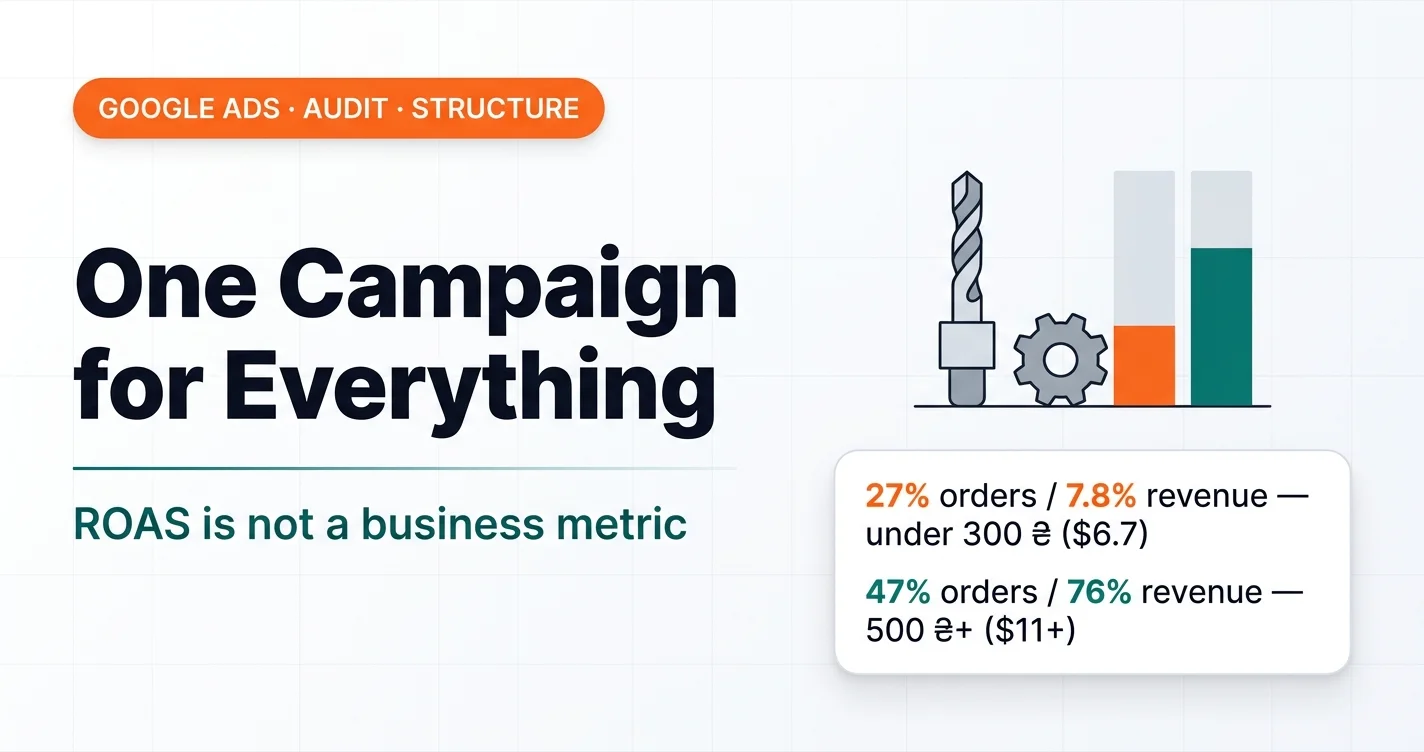
The first two clusters (up to 299 UAH, $6.6) account for 77 transactions, almost 27% of all sales, yet together they bring in only 7.82% of revenue. With an average cost per conversion of around 70–80 UAH ($1.6–1.8), selling something for 100–299 UAH ($2.2–6.6) and staying profitable after ads and operating costs is practically impossible.
And the other way around: the over-999 UAH ($22) cluster is only 15.68% of transactions but 44.28% of total revenue. Together with the 500–999 UAH ($11–22) cluster (31.01% of transactions), these two segments deliver over 76% of the store’s revenue.
Key point. ROAS isn’t a business metric. Even if ROAS in the cheap price cluster shows 1200%, that doesn’t mean profit: on a small order you may still be earning pennies or losing money. More on the difference between ROAS and real profitability in the article High ROAS, but no money?
Why a single campaign is a problem
When all products are lumped into one campaign, you’re not really managing it. If at some point you want a separate setup for a specific segment, this structure simply won’t allow it. The campaign just “sort of works”, and that’s it.
With the current structure you can scale a bit more, roughly 20–30%, but no further. Beyond that you need to look at the bigger picture, not just the ad account.
The solution is to split 100% of products into separate campaigns by price and margin clusters. A few campaigns (2, 3, 5, 10, without going overboard), where products within one campaign are roughly similar in margin and price range. That gives you flexible control going forward: the cheap segment doesn’t need the same ROAS as the expensive one. There you can deliberately run a lower ROAS and still turn a profit thanks to a lower cost per order.
The technical part: the ad account
This is tactics, not strategy. You should start with the strategic part above; technical fixes will only bring partial improvement.
Signals in Performance Max
Right now there’s one asset group with signals (purchasers, visitors, etc.). The strongest signal for Google is purchasers, people who have already completed a transaction. I wouldn’t touch this campaign so as not to break it.
What’s worth doing: create a new product feed with changed modifiers (this makes Google treat the products as new) and launch a parallel structure. In the new structure, test an asset group with no signals at all. With large data volumes, campaigns without signals sometimes perform better. It’s even an official recommendation from Google support for testing.
Audiences
Different audience segments deliver different payback and cost per order. The 65+ segment stands out with the lowest payback of all age groups. Maybe this audience simply calls more instead of buying online, and calls aren’t visible in this data. If there are no calls and payback is objectively the lowest, the segment should be excluded and the budget shifted to audiences that convert better.
Geo
The site’s average conversion rate is 2.77%. Once a specific location has 100 clicks, you can already draw conclusions: if there are few or no sales there, you can turn that geo off.
| City | Result |
|---|---|
| Sumy | ROAS well below target, ads don’t pay off |
| Mykolaiv | ROAS well below target, ads don’t pay off |
| Odesa | ROAS ~700% vs a 1000–1200% target, almost half as low |
| Zhytomyr | Weak performance, candidate for exclusion |
Zhytomyr and a number of other cities show weak results and are also candidates for exclusion.
Traffic quality
Negative keywords aren’t being worked on in the account at all, and that’s likely one of the reasons for the weak geos and audiences. Clean traffic is the foundation of quality leads, and it needs constant attention: review search terms weekly and cut out the irrelevant ones.
Manual bidding as a parallel test
Ad payback depends on the number of orders, average order value, site conversion rate and cost per order. Without changes to the site it’s hard to move the conversion rate, but you can influence the final cost per order by lowering the cost per click.
Example: if the average CPC is now around 59 UAH ($1.3), you can launch a parallel Shopping campaign with a manual bid cap (say, 1 UAH, $0.02) and test at what levels the ads start showing and delivering results. It won’t give you gross order volume, but as a low-bid strategy it lowers customer acquisition cost and improves payback.
Key point. In a niche with a relatively modest average order value, testing manual bidding isn’t optional, it’s a necessity. You simply won’t get there without it.
On “just raising ROAS”
A tempting but risky idea: if ROAS is 1073% now, just raise the target to 1200% and see what happens. In practice, Maximize conversion value often works better than a ROAS strategy. Use Target ROAS as a constraint, when you need to lock in a floor for ad payback, not as a way to “order” the system to earn more.
A safer option is to launch a parallel copy of the current campaign with its own budget and a ROAS target of, say, 1200%. If it performs well, scale it and gradually shift budget over. There’s no perfect solution that works 100% of the time here: you have to test combinations of strategies, price segments, audiences and geos and find what actually works.
On traffic quality overall
The traffic here is good: the vast majority comes from the Search Network (search partners are a small share). There are no traffic problems; everything else is a matter of testing.
Summary
You can’t just click two or three buttons and get the results you want. The place to start isn’t small technical tweaks in the account but the structure: splitting products into clusters by price and margin, separate campaigns for each segment, and only after that working on signals, audiences, geos and negative keywords. I described a similar approach, a deep audit before any technical fixes, in the VR club audit case study.
To clean up search terms faster, I built a free extension for adding negative keywords in bulk. More about it in “Two Free Chrome Extensions for Google Ads”.
Where to find me
Message me on Telegram or by email — I respond quickly. Telegram channel and YouTube are for those who want to see real cases before reaching out and understand my approach.