
Marketer, analyst, ex-CMO focused on the Google ecosystem (Ads, Merchant Center, GA4, GTM). Google Partner. 150+ projects, 100+ positive reviews on Freelancehunt, 12+ countries.
- I work directly, with no account managers or subcontractors
- I measure results in sales, not in-platform conversions
- Maximum expertise in the Google ecosystem — instead of “PPC, social ads and SEO, all in one”
People usually answer this question depending on what they do. A social ads specialist will say “Meta”, an SEO specialist — “SEO”. From me, as a Google Ads specialist, you would expect “Google”.
But in this article three personas live in me: a Google Ads specialist, a marketer and an analyst. And I look at all the key metrics of a project where many channels work together: 9,171 leads and 425 deals from February to September 2026. At the end there will be an answer to which one is better. Or maybe there won’t.
Contents
Still Judging Results Only Inside Google Ads? That’s Why Things Look Bad

The wrong question
When people ask “which is better”, they want the simplest possible answer: here is one channel, it will cover everything. But a question like that already throws away the whole point of omnichannel marketing.
As a marketer, I’ll say this: the more channels you use, the better, because each next one reinforces the previous. So I would ask differently: which channels to start with and in what order at your particular stage. A company that has been building its brand for years and a company that is just entering the market work with different sets of channels.
How the channels differ at their core
Google Ads captures existing demand. I’m talking about Search and Shopping: a person types a query and gets an answer. Google Ads also has reach campaigns, but here we’re talking about hot demand.
SEO captures the same demand, only much more slowly. SEO specialists like to say that SEO is free and forever. As a marketer, I disagree.
Free — no. You still pay for technical site improvements, link building and content. Forever — no as well. Look at what happens to organic traffic after another Google ranking algorithm update. It doesn’t dip, it simply collapses.
In this project’s organic channel, besides Google search, there is a YouTube channel and an Instagram profile. Ideally they should be separated, but they have little effect on the overall result.
Meta and TikTok I put into one type — social networks. The ad interrupts a person in their feed while they watch memes or short videos. These channels create demand and recognition, although you can generate direct leads there too.
Direct. For some reason many people think direct means a person typed your domain themselves. No. Direct is any visit whose source the system could not identify. I wrote about where it comes from in the article about ad blockers.
| Channel | What it does with demand | Funnel stage |
|---|---|---|
| Google Ads (Search, Shopping) | captures existing | bottom |
| SEO | captures existing, slowly | bottom |
| Meta, TikTok | create demand and recognition | middle |
Although, as you’ll see below, Meta and TikTok also bring people who buy. So they work at the bottom of the funnel too.
First dashboard: leads, quality and deals
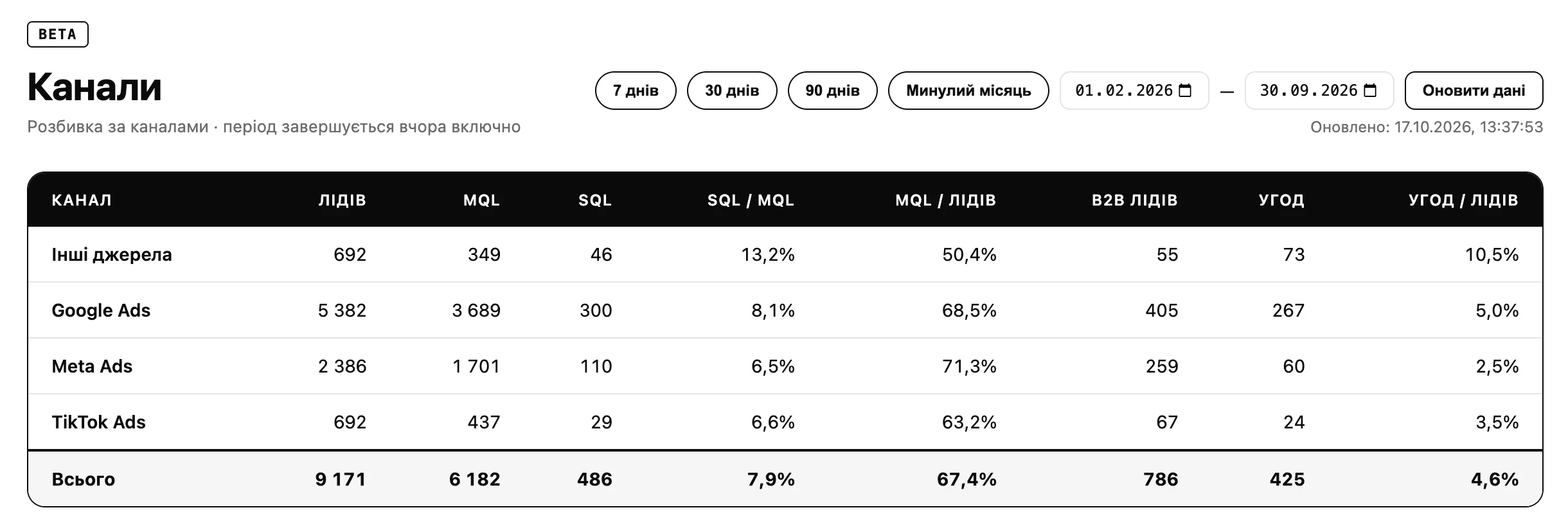
The key metric I will use to evaluate the channels isn’t here yet. Let me keep the suspense a little longer.
How to read the table:
- MQL (marketing qualified lead) — leads that passed qualification, i.e. quality leads.
- SQL (sales qualified lead) — leads the sales team considered ready for a deal.
- Other sources — everything except paid channels: organic, YouTube, Instagram, direct.
Paradox one: quality. Meta has the most qualified leads — 71.3%. Other sources have the fewest — 50.4%. Google organic search on its own — just 44.6%.
Paradox two: B2B. In absolute numbers, Google Ads brings more B2B leads — 405. But its budget is several times larger too. By the share of B2B among the channel’s leads, Meta is ahead of Google: 10.9% vs 7.5%.
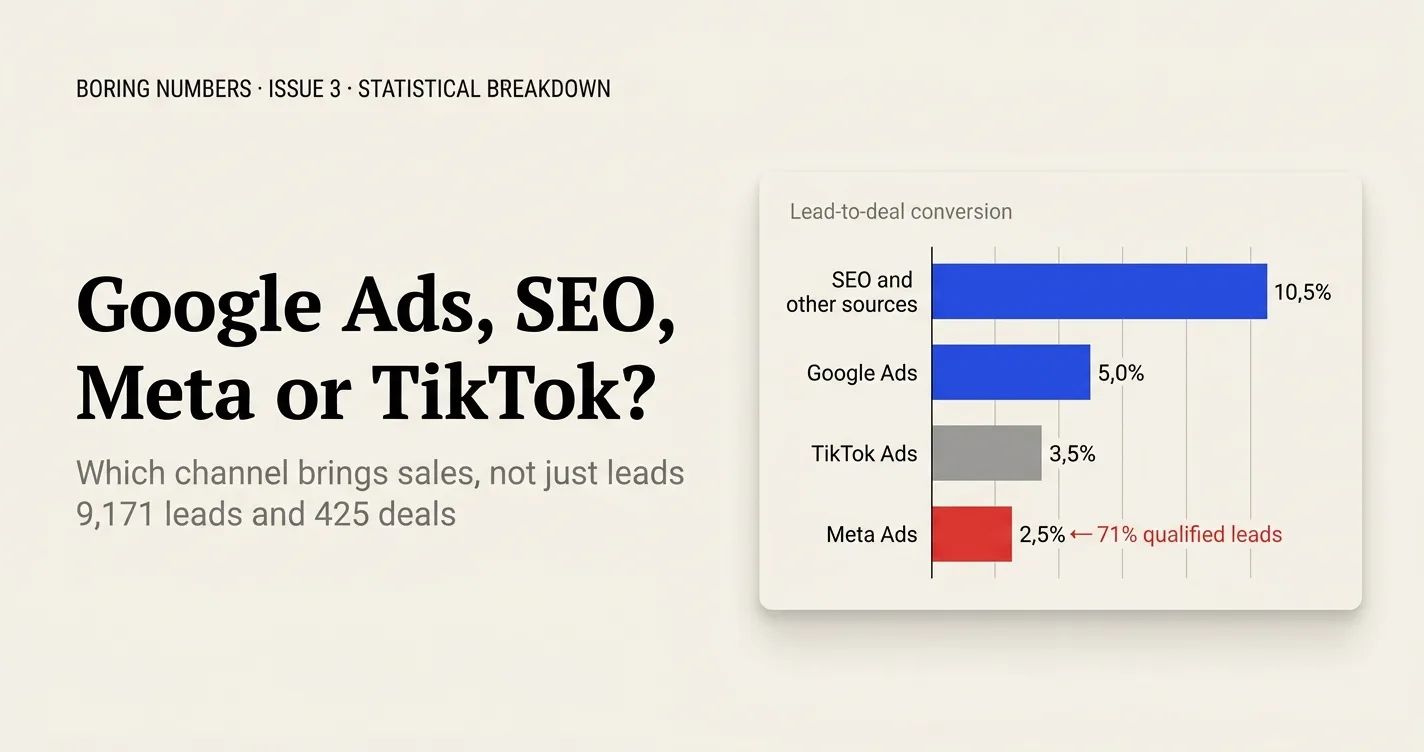
Paradox three: deals. This is where it gets much more interesting. The deals-to-leads rate is calculated the same way for all channels, so it’s the one you can compare fairly.
| Channel | Deals | Deals / leads |
|---|---|---|
| Other sources | 73 | 10,5% |
| Google Ads | 267 | 5,0% |
| TikTok Ads | 24 | 3,5% |
| Meta Ads | 60 | 2,5% |
Other sources have the worst lead quality and the best conversion to deals. Meta is the opposite: the most qualified leads, the largest share of B2B and the worst conversion to deals. Even TikTok converts better.
Within organic, YouTube converts best: 41 leads, 6 deals, 14.6%.
The logical business reaction is to shift budget to where the channel converts into deals better. But look at the volumes. Other sources brought 692 leads, Google Ads — 5,382. Yes, organic converts great, it just brings very few leads. This project can’t be carried by organic alone. Nor can any other.
Second dashboard: B2B and cost per deal
B2B is a separate line of business with a completely different average order value. And now the key metric itself: how much one closed deal costs.
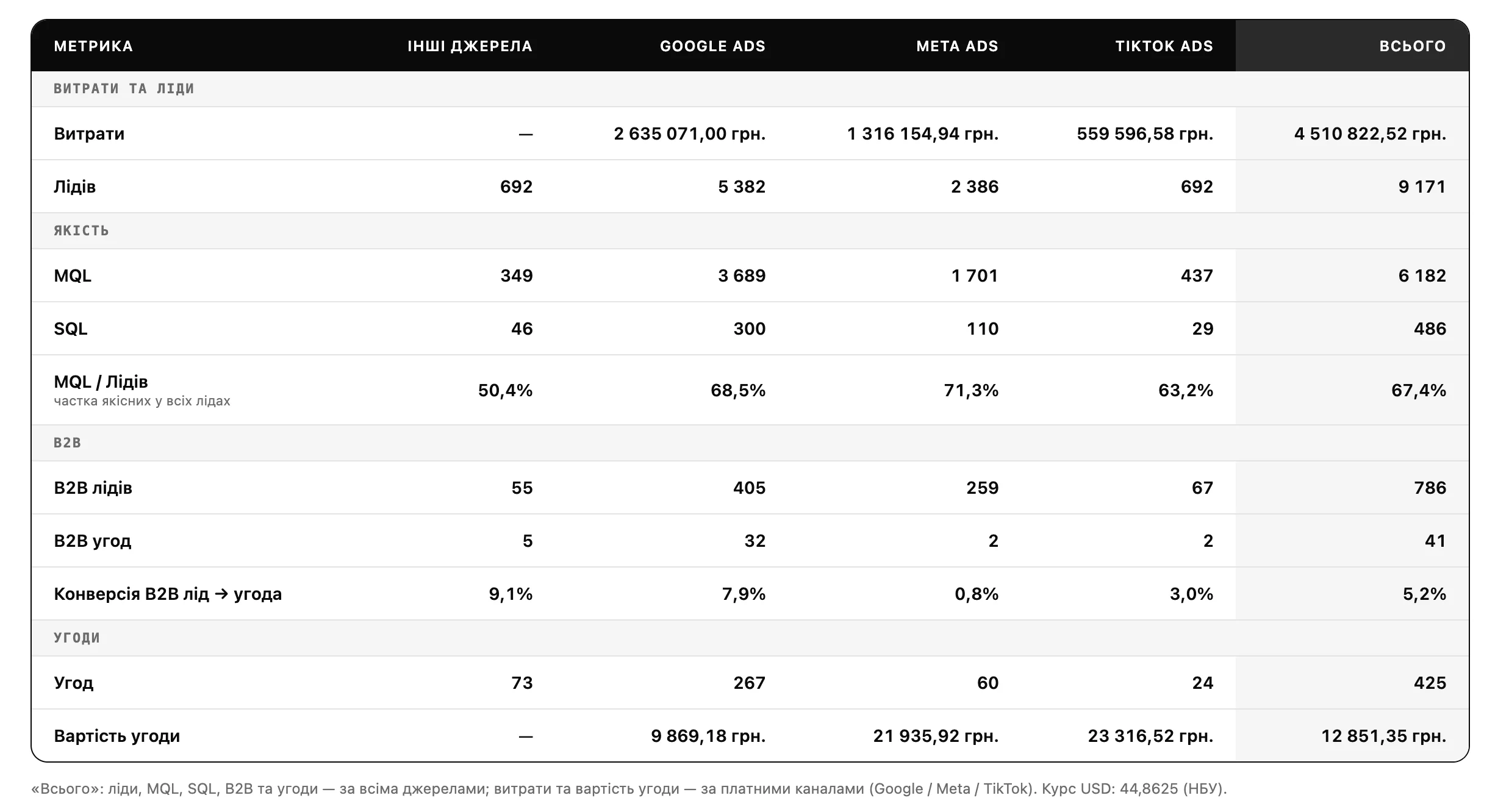
B2B first:
- Meta Ads — 259 B2B leads, of which only 2 converted into a deal, i.e. 0.8%.
- Google Ads — 405 B2B leads, 32 deals, 7.9% conversion.
- TikTok Ads — 67 B2B leads, 2 deals, 3.0% conversion.
- Other sources — 55 B2B leads, 5 deals. A 9.1% conversion — higher than paid Google.
Now the cost per deal. Important: this is not the price of a B2B deal. It is all of the channel’s spend divided by all of its deals — B2B and the rest.
| Channel | Spend | All deals | Cost per deal |
|---|---|---|---|
| Google Ads | UAH 2,635,071 ($58,557) | 267 | UAH 9,869 ($219) |
| Meta Ads | UAH 1,316,155 ($29,248) | 60 | UAH 21,936 ($487) |
| TikTok Ads | UAH 559,597 ($12,435) | 24 | UAH 23,317 ($518) |
| All paid | UAH 4,510,823 ($100,241) | 351 | UAH 12,851 ($286) |
Whether that’s a lot or a little depends on the order value. For one business, UAH 21,936 ($487) per deal is very expensive. For another, it’s a normal figure you can work with at a substantial profit.
What the analyst says and what the marketer says
An analyst without an understanding of marketing will draw a logical conclusion. Increase Google Ads: B2B conversion is the highest here and deals are the cheapest. Cut Meta and TikTok: they convert poorly and deals are expensive. Strengthen organic.
Seems simple. But no.
Now the marketer with an understanding of analytics speaks. Google Ads converts better — that’s the nature of the tool. Not because I’m a super specialist here and the Meta or TikTok specialists are worse. These are different tools, and for a company at a stage of rapid growth you can’t compare them directly.
But the data does make one thing clear: if the budget is limited and you need results fast, it’s better to start with Google Ads. Next, I would invest in SEO and YouTube — conversion there is high, and these channels need developing. Then Meta and TikTok, roughly 50/50 depending on the task.
If you stop at Google Ads alone while your competitors don’t, I have bad news for you. They have more channels, so their marketing will work harder. On hot demand without trust and recognition, you’ll quickly become yet another “shop called Shop” or “barbershop called Barbershop” and watch your results stagnate.
Conclusions
- Evaluate a channel by deals and cost per sale, not by leads. Leads only tell you that they exist. To see deals by channel, you need end-to-end analytics.
- Lead quality is a good but intermediate metric. Meta proved it. The main metric is the sale, and if a channel converts poorly, think about where to reallocate the money.
- Organic, YouTube and Instagram bring the warmest clients, but few of them and slowly. Without constant work they don’t grow.
So which is better: Google Ads, SEO, Meta or TikTok? There is no best channel. There is the company’s stage of development, the task and the budget — and a set of tools to match them.
06 — AnalyticsEnd-to-end analyticsAll inquiry sources and CRM sales in one picture: you see which channel actually brings money.Another channel that launched in Ukraine on October 21 — see the ChatGPT Ads Manager walkthrough.
Where to find me
Message me on Telegram or by email — I respond quickly. Telegram channel and YouTube are for those who want to see real cases before reaching out and understand my approach.