
Marketer, analyst, ex-CMO focused on the Google ecosystem (Ads, Merchant Center, GA4, GTM). Google Partner. 150+ projects, 100+ positive reviews on Freelancehunt, 12+ countries.
- I work directly, with no account managers or subcontractors
- I measure results in sales, not in-platform conversions
- Maximum expertise in the Google ecosystem — instead of “PPC, social ads and SEO, all in one”
For me it's a real red flag when a client, early in our conversations, announces they want to be number one. Show up as high as possible, in the first position, at the very top. And from my own experience, the people who say this most often are the ones working with small budgets.
Contents
Then you start explaining to them: people don't buy from whoever is first, they buy from whoever has the better offer for each individual user. A person types a query into search and then looks at the offers. Showing up higher — apart from a few exceptions, which we'll get to — doesn't change anything.
The bazaar: the best analogy
Think of an open-air market: stalls standing side by side, starting from the entrance, all selling the same product. When someone walks into the market, there are two behavior patterns.
The first: they need to buy something urgently. Then they won't walk the whole market comparing offers. They'll buy from the first stall.
Key point: the only real reason to be number one is if you're in an urgent niche.
Which niches are we talking about? Towing, emergency lockouts — apartments or cars, anything related to emergency hospitalization. Anything needed right here, right now. Emergency plumber, emergency electrician. When something has already happened, a person won't spend long choosing — which is why conversion there is always much higher than in an average project.
I had a project in Melbourne, Australia — emergency car lockout service. Someone walks up to their car, can't get in, and they need to get to work, pick their kid up from daycare, or squeeze in a quick visit to a lover while the wife is at the store. They don't pick the best offer — they pick the first one they see. There's no time to think.
The real lead conversion rate was 25–30%. And even then, not everyone converted — 70–75% still went off to look for an alternative. But 25% is a very high conversion rate.
Niches like this are mostly very expensive. Google understands perfectly well how urgent the niche is, understands the competition, and even understands how much you actually make on it.
Now the question: what if your niche isn't urgent
And that's almost every niche except the urgent ones. Decisions there aren't made in one click. One-click decisions only happen in urgent niches. In any other niche, you need several touchpoints with the user across different channels. Google cites 5–7 — and that's roughly how it is for average projects. Sometimes fewer touchpoints, sometimes more. By the way, Google Analytics has a “Path to purchase” report — you can see how many times a person interacts with your ads or other channels before buying.
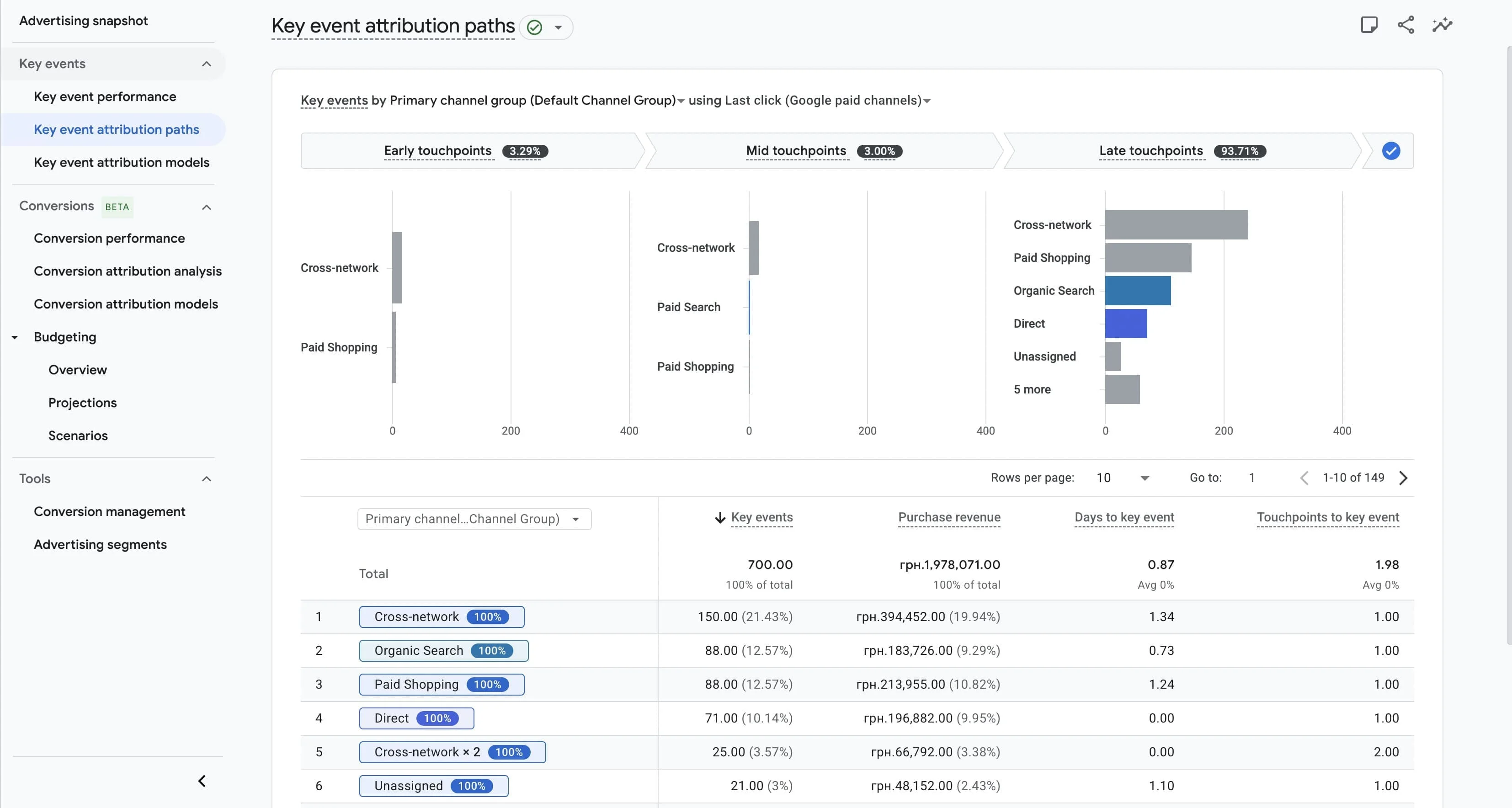
The same thing happens in Google Ads as at the bazaar back in the day — anyone who grew up in the '90s remembers how people shopped there: walking past dozens, even hundreds of stalls, stopping at one, a second, a third, trying things on, comparing, and only then deciding. Nobody buys from you right away. If it were that linear — the top spot guaranteed a sale — this whole logic would have a right to exist. But it doesn't guarantee anything.
Even without bid limits, you won't win every auction
Even if you remove every limit from the bid strategy, you still won't win 100% of auctions. You won't show up for every query. Because the auction is run for each individual query and considers not only the bid but also landing page quality, how relevant the offer is to the query, and so on.
A side note about business partners who split up
I run into this “I want to be number one” nonsense most often when former business partners have split up and are now fighting each other with ad budgets. “I have to be above my ex-partner.” That's just absurd — are you running a business or having a measuring contest? What's the point?
When you tell a client like that, “okay, let's remove all bid limits and show up at the top as much as possible” — not only will you not take part in every auction, you also won't always be in first place. You'll be second, third, and sometimes you won't show up at all.
Key point: when you start working for impressions, you're working for impressions. You're not working on ad performance. Impressions are impressions; performance marketing is something else entirely.
You can't effectively increase sales just by increasing the number of impressions. These are different goals — not just in the ad account, but in the business too. If you want lots of impressions, put up a billboard downtown and skip all this advertising. You want to catch fish, but you show up to go fishing with a rifle instead of a rod.
When an impression strategy does make sense
Google Ads has separate bid strategies aimed specifically at ad impressions. They make sense in certain circumstances — mostly ones the average advertiser will never be able to afford. When you enter a market with an unlimited budget and the goal is simply to be present everywhere. The typical “Chinese strategy,” as I call it, because that's mostly how China enters markets. Remember how Temu entered, or OLX (back when it was still Slando)?
If the article hasn't convinced you and you want to check for yourself, use the experiments feature for Search campaigns. Allocate 50% of the budget to a copy of your current campaign running on any sensible strategy — Maximize conversion value, Maximize conversions, Target CPA, Target ROAS — and switch it to an impression strategy with no click limits, as close to the top position as possible. Give it a month. I think within a month you'll realize you were doing complete nonsense and burning money.
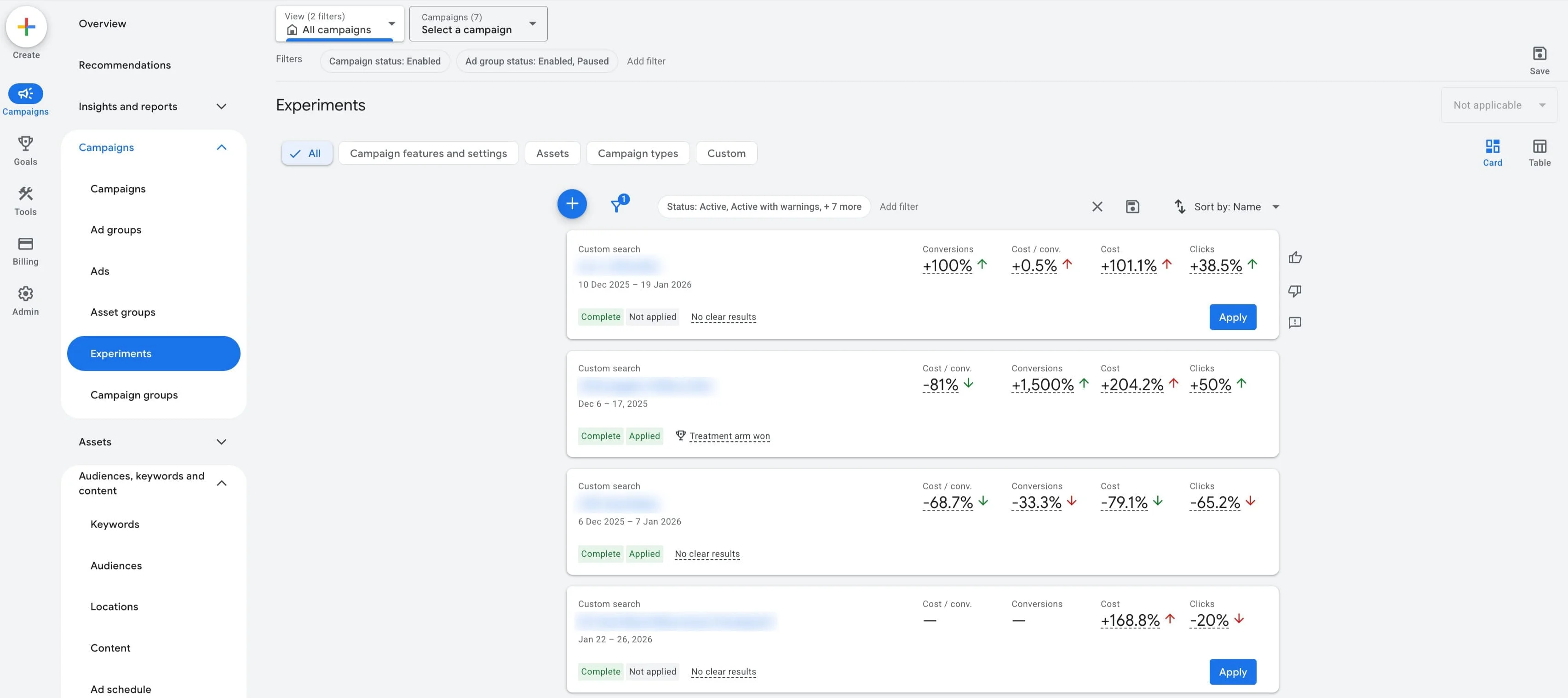
I regularly get this kind of parade: a client suggests something, and I tell them — look, I've already tested this 10–20 times. “My buddy told me, it works for him.” I say — we can do it your way, but I'm warning you: the chances of success are low, because I've already tested this 10, 20, 30 times. I don't rule out that it'll work in your specific case — but most likely it won't.
One last case: the feed and the language
The client says: we'll run the feed in both Russian and Ukrainian, right? I say: no, only Ukrainian. He asks: why? I say: I've tested this hypothesis on dozens of projects — how well a Russian-language feed performs versus a Ukrainian one. There was no correlation on a single project. The results were roughly the same.
At the same time, a reminder: there's a legal requirement for ads to be in the state language — I've already covered this in another article. Whatever the ad type — digital, Shopping, Search — it must be in the state language. It's the law.
The client: but I was really told that Russian works better because users google more in Russian. I say: first of all, it doesn't work that linearly. Even with a Ukrainian feed, you'll still show up for Russian-language queries. Why? Because Google doesn't treat Ukrainian and Russian as separate languages for ad serving — to it, they're essentially one language with a few character differences. If you take even a quick look at the search terms your ads show for, you'll see a lot of interesting things.
Summary
The “I want to be number one” strategy works in two exceptional cases: a super-urgent niche, and as part of a global marketing strategy with an unlimited budget. For any other niche it makes absolutely no sense.
Impressions are impressions. Performance marketing is performance marketing. Don't swap one concept for the other.
It’s a similar story with “competitor analysis”: it rarely gives anything practical — more in “Google Ads Competitor Analysis”.
Can’t find your own ad in search? Here’s why you can’t see your own ads even though they’re running.
Where to find me
Message me on Telegram or by email — I respond quickly. Telegram channel and YouTube are for those who want to see real cases before reaching out and understand my approach.