
Marketer, analyst, ex-CMO focused on the Google ecosystem (Ads, Merchant Center, GA4, GTM). Google Partner. 150+ projects, 100+ positive reviews on Freelancehunt, 12+ countries.
- I work directly, with no account managers or subcontractors
- I measure results in sales, not in-platform conversions
- Maximum expertise in the Google ecosystem
“We get clicks but no sales” is probably the phrase people most often bring to me for an audit. Money is being spent, people visit the site, so the ads must be to blame. But a click only means a person came to take a look. Before paying, they still have to go through several stages, and any of them can break.
Contents
The most striking example from my audits is a B2B project targeting the US market: over $10,000 in spend and zero leads. The company sold an industrial machine priced from $10,000. Conversions in the account were set up incorrectly, and none had a value. Of the 312 search terms that took $3,500, less than 1% turned out to be relevant. The campaign ran on the “Maximize clicks” strategy. And the landing page had no lead form at all. Fixing any one of these problems alone would have changed nothing; everything had to be fixed together.
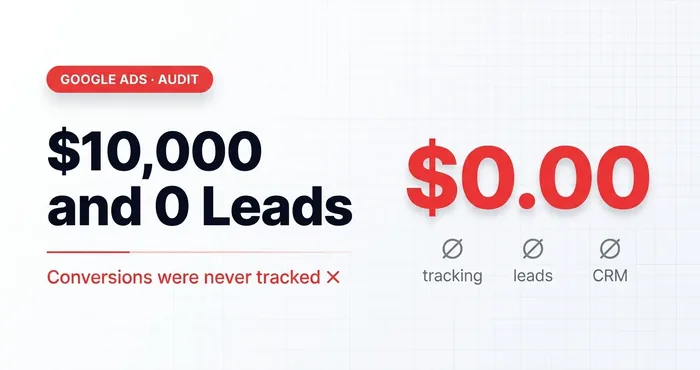 Case study · Account audit · B2B Google Ads$10,000 on Google Ads and 0 leads — a real expert auditAccount audit: $10,000+ spent, 0 leads. Three causes — conversion tracking, irrelevant keywords, a landing page without a form.
So I don’t look for the cause at random, but in order: are sales visible at all, who clicks, where they land, what they are offered, who talks to them, and is there enough data to draw conclusions.
There are sales, but the account doesn’t see them
It sounds strange, but this happens more often than you’d think.
Calls and messengers get lost most often. A person saw the ad, visited the site and called or wrote on Telegram. The sale happened, but Google Ads doesn’t know about it.
The second reason is technical. An online sneaker store where the owner ran the ads himself: one Performance Max campaign, 17–18 thousand UAH (~$390) a month. The client named an average order value of 3,250–3,500 UAH (~$72–78), while the account showed about 1,775 UAH (~$39). Meanwhile, GA4 for the same period saw 63 purchases worth 228 thousand UAH (~$5,070), that is about 3,600 UAH (~$80) per order. The cause was in Google Tag Manager: the Google Ads purchase tag didn’t pass the order value.
Even more often the picture is the opposite: lots of conversions in the account, few sales. For example, every click on a WhatsApp button counts as a conversion, including repeat clicks by the same user or a bot. Or a “form submitted” event fires on every reload of the “Thank you” page, and one lead multiplies in analytics. That’s exactly the tracking I saw at an agency charging $750 a month for management.
The simplest check is to compare the number of conversions in the account for a month with real orders in the CRM or the manager’s spreadsheet for the same period. They will never match perfectly, but if the difference is several-fold, sort out tracking first. Otherwise all conclusions about the ads are built on wrong numbers.
Which search terms people click on
Ads and keywords work as a filter: out of everyone searching for something on Google, they should let through to the site those who resemble your customer. When the filter leaks, there are lots of clicks but nobody among these people to buy.
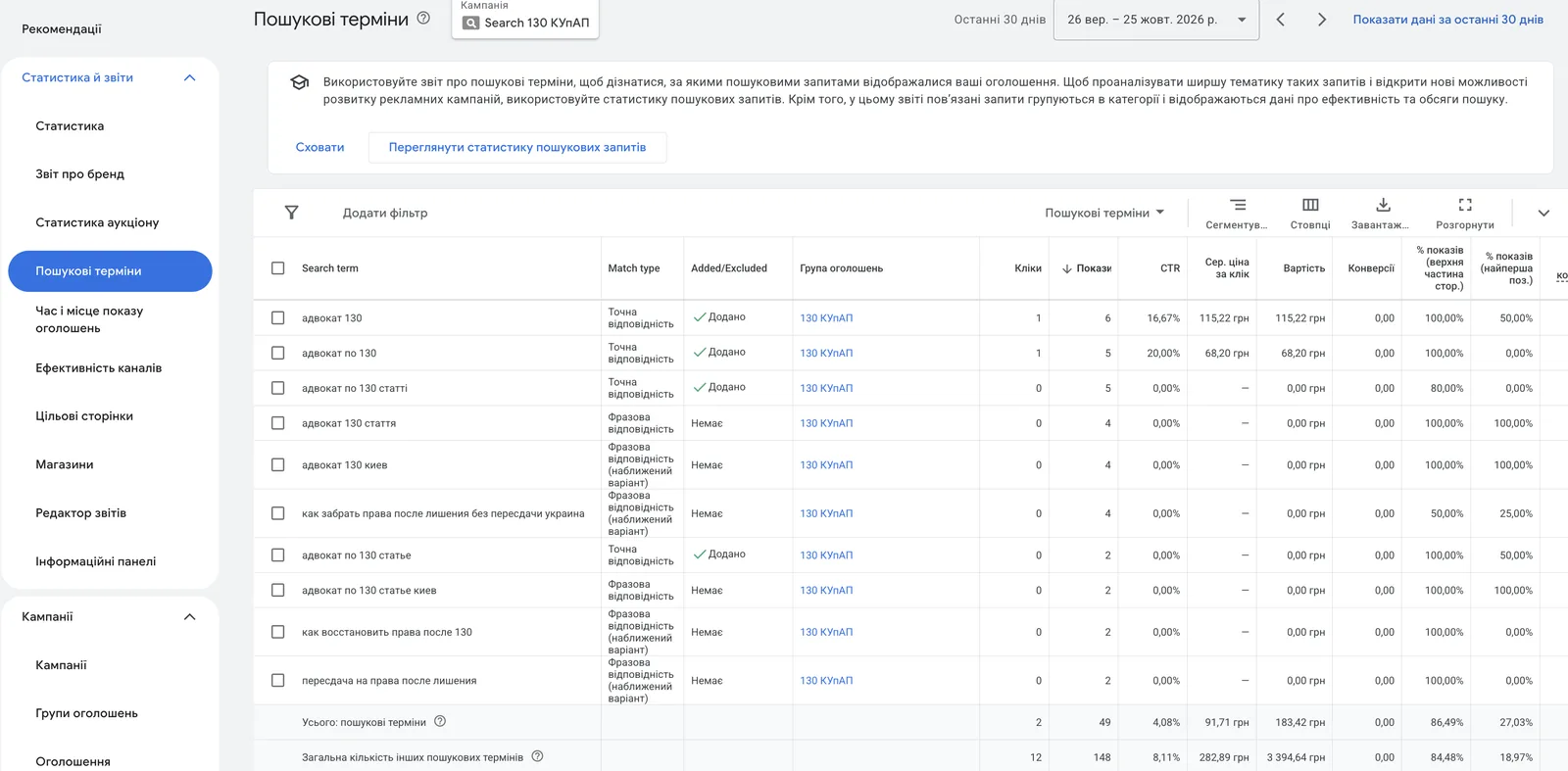
What people typed into search before clicking is shown in the “Search terms” report. In that B2B case, money went to search terms about a consumer portable gadget for €604, rolled ice cream equipment and paper cones. Meanwhile, the keywords that described the client’s actual product and had real search demand were never added to the account.
Most often such traffic comes from a combination of several things:
- broad match keywords without negatives. Google shows ads for search terms it considers similar, and negative keywords are the list of terms you don’t want to show for. Without them, part of the clicks is paid for in vain;
- dynamic keyword insertion (DKI), when the user’s search term is automatically inserted into the ad headline. The ad looks relevant to almost any search;
- the “Maximize clicks” strategy. It optimizes the number of visits and knows nothing about sales. Google Ads looks for people who will do what you called the result, and if the result is a click, it brings people who click;
- Performance Max going to YouTube. In the same sneaker store 54% of the budget was spent on YouTube and only 33% on Search, while the site conversion rate over 90 days was 0.17%. For a niche where a person searches for a specific model and is ready to buy, that’s a strange split. The road to YouTube was opened by an asset group with images and texts and automatic video creation turned on in the campaign settings.
The site
The ad brings a person to the page, but they decide to buy there. In my experience, site quality matters for ad results no less than account settings. You can see it even in the simplest calculation. A $100 budget, a click costs $1, so 100 clicks:
| Metric | 1% conversion | 2% conversion | 3% conversion |
|---|---|---|---|
| Budget | $100 | $100 | $100 |
| Cost per click | $1 | $1 | $1 |
| Clicks | 100 | 100 | 100 |
| Leads | 1 | 2 | 3 |
| Cost per lead | $100 | $50 | $33 |
The ads are the same; only the share of visitors who left a request changes.
In practice it looked like this. A long-term B2B metal processing project: a Wix landing page converted visitors into leads at 5–8%. I rebuilt the page, moved it to a fast HTML landing page and refined it a bit from a CRO standpoint. Conversion became 15.79%. I didn’t change anything in the ad account during that time, and I compared comparable seasons. The 15.79% figure itself is the result of a specific niche and a specific landing page, so don’t carry it over to other projects. What matters is the order of growth: 2–3 times.
On mobile pages I most often see the same problems: there’s no form or it has too many fields, the first screen doesn’t make clear what it is and how much it costs, the menu takes up a noticeable part of the screen, and you have to hunt for the order button. In the sneaker store my test order “spun” for a long time at checkout. Maybe it was a one-off glitch, but such things cut conversion too.
The best test here costs nothing: open your site on a phone and try to buy what you advertise. If at some step you get annoyed, the customer will leave for a competitor at that step. They won’t call to figure it out.
 Google Ads · MarketingCRO for Google Ads: It's Not the Ads Wasting Your Budget. It's Your WebsiteCRO for Google Ads: why ads can't save a broken website. Two real teardowns — a landing page and a product page — plus a first-screen checklist.
Offer and price
Even a targeted visitor on a convenient site won’t buy if they don’t see a reason to choose you. That’s why I start with the question “why should people buy from you and not someone else” before launch. In Google Shopping it’s most acute: competitors’ prices are visible next to yours before the click.
A telling example is a test launch for a new Ukrainian motor oil manufacturer. A former client of mine, who had moved there as a marketer, reached out. Nobody knew the brand, there were no brand searches in Keyword Planner at all, and the prices were at the level of Total or Mobil. The engine and gearbox are the most expensive parts of a car, and a driver who knows even a little won’t trust them to an unknown brand without a strong reason. The test budget was 30,000 UAH (~$670) including VAT. Site conversion came out at 0.73%, the average order including calls about 1,000 UAH (~$22), margin about 50%. So a purchase cost about 1,150 UAH (~$26), while it earned about 500 UAH (~$11). I had warned about such a result before the start.
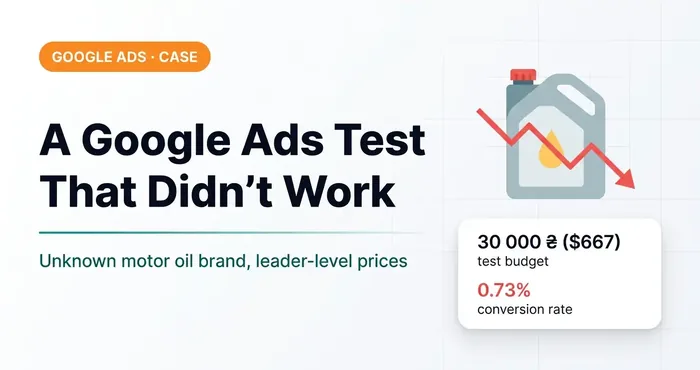 Google Ads · MarketingA Google Ads PPC Test. Why Didn’t It Work? A Real CaseAn unknown motor oil brand, market-leader prices and a 30,000 UAH ($667) Google Ads test. Why the ads didn’t pay off — and why it was clear before launch.
A single decision can also break the offer. An online seedling store ordered a paid audit from me asking why sales were worse than last year. I compared September 2026 with September 2025. During that time the minimum order was raised from 400 to 500 UAH (~$9 to $11), and last year 39% of orders were below 500 UAH. Site conversion fell from 1.74% to 0.91%: a person comes from an ad, can’t fill the cart to the required amount and leaves. The click got 29% more expensive, but I saw similar year-over-year growth on other projects, so it wasn’t the main cause.
The strongest argument was something else: the number of orders dropped in all channels at once, including organic search and social media organic, which Google Ads doesn’t affect. If you see a similar picture, look for the cause on the site or in the offer first, and only then in the ads.
Missed calls and slow replies
Even when there’s a lead, someone has to handle it: pick up the phone, reply in the messenger, call back.
In a clinic with Binotel dynamic call tracking, the specialist before me optimized the ads for all calls in a row, including visit cancellations and questions about directions. I switched optimization to calls that administrators mark as qualified. In the third month the numbers stopped adding up: in 28 days the ads brought 337 calls, 114 were marked as qualified. The ads ran only on Search, for targeted queries, so two thirds of calls being unqualified looked implausible.
I opened Binotel stats for a week: 157 calls, 77 of them not answered during working hours, that is 49%. I looked through more than 20 missed call records, and not one was marked as qualified, although 70–80% of answered calls were qualified. If the share among missed calls is the same, there were not 114 real qualified calls in 28 days but roughly 235–270. That’s an upper estimate: some of the missed calls are repeat calls from the same people, there were 122 unique numbers out of 157 in a week. But even if qualified calls were not double but one and a half times more, the cost per lead comes out completely different.
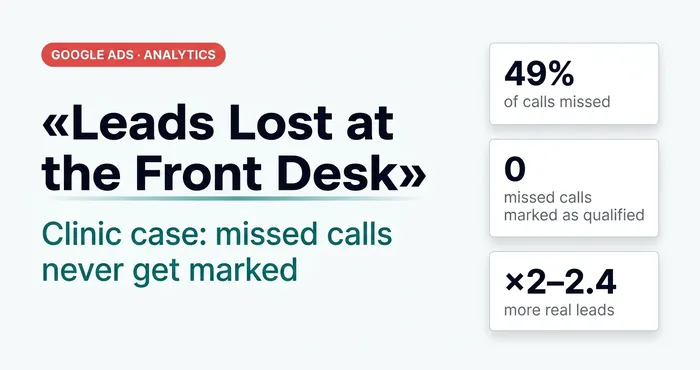 Analytics · Google AdsThree Months Treating the Ads. The Front Desk Was SickA clinic marks qualified calls in Binotel, but never the missed ones. Why Google Ads sees only half the leads — and why the problem isn’t the ads.
For the algorithm it’s also bad training. A missed call never becomes qualified, so the ads gradually learn to avoid exactly the people who call when the reception doesn’t pick up.
This happens not only in clinics. On one project I opened the telephony and saw that 70% of missed calls were never called back. An ads specialist can notice such things, but controlling administrators and managers is the job of someone on the business side.
Too early to draw conclusions
Sometimes everything is fine with the ads, there just isn’t enough data yet.
The first week after launch gives raw data. How long campaign learning lasts depends on the number of conversions; in my practice it’s usually 2 to 6 weeks. The first month goes to technical work and collecting statistics, the second to testing hypotheses, the third to scaling. In a dental clinic the first month brought 6 leads at 3,500 UAH (~$78), the second 17 at 1,700 UAH (~$38), with the same budget.
With a small number of clicks, zero sales can be plain chance. A simplified calculation: if your site converts 1% of visitors on average and every click has the same chance of ending in a purchase, then at 50 clicks zero sales will happen in about 6 cases out of 10, at 100 clicks in about a third of cases. Real traffic isn’t uniform, but the order of numbers shows the main point: 50 clicks without a sale say nothing about the ads yet.
Where to start checking
- Compare conversions in the account with real sales for the same period.
- Open the “Search terms” report and see which terms the money went to.
- If Performance Max is running, check in the “Channel performance” report how much budget goes to YouTube and Display.
- Go through the buyer’s path on a phone: from the ad to a completed order.
- Compare your price with competitors in Google Shopping.
- Check missed calls and reply speed in messengers.
- Calculate how many clicks one sale takes at your conversion rate, and whether you’ve had that many.
The first three items concern ads and tracking. From the fourth, the business zone begins, and the problem very often hides there.
Conclusion
Ads are responsible for who comes to the site. Whether a person buys is decided by the site, the price, the assortment and the reply speed. So when there are clicks but no sales, I check tracking first, then traffic, and only after that draw conclusions about the ads themselves. As the $10,000 case showed, the problem is rarely just one.
If you want someone outside to check this chain, I do independent audits. I look for exactly where sales are lost, even if the cause is outside the ad account.
Where to find me
Message me on Telegram or by email — I respond quickly. Telegram channel and YouTube are for those who want to see real cases before reaching out and understand my approach.