
Marketer, analyst, ex-CMO focused on the Google ecosystem (Ads, Merchant Center, GA4, GTM). Google Partner. 150+ projects, 100+ positive reviews on Freelancehunt, 12+ countries.
- I work directly, with no account managers or subcontractors
- I measure results in sales, not in-platform conversions
- Maximum expertise in the Google ecosystem
Keyword match type is one of the first things I look at in an audit. A recent example is a VR club: broad match, a “Maximize clicks” strategy with a max CPC of about 15 UAH ($0.33) and not a single negative keyword at either the account or the campaign level. The ads showed for competitors’ brands, the names of other shopping malls, laser tag and the query “birthday song for a boy”.
It also happens the other way round: everything in exact match, “to catch only the hot ones”.
Contents
About keyword match settings in Google Ads

What a match type is
A keyword is what you add to the account. A search term is what a person typed into search. The match type defines how far the search term can differ from your keyword for the ad to show.
The types are written differently:
- broad — no symbols: furniture store;
- phrase — in quotes: "furniture store";
- exact — in square brackets: [furniture store].
A broader type covers the search terms of a narrower one, so there’s no point duplicating one keyword in three types in the same ad group. And Google treats “red car” and “car red” as duplicates and uses only one of them.
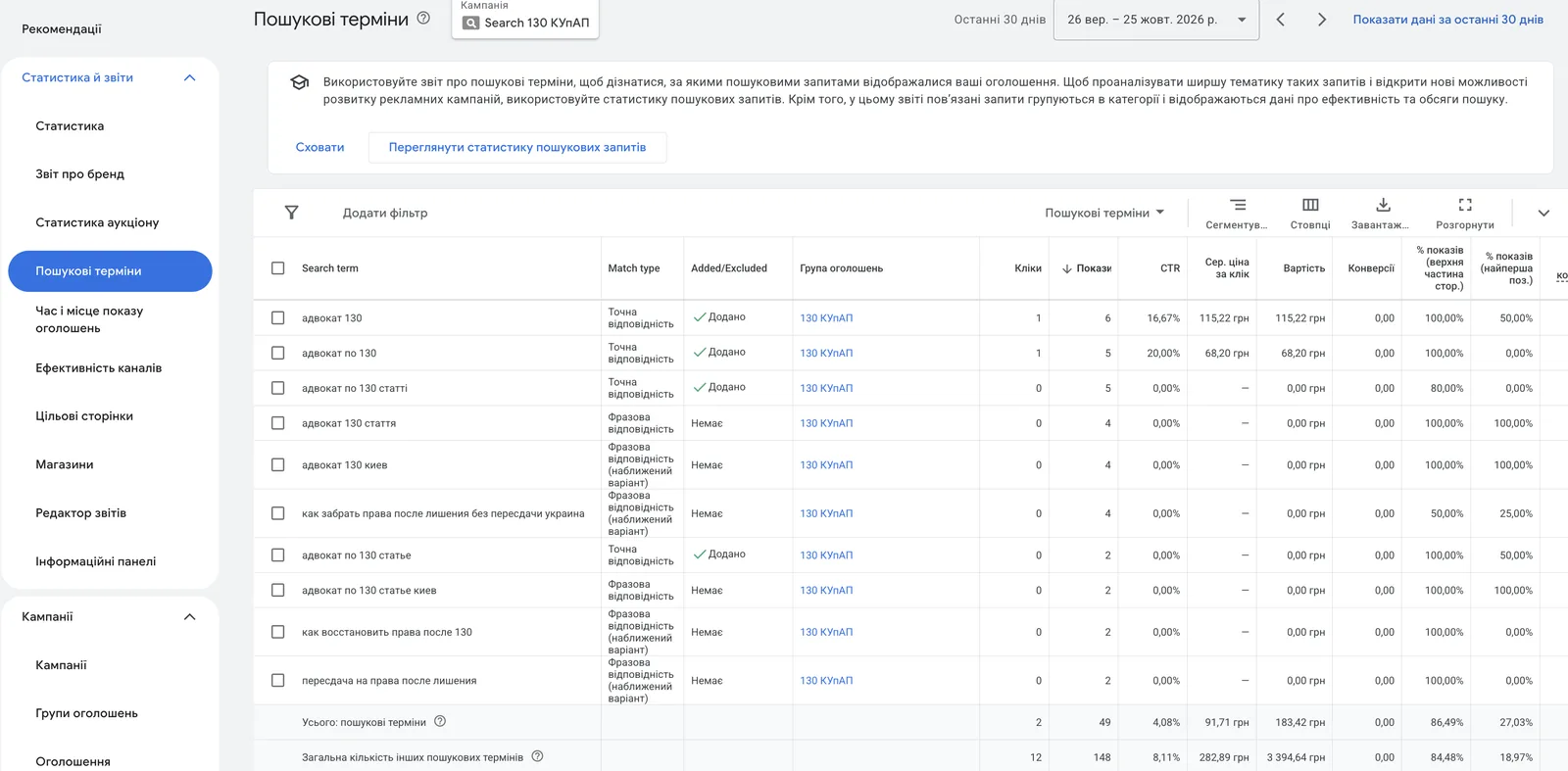
Which type each search term came through is shown in the “Search terms” report, in the “Match type” column.
It’s better to read the official logic in the original source. Two Google Help articles, on keywords and on negative keywords, cover almost every question. Nobody tells you about Google better than Google, so in my hierarchy of sources the Help Center, official announcements of new features and free Skillshop courses come first.
Phrase: what I work with
I’ll start with it, because it’s the one I use on most projects.
Ads can show for search terms that include the meaning of your keyword. For "furniture store" that’s “cheap furniture store”, “furniture store Kyiv”, “find a furniture store” and terms Google considers close in meaning.
It doesn’t restrict traffic the way exact does, and at launch it doesn’t generate as much junk as broad. You still have to clean up negatives here, the flow of irrelevant terms is just much smaller. I also put brand campaigns on phrase match: for the same VR club I recommended a separate brand campaign on phrase match with a budget of about 50 UAH ($1.1) a day.
Broad: for scaling and narrow niches
Ads can show for search terms related to the keyword even if they don’t contain its words. For “furniture store” that’s already “home decor” or “brown leather sofa”. There is overlap with furniture, but far from complete.
I’m not saying broad match is bad. I switch to it when phrase has used up its potential and more traffic is needed. Then I look for an audience with similar search terms that I didn’t reach before. The second case is very narrow niches: you collect keywords and there are almost none, yet the client wants more leads. Here you can start with broad straight away.
The price for that is negative keywords almost every day. For mass market, say floor installation services, I’d still take phrase at launch: on broad you’ll get tired of cleaning out negatives.
 Google AdsNegative keywords in Google Ads: match types and examplesHow negative keywords work, how their match types differ from keywords, why “flowers” doesn’t block “flower” and when negatives hurt.
Google says directly that broad match must be combined with smart bidding. But smart bidding learns from what you called a conversion. In the VR club, broad was running on “Maximize clicks”, so the algorithm diligently looked for people who click. What to count as a conversion so that it looks for people who buy — in the article what a conversion in Google Ads is. Some broad search terms are also more expensive, more on that in the article what the cost per click depends on.
A standard Shopping campaign has no keywords at all: Google picks search terms itself based on the feed. Officially it doesn’t say anywhere which match type applies there. But judging by the search terms, it’s effectively broad, and negatives in Shopping need constant cleaning. How Shopping differs from Search and Performance Max — in the article Search, PMax, YouTube, Display or Shopping.
Exact: I hardly use it
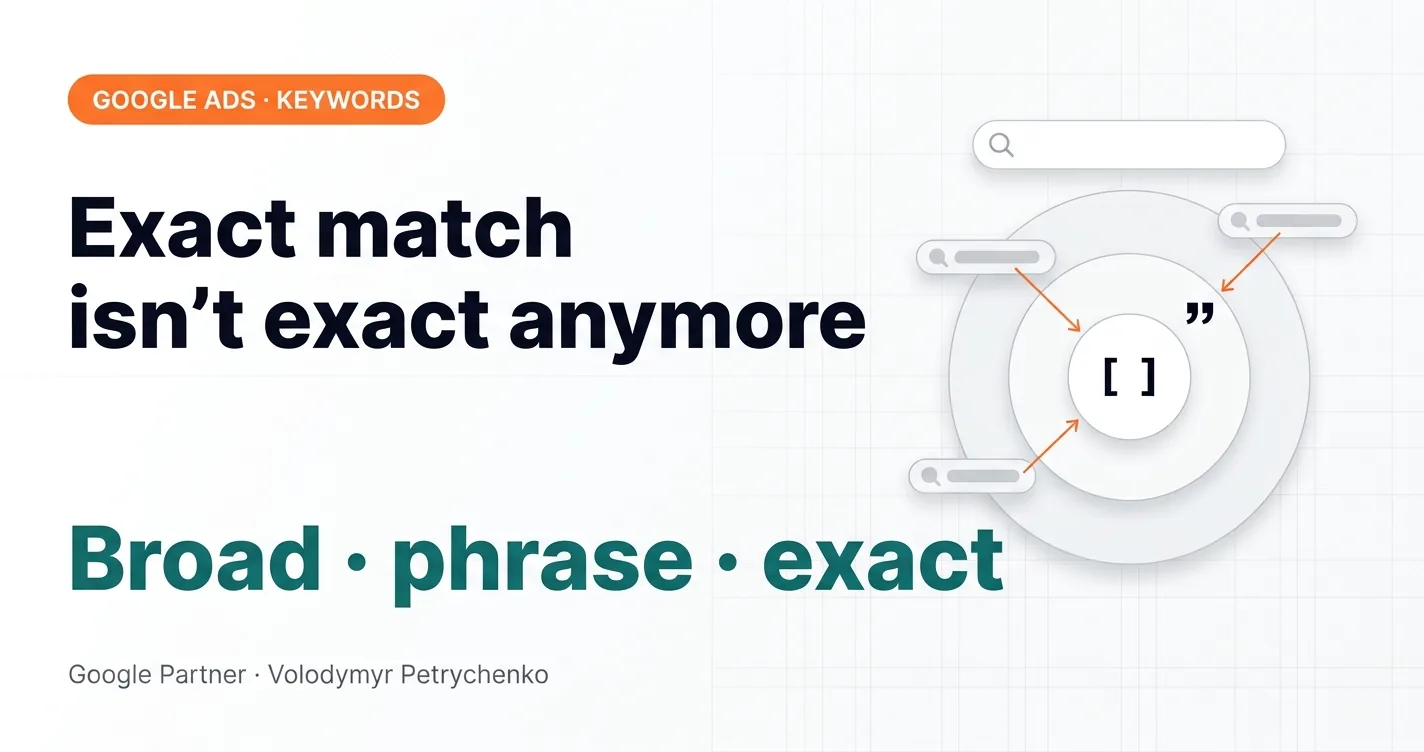
A few years ago exact match meant a 100% match: the keyword [furniture store] showed only for the term “furniture store”. Now Google says ads can show for search terms with the same meaning or intent. So it may consider “store for furniture” the same thing too.
Business owners still see exact match as a way to pay only for the “hottest” people. On Freelancehunt I was asked to look into a search campaign with zero impressions. The client had restricted it heavily with exact match, so the first thing I did was create copies without restrictions, including broad match. In the end the cause turned out to be in the account, not in the keywords. I described this story in detail in the article why Google Ads shows no impressions.
The very logic of “hot” keywords is outdated too. People used to think “buy furniture” was a hot query and “furniture store” a general one. But a person who types “furniture store” may also be planning to buy, they just don’t write it in the search. Same story with length: in two accounts where I counted 474 and 2,305 conversions, most came from search terms of 2–4 words, not long “exact” phrases.
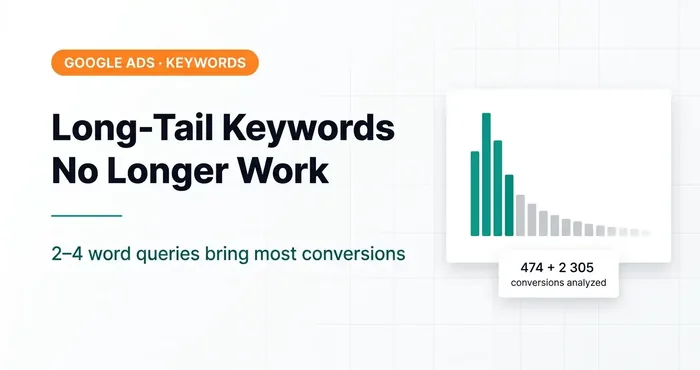 Google AdsLong Tail Keywords in 2026: Why the “Long Tail” Strategy No Longer WorksData from two accounts (474 and 2,305 conversions): most leads come from 2–4-word queries, not long tail.
Exact can work in a narrow niche with a limited budget. Or as a test: when a campaign has plenty of data and certain keywords clearly convert better, you can move them into a separate ad group in exact match or run an experiment. Test it, but in my experience the chance of success is small.
AI Max: Google expands everything itself
From September 1, 2026, Google automatically moves to AI Max the search campaigns that had campaign-level broad match or automatically created assets turned on. Advertisers were warned by email on August 5. AI Max itself expands the range of search terms the ads can show for.
If your campaigns had these settings, go in and check what is turned on now, and look at the fresh search terms.
Three types in one table
| Exact | Phrase | Broad | |
|---|---|---|---|
| Notation | [furniture store] | "furniture store" | furniture store |
| What it catches | terms with the same meaning | terms containing the keyword’s meaning | related terms, even without the keyword’s words |
| Traffic volume | lowest | medium | highest |
| Junk at launch | little | moderate | a lot |
Conclusion
Open the “Search terms” report for the last month and sort by cost. In five minutes you’ll see whether your match type works. If irrelevant terms take a noticeable share of the budget, add negatives or narrow the match. If there are few terms and the campaign underspends its budget, expand.
How I collect and cluster keywords, build negative keyword lists and launch a search campaign from start to finish — I show it in a long video:
Collecting and clustering keywords. Collecting negative keywords. Launching an ad campaign in Google Ads

Where to find me
Message me on Telegram or by email — I respond quickly. Telegram channel and YouTube are for those who want to see real cases before reaching out and understand my approach.