
Marketer, analyst, ex-CMO focused on the Google ecosystem (Ads, Merchant Center, GA4, GTM). Google Partner. 150+ projects, 100+ positive reviews on Freelancehunt, 12+ countries.
- I work directly, with no account managers or subcontractors
- I measure results in sales, not in-platform conversions
- Maximum expertise in the Google ecosystem
This article is for followers of the cult of the low CPC.
One of the most common questions from business owners: why did the click get more expensive? It was cheaper last year, it’s pricier now, so the ads got worse and the specialist broke something.
For me, CPC is a consequence, not a cause. Cost per click affects the final return on ads, but it is itself the result of a thousand factors and market realities. So chasing a cheap click is playing with probabilities, not building a system. Below I’ll show it with numbers from real ad accounts.
Contents
What CPC is in plain words
CPC (cost per click) is how much you pay for one click on an ad. In the Google Ads account you see the average cost per click: spend divided by the number of clicks. Two clicks at UAH 8 and UAH 12 give an average CPC of UAH 10.
An important point: a bid and a cost per click are different things. Google Ads works as an auction, and it runs on every search query. You don’t pay your maximum bid, but the amount that’s enough to beat the advertiser below you. And the winner isn’t whoever paid more: Google takes into account the bid, the ad quality and the likelihood that a person will click it.
In other words, you don’t set the cost per click. It’s formed in the auction.
What drives the cost per click
- Competition. How many advertisers want to show up for the same query. More players means a pricier auction.
- Ad and website quality. Google evaluates expected CTR, how well the ad matches the query, and the landing page. The more relevant advertiser pays less for the same position. More on this in the article “CTR in Google Ads: Does It Affect Business Metrics?”.
- Bid strategy. A manual bid caps the cost per click. Smart bidding strategies (target CPA, maximize conversions) pay as much as they consider necessary to get a conversion.
- Keyword match types. Broad match picks up more queries, and some of them are more expensive.
- Location, device, time of day, audience. The same query costs differently in Kyiv and in a small town, during the day and at night.
- Campaign type. Search, Shopping, Performance Max, Display — different auctions and different prices.
- Niche seasonality. In season, more advertisers compete for the same query.
Why CPC grows year over year
Year over year, the cost of advertising grows. More businesses go online, more advertisers enter the same auctions, and competitors’ smart bidding strategies also know how to raise bids where they see a buyer. There’s no point waiting for clicks to get cheaper. The business model has to adapt to market realities.
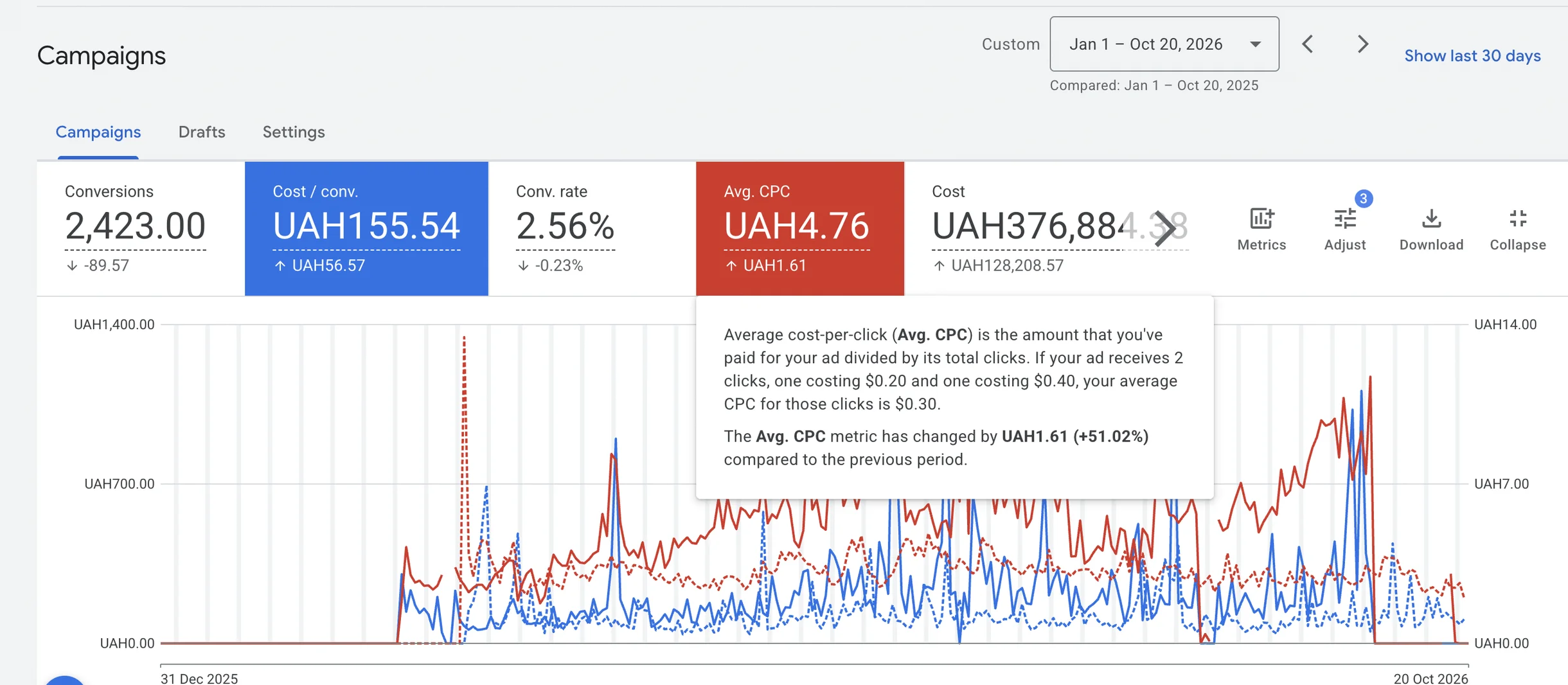
Here’s what it looks like in the garden niche: January 1 — October 20, 2026 compared with the same period of 2025.
| Metric | 2025 | 2026 | Change |
|---|---|---|---|
| Average cost per click | UAH 3.15 ($0.07) | UAH 4.76 ($0.11) | +51% |
| Spend | UAH 248,676 ($5,526) | UAH 376,884 ($8,375) | +52% |
| Conversions | 2 513 | 2 423 | −3,6% |
| Cost per conversion | UAH 98.97 ($2.20) | UAH 155.54 ($3.46) | +57% |
The number of clicks in both years is almost the same, about 79 thousand. So for the same traffic the business paid 52% more and got 3.6% fewer conversions. Nobody broke anything. That’s the market.
Case: pricier click, cheaper lead
Is a Lower CPC Always Better Than a Higher One in Google Ads? A Practical Case

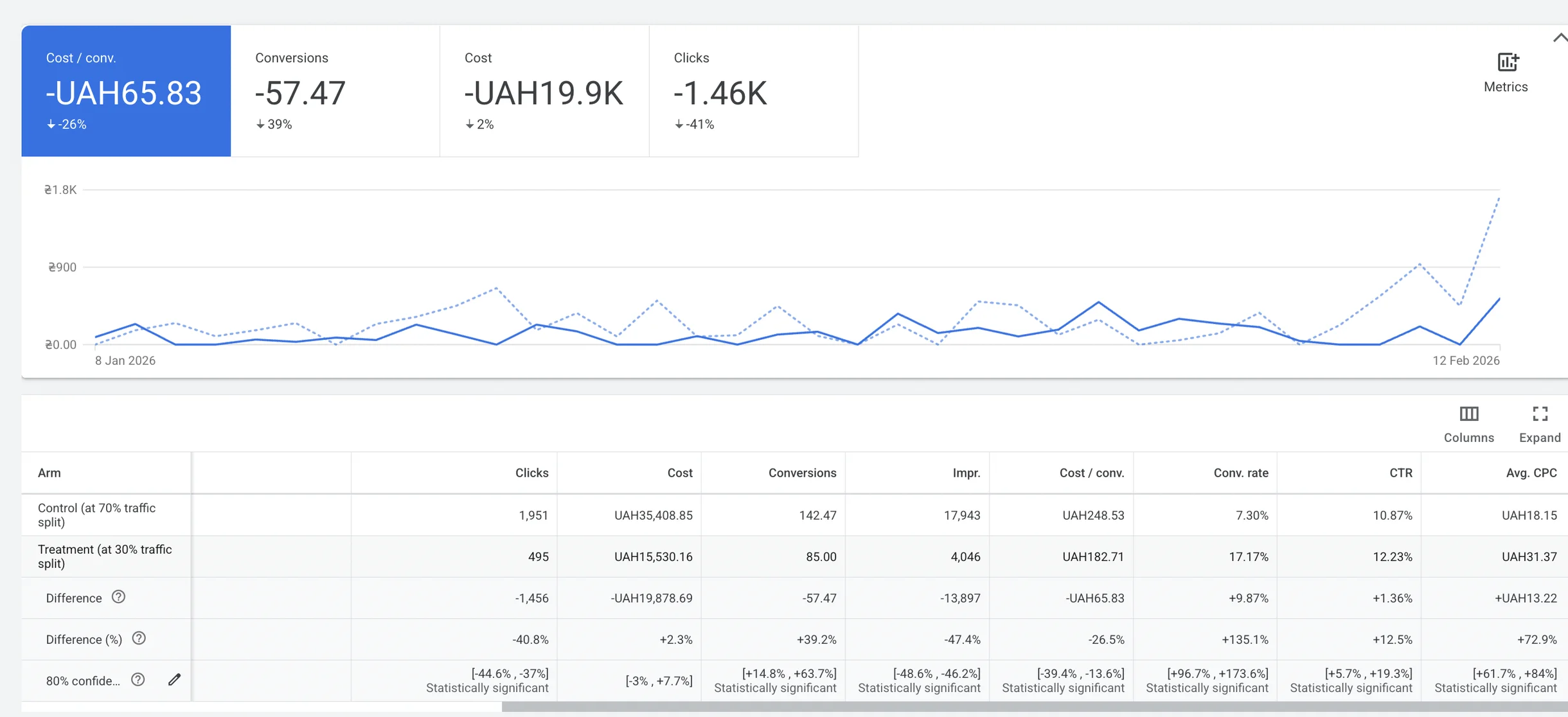
Two search campaigns launched through the Google Ads experiments feature. Traffic was split 70/30. The first campaign runs on manual bids, where the bid is capped. The second runs on the “Target cost per action” (tCPA) strategy. The experiment ran for more than a month: from January 8 to February 12, 2026.
| Metric | Manual bids | tCPA | Difference |
|---|---|---|---|
| Average cost per click | UAH 18.15 ($0.40) | UAH 31.37 ($0.70) | +72,9% |
| Conversion rate | 7,30% | 17,17% | +135% |
| Cost per conversion | UAH 248.53 ($5.52) | UAH 182.71 ($4.06) | −26,5% |
The click in the manual-bid campaign is 42% cheaper. It seems everything should be better here. But no. Its conversion rate is less than half, and the conversion ends up 26.5% more expensive than in the campaign with the pricier click.
The explanation is simple. A manual bid is the same for everyone who sees the ad. tCPA pays more where it sees a likely buyer, and less or nothing where it doesn’t. A cheap click from a person who won’t buy costs more than an expensive click from a person who will.
Google Ads marks these differences as statistically significant. The confidence level in the experiment is 80%, which is softer than the classic 95%. But the interval for cost per conversion is from −39.4% to −13.6%, i.e. entirely in the negative.
Key takeaway: the cost per click doesn’t correlate in any way with the final results of ad campaigns. A higher cost per click doesn’t always make your ads worse.
Smart bidding or manual bids
In most projects, smart bidding works much better than manual CPC bids. The algorithm evaluates each auction separately: device, location, time, the person’s behavior. A manual bid doesn’t see any of that and pays the same for everyone.
How to Choose a Bid Strategy Based on Your Goals in Google Ads: Examples

But smart bidding works only as well as conversion tracking is set up. If real leads or sales aren’t passed to Google Ads, the algorithm optimizes for junk. What should count as a conversion at all, I covered in the article “What Is a Conversion in Google Ads — in Plain Words”.
When I use manual bids myself
Do I use manual bids? Yes. In projects with a limited budget and where CPC on smart bidding shoots to the Moon.
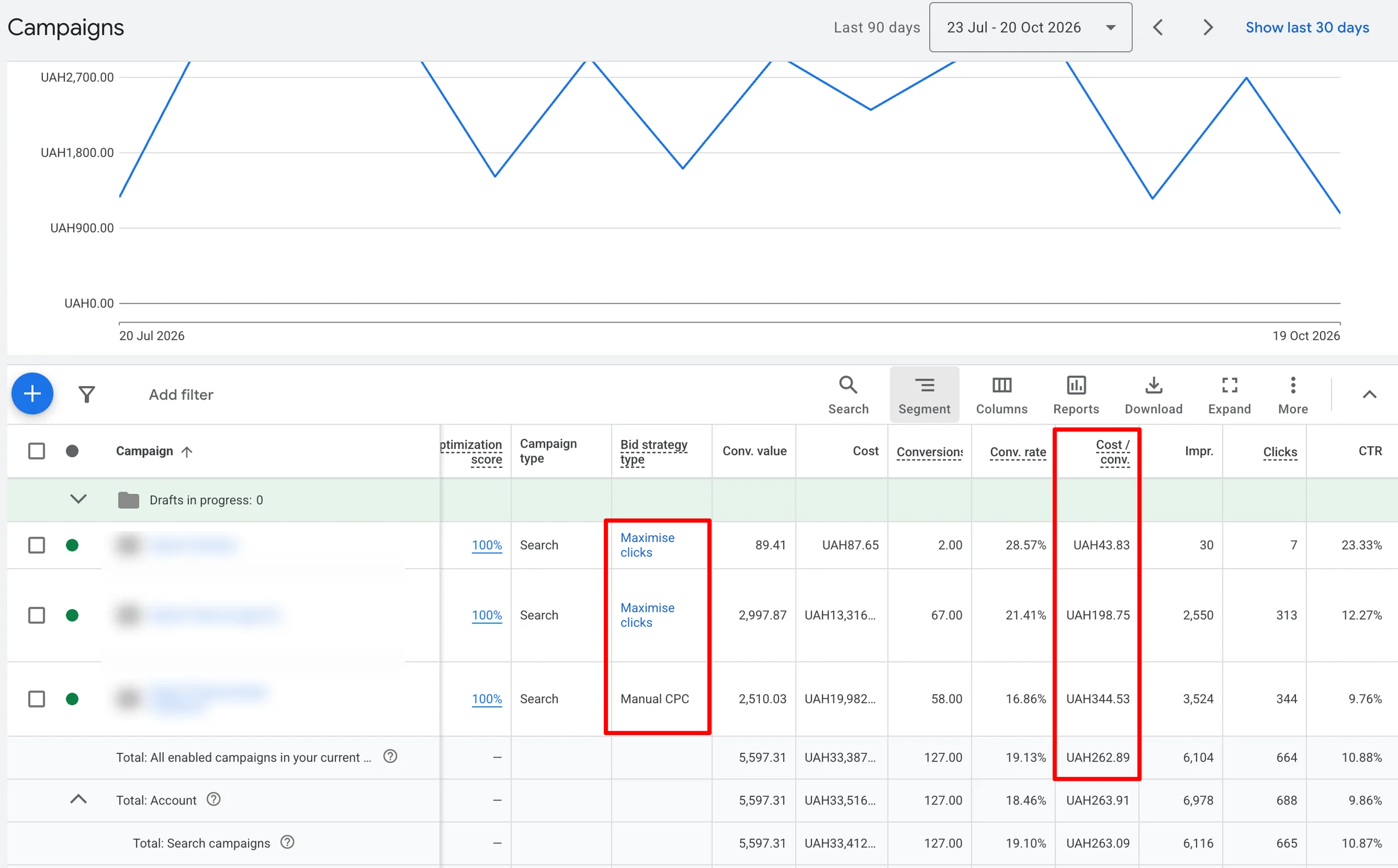
An example: a project with a limited budget, three search campaigns over 90 days (July 23 — October 20, 2026). All campaigns run on manual strategies: two on “Maximize clicks”, one on manual CPC. I count “Maximize clicks” as a manual strategy too, because it optimizes for the number of clicks, not conversions.
| Campaign | Strategy | Spend | Conversions | Cost per conversion |
|---|---|---|---|---|
| Campaign 1 | Maximize clicks | UAH 88 ($1.96) | 2 | UAH 43.83 ($0.97) |
| Campaign 2 | Maximize clicks | UAH 13,316 ($296) | 67 | UAH 198.75 ($4.42) |
| Campaign 3 | Manual CPC | UAH 19,982 ($444) | 58 | UAH 344.53 ($7.66) |
| Total | UAH 33,387 ($742) | 127 | UAH 262.89 ($5.84) |
The goal here is to get leads within a limited budget and not let CPC shoot to the Moon.
Look at business metrics, not account metrics
CPC isn’t a business metric, it’s an ad account metric. For you as business owners or marketers, other numbers matter more: how much a lead or sale costs, what the click-to-lead conversion rate is, what the ROAS is and how much profit is left after ads.
The period when people focused heavily on the average cost per click ended somewhere around 2020. It’s 2026 now. So don’t build your analytics on ad account metrics.
If you want to calculate before launch what cost per click is acceptable for you, use the Google Ads ROI calculator.
How to influence CPC without hurting sales
- Negative keywords. You don’t pay for queries that don’t sell.
- Campaign structure. Separate ad groups for separate intents, ads that match the query.
- Landing page. Fast and about what the person was searching for.
- Location and schedule adjustments. Where the data shows a difference in cost per sale, not in cost per click.
- Manual bids. Where the budget is limited or smart bidding overpays without results.
What you can’t change: competition in the niche, seasonality and the overall rise in market prices.
Common mistakes
- Switching off a campaign because of an expensive click without looking at the cost per sale.
- Comparing your CPC with the “market average” or with another niche.
- Comparing CPC with last year’s and drawing conclusions without the cost per sale.
- Setting a low manual bid to save money and getting cheap but untargeted traffic.
Conclusion
Cost per click affects the return on ads, but it isn’t the cause of it. It grows with the market, and that’s normal. It’s also normal that a pricier click can bring a cheaper lead, as in the experiment above. Count the cost per lead, per sale and profit, not per click.
06 — AnalyticsEnd-to-end analyticsAll inquiry sources and CRM sales in one picture: you see which channel actually brings money.Estimated bids for your keywords are shown by the free keyword research tool.
Where to find me
Message me on Telegram or by email — I respond quickly. Telegram channel and YouTube are for those who want to see real cases before reaching out and understand my approach.