
Marketer, analyst, ex-CMO focused on the Google ecosystem (Ads, Merchant Center, GA4, GTM). Google Partner. 150+ projects, 100+ positive reviews on Freelancehunt, 12+ countries.
- I work directly, with no account managers or subcontractors
- I measure results in sales, not in-platform conversions
- Maximum expertise in the Google ecosystem — instead of “PPC, social ads and SEO, all in one”
The most common question from clients: what budget would you recommend? What budget do I need to launch Google Ads effectively and keep working with it?
The honest answer here isn't abstract numbers. This question has a real, concrete answer, and it depends on what you want to achieve. The question isn't the amount, it's the goal.
Contents
- Budget is calculated from the goal, not the other way around
- The reverse calculation formula
- Everyone advertises, not everyone earns
- An example in numbers
- Limitation #1: few tests
- Limitation #2: little data for the algorithms
- A vicious circle
- 10 vs 50 vs 100 dollars a day
- If your budget is small anyway: how to survive
- So when are those miserable 10 dollars enough?
- How to get the most out of a small budget
- FAQ
Budget is calculated from the goal, not the other way around
Why is “how much should I invest” the wrong question? Because at launch the client thinks about costs, while they should be thinking about results.
There's no single standard like “here's your budget of 10, 20, 50, 100 dollars a day”. For some that's a lot, for others it's nothing at all.
What to start from:
- how many requests, sales or quality leads you need: MQL (Marketing Qualified Lead — a lead that matches your target audience profile and has shown interest but isn't ready to buy yet) and SQL (Sales Qualified Lead — a lead the sales team has checked and deemed ready for a deal);
- what cost per lead is acceptable, or what target ROAS (ad revenue divided by ad spend: ROAS 4 means 4 dollars of revenue for every dollar of ads) or ROMI (return including margin: shows whether ads bring profit, not just revenue; more in the article on the difference between ROAS and ROMI) you need;
- what your margin, average order value and customer lifetime value are (LTV — how much money a customer brings the business over the whole relationship, not just the first purchase).
And do a calculation that shows what budget to plan for your goal.
The reverse calculation formula
It's all fairly simple. You have a wish: for example, to get 100 leads at an acceptable cost per lead of 10 dollars. 100 × 10 = 1,000 dollars — that's your monthly budget.
Next you calculate (or already know) your lead-to-sale rate. You calculate cost per sale (CPS — the cost of one sale: ad spend divided by the number of sales) and see whether the math works at all.
For this I have a tool — the online Google Ads ROI calculator. It doesn't just help define a budget: based on your data, it forecasts whether launching Google Ads makes sense at all.
Everyone advertises, not everyone earns
You might ask: what does a “sensible launch” mean? Everyone advertises on Google Ads.
Yes, everyone advertises. But not everyone earns.
Yesterday someone called me on Dmytro's recommendation. I don't know which Dmytro exactly, but thank you, Dmytro. Another confirmation of my effectiveness as a Google Ads expert.
The person says: we launched ads a week to ten days ago. On the first day there were some sales, and since then one sale comes in per day. In short — the ads are performing poorly.
I ask what they do. Mobile phone accessories: cases, screen protectors, power banks. I ask: how many SKUs (individual products, e.g. a specific case model in a specific color) per order on average? One. Average order value? 300 UAH ($6.7). Ad budget? 500 UAH ($11) a day.
He told me how many clicks and sales there were. I calculated the website conversion rate — 0.6%.
After the call I sent him a link to the calculator. If he had calculated this picture in advance, he'd have understood he didn't need a launch at all. With a 300 UAH ($6.7) average order, a 0.6% conversion rate and a very competitive niche, the ads simply can't pay off. And it's no longer a budget question: spend even 100,000 UAH ($2.2K) a day, the math won't work.
The only thing I advised: try to make it work with upsells, after the user has placed an order. Not a cure-all, but there's no other option when people buy one SKU on average. Sure, someone might take both a screen protector and a case, or two cases for the whole family. But that's rather rare.
He says: I'll try for two more weeks, and if nothing works I'll come to you. But why come to me if I'm already telling you it won't work?
Not every niche is profitable on Google Ads, because there are many inputs: website conversion rate, USP (if you just sell phone cases — okay, you just sell phone cases), pricing, average order value, margin. All of this affects the final result. More on advertising with a small average order in the articles about a 300 UAH ($6.7) order and the case with orders under 1,000 UAH ($22).
Google Ads with a 300 UAH ($6.7) average order. Does it even make sense?

An example in numbers
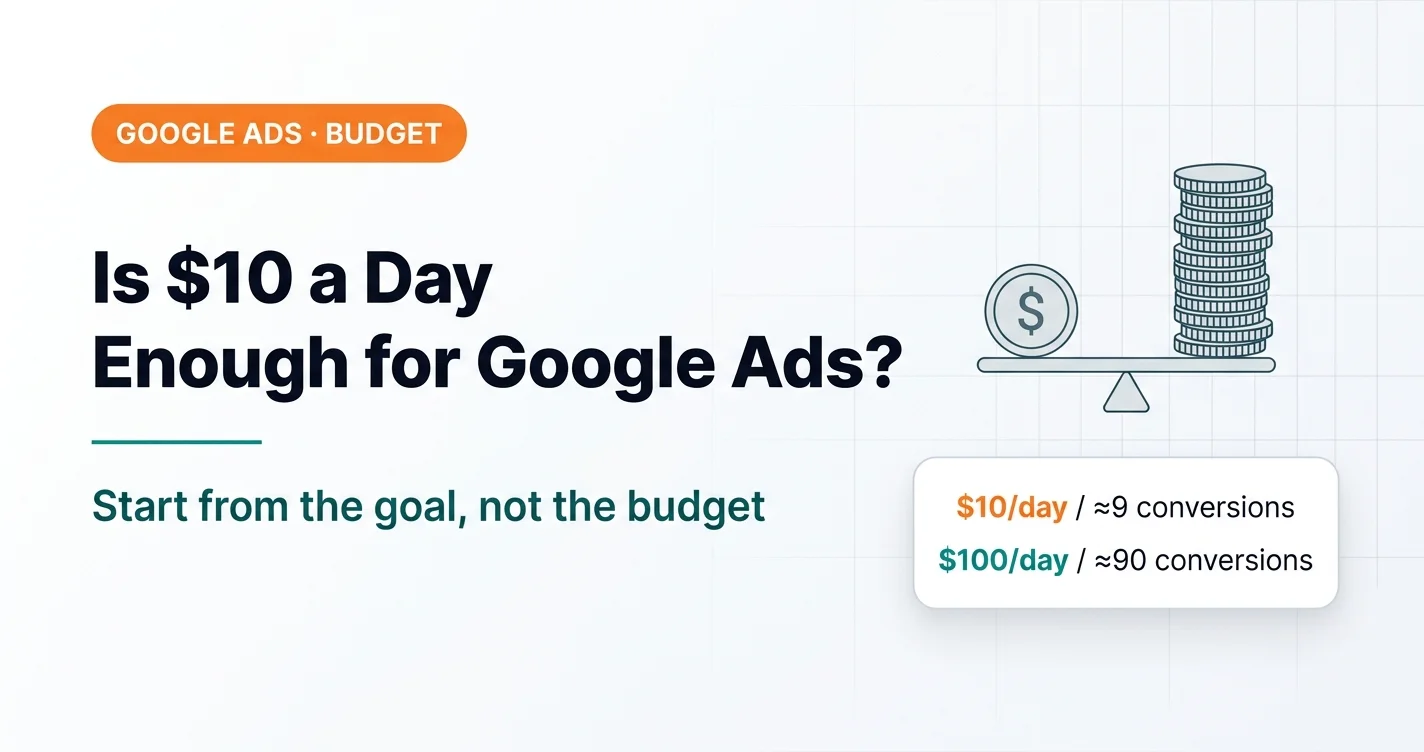
Take any niche with a budget of 10 dollars a day, i.e. 300 dollars a month. Cost per click from Keyword Planner — say, 1 dollar. Website conversion rate — 3%. Ideally you calculate several scenarios right away, but for the example let's take this one.
300 dollars / 1 dollar = 300 clicks. At a 3% conversion rate that's 9 conversions a month.
The question: does this meet your goal? Will the whole thing pay off, including paying a Google Ads specialist?
Key point: at the calculation stage, ask yourself two questions: does this budget meet your goal, and will it all pay off.
I often hear the same phrase: “Let's start with, say, 10 dollars a day, and then take it to infinity.” And here we smoothly get to the main point: a small budget means few tests and little data for the algorithms.
Limitation #1: few tests
Marketing is first and foremost constant hypothesis testing.
In PPC, hypotheses can be different ad messages, different keyword match types, different landing pages, different offers (I'd call this one of the key tests), different bidding strategies. And lots of other options.
Because in Google Ads there's no such thing as set it and forget it. That would work in a utopian world where only you exist, there are no competitors, the environment is stable and Google's algorithms work perfectly. But that's not how it works.
Any test needs statistically significant information to make a decision. Statistical significance is relative. For some it's 100 target actions, for others a thousand, and for some 10 is enough. If you get only 20 leads a month, 10 leads is already statistically significant. If you have a thousand transactions a day, a thousand transactions is too few for the right decision.
On 10 dollars a day you can't test anything. You get one hypothesis: you launch it and collect crumbs of information, and validation takes months. Because with a small budget you won't get enough statistically significant data to make the right decisions. I stress: the right ones.
If you make decisions on data that isn't statistically significant, it's easy to reach false conclusions. Anyone familiar with mathematical statistics knows: the more data, the smaller the error. And vice versa.
Limitation #2: little data for the algorithms
There's a second limitation that, for some reason, people either don't know about, forget, or don't talk about.
Google Ads smart bidding strategies — maximize conversions, target ROAS, target CPA, maximize conversion value — and Performance Max campaigns run on conversion data.
Google used to state that for a smart bidding campaign to work properly it needs at least 30 conversions in 30 days. But a few months ago, at a meeting with my Google consultant, I was told: now, for smart algorithms to work properly, one campaign should get 3 to 5 conversions a day. That's 90–150 conversions a month.
Without enough conversions, the algorithm stays in the initial learning phase all the time. Bids will be unstable, and you'll see clicks at 500 UAH ($11) in your account. Spreading the budget across several small campaigns makes it even worse.
I call these micro-budgets. It's not about advertising at all, but about chance and probability. Sometimes this approach works, but at the level of probability, not a system.
A vicious circle
The two limitations reinforce each other. Little data → the algorithm optimizes worse → higher cost per conversion → even less data for decisions.
You end up in a vicious circle, after which the client draws one of two conclusions. Either “Google doesn't work”, although millions of advertisers use it. Or “my contractor is doing something wrong”. Which, by the way, shouldn't be ruled out either.
10 vs 50 vs 100 dollars a day
For clarity, let's calculate three budgets at a cost per click of $1 and website conversion rates of 1%, 2% and 3%:
| Daily budget | Monthly | Clicks | Conversions at 1% | at 2% | at 3% |
|---|---|---|---|---|---|
| $10 | $300 | 300 | 3 | 6 | 9 |
| $50 | $1 500 | 1 500 | 15 | 30 | 45 |
| $100 | $3 000 | 3 000 | 30 | 60 | 90 |
Now compare with the benchmark of 90–150 conversions a month per campaign. At $10 a day the algorithms won't get enough data in any scenario. At $50 — neither. Only $100 a day at a 3% conversion rate reaches the lower bound.
So with a small budget, smart strategies work “blind”, and tests stretch over months.
If your budget is small anyway: how to survive
My recommendations are based on my experience. But my experience rests on a statistically significant number of projects and on what Google states in its training and help materials. For the most part they confirm each other well, so you can use this as a foundation.
1. Consolidate campaigns into one. A budget of 10 dollars a day means one campaign, and that's it. Segment it properly inside: ad groups, asset groups or product groups, depending on the task. You need to concentrate data, not spread it.
2. For Search campaigns, start with manual bids. Without conversion data, smart strategies make no sense: the system doesn't know yet what a conversion is. With manual bids you, say, set half a dollar per click, spend your 10 dollars and get 20 clicks a day. At a 5% conversion rate that's already one conversion a day. On automated strategies a click can cost 5 or 10 dollars — a completely unpredictable story.
Once you collect enough conversions to make a decision, you can try automated strategies. But with this budget it's a risk. If manual bids work fine — don't break it. If they work poorly — you have nothing to lose, switch to automated strategies, even though clicks may be more expensive there.
I showed in a statistically significant experiment that with a higher cost per click the final cost per conversion can be lower:
Is a lower CPC always better than a higher one in Google Ads? A practical case

3. Optimize for micro-conversions to give the algorithm more signals. In an online store these are, for example, add to cart, checkout start and the purchase itself. This way the system gets enough data to keep learning.
But understand: a purchase is the cleanest event, the final goal. Add-to-carts have a lot of noise and non-target actions, because not every add to cart turns into an order. You need to account for that.
4. Choose one direction. If you have several directions and a small budget, choose one. And depending on the keywords — the hottest queries, in your opinion.
But keep in mind: the time when everything was decided by commercial queries like “buy” or “price” is over, compared to five years ago. In one video I showed, using long-tail and short keywords as an example, what share of conversions they bring. The conclusion: even one-word keywords can convert as well as long-tail ones.
Long Tail Keywords vs short keywords: which really drive sales?

Why? Because user behavior changes, and it changes because search engine algorithms improve. Five years ago, to find online stores rather than informational articles, you had to add the word “buy” to your query. Now you type “Bosch boiler”, and the system, based on signals about you, understands you're looking to buy it. So don't be naive and don't use five-year-old methodologies.
So when are those miserable 10 dollars enough?
That's probably the answer you want to hear. I have a project with a budget of 10 dollars a day: a great conversion rate, a great number of leads, the client is happy. But there are nuances.
- Local niche. This business, for example, is local.
- Low CPC. There are many niches with a low cost per click. But again, CPC isn't the deciding factor: it's a consequence, not a cause.
- Brand protection. For a brand campaign, this budget may also be enough.
- Remarketing. That's a separate conversation.
There's an opinion — I don't know where it came from — that remarketing is a cure-all. There's some logic to it, but it's heavily idealized. Just like people think Performance Max is a cure-all.
I don't share this view. Its supporters' logic is: if a person has already been on the site, did something and left, they'll most likely come back.
I put forward a different hypothesis, again based on the large number of projects I've worked and work with. If a person didn't finish something on your site, left and didn't come back — the question is why. Maybe they found a more interesting offer elsewhere. Yes, there are tons of distractions, I agree. But they left and for some reason didn't choose you. If the sales cycle is long, then remarketing does make some sense.
I don't consider remarketing a cure-all. As an additional tool, an additional touchpoint — yes. But on its own it won't bring you anything.
And one more thing: to launch remarketing in Google Ads you need collected audiences. A small project can't always afford that: there just isn't enough data to launch.
How to get the most out of a small budget
One campaign, narrow keywords and focus on one hypothesis. There's no other option. Splitting one campaign into two and testing two hypotheses means never collecting statistically significant data for a decision.
Key point: budget isn't the entry price, it's the speed at which you can find a working model.
What I said at the beginning: “let's start with 10 dollars a day, and if it goes well — we'll increase it”. That “if it goes well” may never come, because in such conditions you simply can't make decisions.
There are no magic approaches in advertising. When people come to me for promotion, I already have a pool of proven solutions that increase the probability they'll work in a given project. But they may not work either, that happens too. Then you need to test the next model. And on a small budget, testing will take us a very long time.
If you need to calculate a budget for your goal, need a consultation or a Google Ads account audit — get in touch, contacts are on this page.
Why, on a small budget, one campaign on the hottest demand beats five different ones — see “Search, Performance Max, YouTube, Display or Shopping: What to Choose”.
Search volume and cost per click in your niche are shown by the free keyword research tool.
Why you may not see your own ads on a small budget — see why you can’t see your own ads even though they’re running.
Where to find me
Message me on Telegram or by email — I respond quickly. Telegram channel and YouTube are for those who want to see real cases before reaching out and understand my approach.