
Marketer, analyst, ex-CMO focused on the Google ecosystem (Ads, Merchant Center, GA4, GTM). Google Partner. 150+ projects, 100+ positive reviews on Freelancehunt, 12+ countries.
- I work directly, with no account managers or subcontractors
- I measure results in sales, not in-platform conversions
- Maximum expertise in the Google ecosystem — instead of “PPC, social ads and SEO, all in one”
Recently, in one of my articles I described situations where you seem to have a case study, but showing it from a marketing point of view is pretty hard. This case is exactly one of those. It’s a pretty good case — a really great cooperation of over three years with a big company, a large holding, one of whose business lines is rolled steel. In other words, steel warehouses, lots of them.
Contents
- Why this case can’t be shown as is
- Gap #1: untracked orders through the cart
- Gap #2: goal switching and the real number of conversions
- Gap #3: messengers and email
- Campaign structure
- Gap #4: call clicks from Google Maps
- The final count
- Summary
- How I work with clients
- A second project with this client
- FAQ
Why this case can’t be shown as is
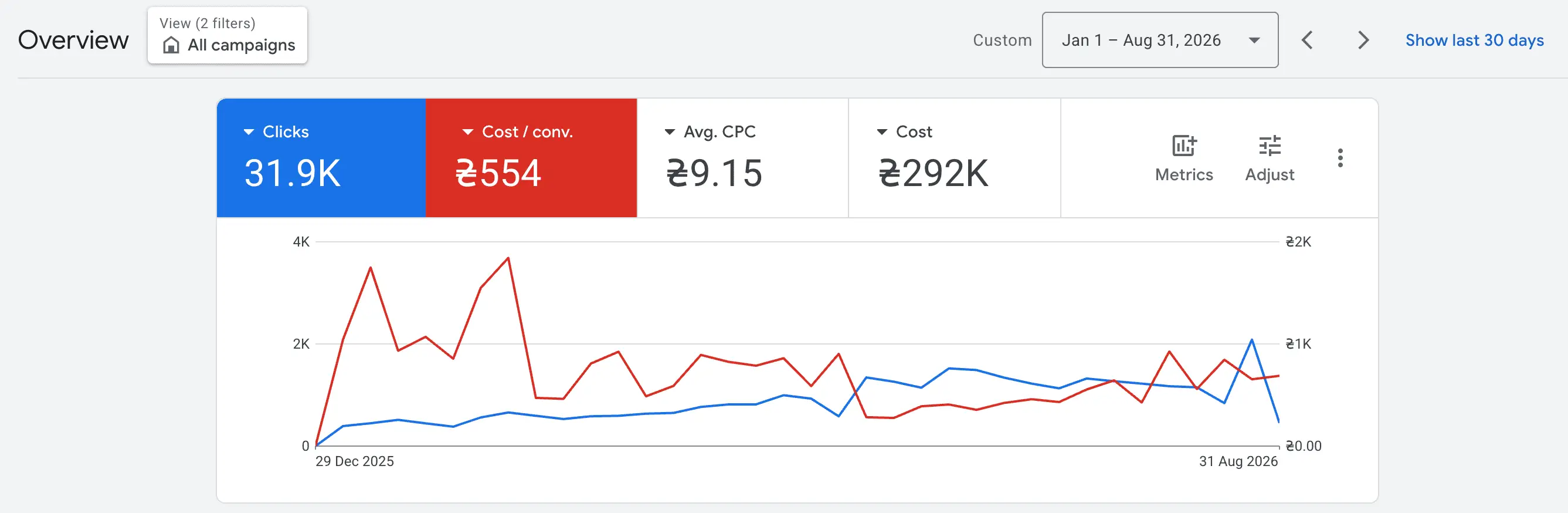
If I simply took a screenshot of the Google Ads dashboard, here is the data you would see.
I’m taking the period from January 1 to August 31 — it covers different demand periods, there are no tracking issues anymore, and nine months is basically a long enough window to show as a case study. Presenting a month, a month or two, or two weeks as a case study is pure sham, a bait-and-switch — in short, that’s not a case study.
What do we see on this dashboard? We invested 365,000 UAH ($8.1K) in ads and got 586 conversions of various types at 623 UAH ($14) each.
In principle, I could have shown just this number — it’s quite good for a niche where the average order runs into five figures (in UAH; steel is an expensive pleasure these days), and some orders reach six figures. I could have said “there’s the whole case, good price” and stopped there. But no — I decided to show this case not only in terms of my own achievements, but also in terms of a big analytics gap that exists here and on many other projects.
Gap #1: untracked orders through the cart
Even though the business is essentially built as an online store, only about 5% of users actually use the cart. That was clear from the start three years ago, because I had already worked with similar niches and fully understood how this one works. At that point I already had two clients in an adjacent niche — metal processing services, and I recently wrote about one of them in a case study with 288 UAH ($6.4) per lead.
I’ve been working with one of those clients for over 4 years, with the other for 3.5. With the client from this case — also for over 3.5 years.
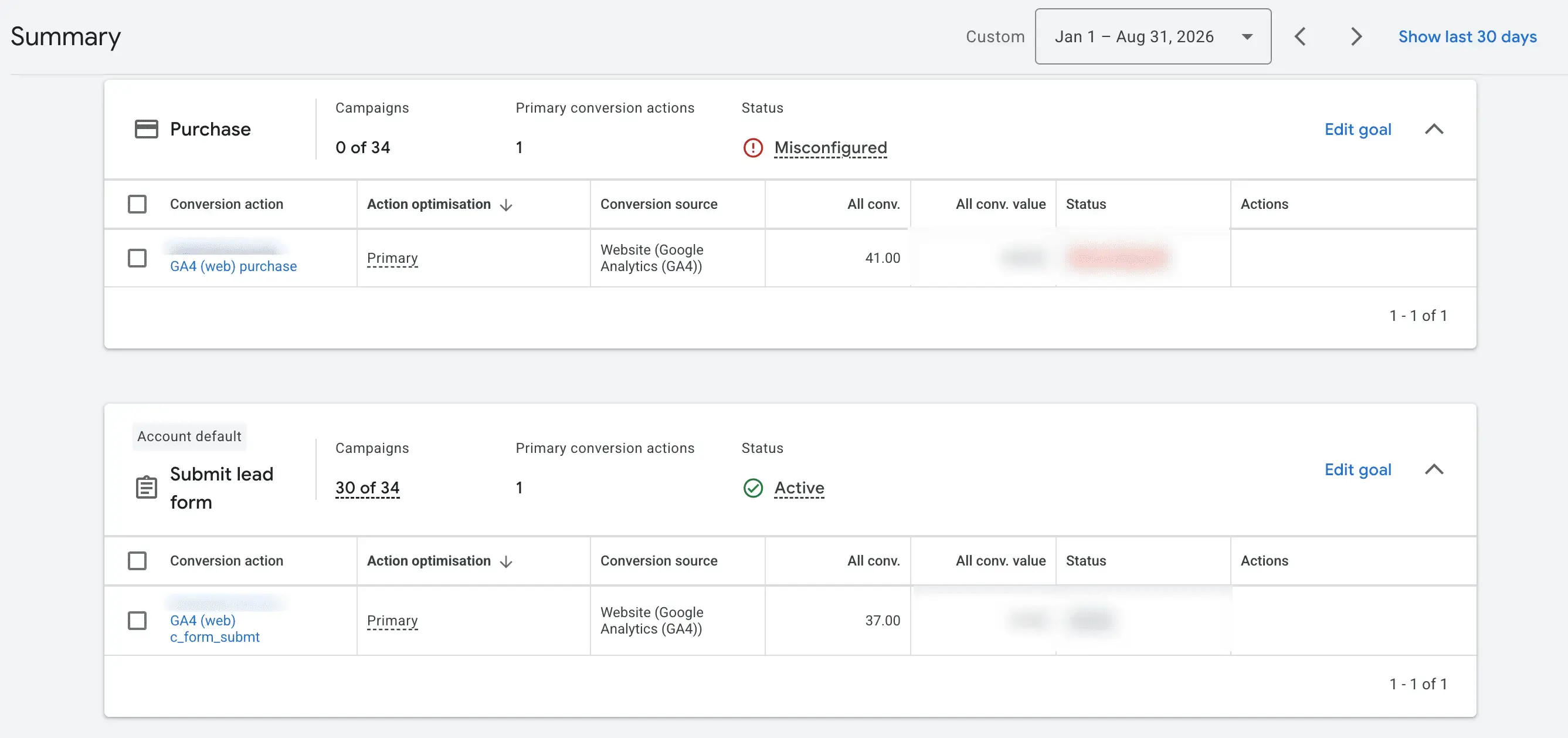
It was clear from the start that nobody was going to buy through the cart there. The client had just rolled out a new site with online store functionality and assumed people would buy through the cart. Products like these aren’t bought through a cart. So we never used this goal for optimizing campaigns — we just track it, let those ~5% be there, but we don’t target them.
For this period — 41 purchases through the cart.
Gap #2: goal switching and the real number of conversions
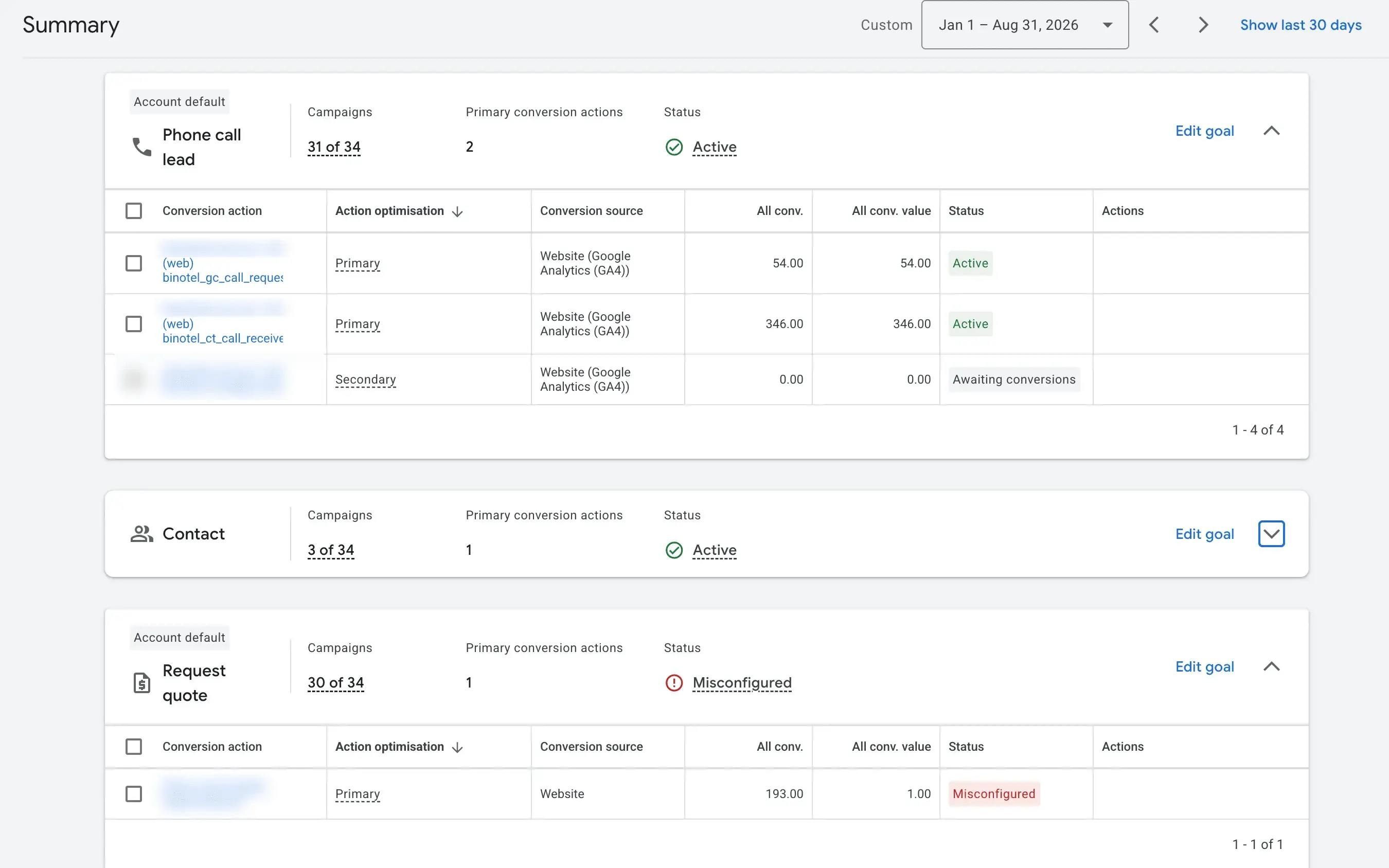
This is a dynamic story, not a static one — over the period the goals were switched between each other, and from the ad account data I counted 671 conversions versus the 586 shown on the dashboard. That’s 14.5% more conversions.
So the cost per conversion is already 14.5% lower: 623 UAH ($14) minus 14.5% gives 532 UAH ($12).
I could have stopped here and given this data — said “532 UAH, guys, that’s a great result for this niche, the order value is very high here.” But I wouldn’t be myself if I didn’t keep digging.
Gap #3: messengers and email
There’s another tracking gap — messengers and email. According to the client, some really big orders come in by email — mostly tenders with enormous order values. These are tender or wholesale orders. We don’t count them in this setup yet — the client isn’t ready, and this approach requires a bit of manual work that nobody wants to do.
Campaign structure
We use two types — Search and Performance Max (pure), plus local campaigns. Local campaigns are one of the main drivers of inquiry volume.
Gap #4: call clicks from Google Maps
The account has a “call clicks” goal with Google as the conversion source, meaning these are clicks on the phone number on the map. We don’t know how many of those clicks actually turned into calls. Or rather, we do, because we set this up a couple of years ago: on one project I tested static call tracking on Maps for a local business, and calls from Maps show up in conversions quite often.
Remember this number — 238 clicks.
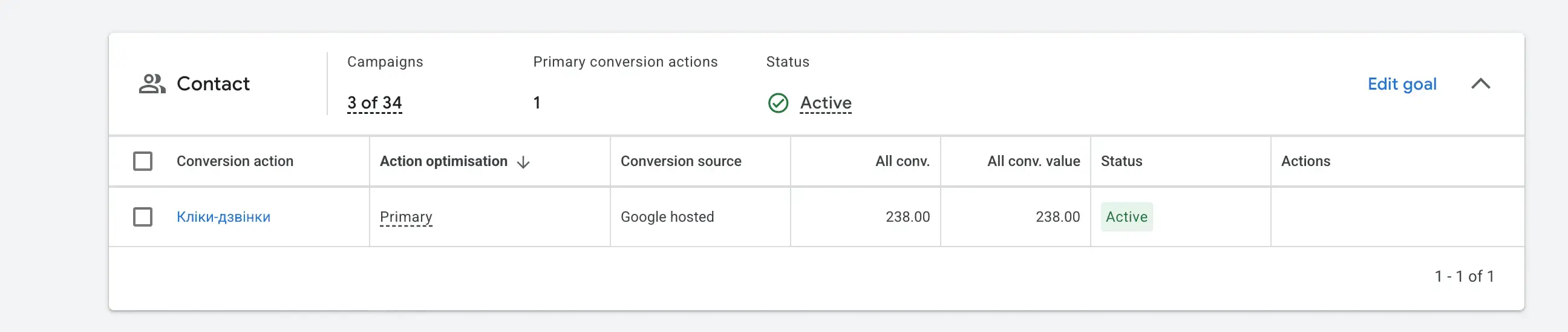
Disclaimer: phone number clicks are nonsense. The number of calls can range from 2x to 10x in either direction from what the ad account shows. That means this metric can’t be used for ad optimization at all — it’s unpredictable, and you never know which way it’s lying. I show this clearly in the video:
Don’t trust call clicks in local campaigns 😄

Without call tracking, Google Ads is nonsense ❌

In this particular case, let’s see how many calls there actually were. Since static call tracking is installed on Maps — a separate dedicated number shown only on the map — we see and hear every call that comes in and draw conclusions about performance.
For the same period, January 1 to August 31, 2026, 781 calls were recorded, of which 565 were unique. First-time callers — 504, almost 90% of the audience.
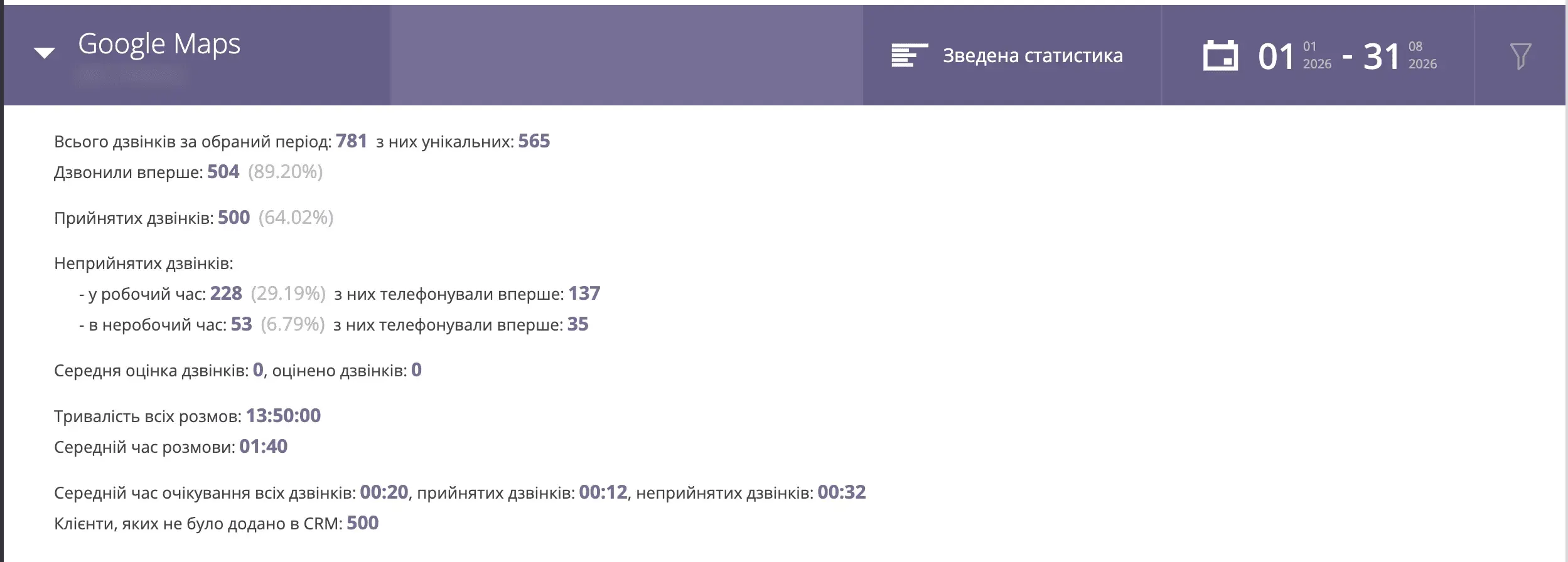
Key takeaway: drop the total of 781 and take only the 565 unique ones, while the ad account shows 238. 565 divided by 238 — a difference of 2.37x.
You might point out that Maps traffic isn’t only from search ads — true. But here there are no other traffic sources besides search ads: no big organic presence, no separate local Maps promotion. Let’s allow for error — organic traffic makes up 14% of total site traffic. Even if we subtract that 14% from the 565 calls (there’s no other tool to verify, so we calculate roughly), we are left with 525 clean calls from ads.
We use local campaigns very actively, because the cost per lead there is very sweet. The leads aren’t always perfectly targeted — the client deals in only one type of metal, ferrous steel, and when people search for metal (ferrous, galvanized or aluminum), the queries come through general rolled-steel searches. Formally not always on target, but they can be redirected and sold ferrous steel — depending on the specification, of course.
The final count
In total we have 525 leads after subtracting organic from Maps, and 671 leads from the ad account. Altogether — 1,196 leads, whereas we started with 586 (per the dashboard).
More than a twofold difference.
Let’s calculate the real cost per lead: 1,196 leads, 292,000 UAH ($6.5K) spent. The cost per lead is 244 UAH ($5.4).
Summary
The first conclusion — the right strategy was chosen from the very start. At that point I already had projects in an adjacent niche with an identical audience that thinks and makes decisions the same way — that made the start easier, and we discarded weak hypotheses right away. The client wanted to launch Shopping for the products — I said it wouldn’t work for this niche, so we didn’t test it at all, because there was no point.
By the way, this is the same case where a single feature multiplied the number of leads several times over. Here I talk about it on my YouTube channel:

The cooperation has lasted over three and a half years, closer to four. Another B2B case, complicated by gaps in data attribution, in analytics, and by a person who makes decisions solely based on analytics (meaning me) — that makes things a bit more complicated. But the client is always happy and keeps writing positive reviews. That’s what matters.
This case shows clearly how much real data differs from what an untrained person sees on the ad account dashboard. Sometimes a client freaks out — logs into the account without understanding the context, especially when you work with offline conversions, where data lands not on the date it actually happened (for example, on the date of the first ad click). The client doesn’t understand how to analyze it — that’s a separate problem when clients try to analyze the account themselves. For this I build special dashboards that help them find all the information they need in a few clicks.
Four examples of such dashboards (more on the approach in the article “End-to-end analytics: what problems it actually solves”).
How I work with clients
An important point I always make to clients at the start: there’s a fixed fee depending on the project, and everything I do within the project is already included. For example, connecting offline conversions — I need it first of all myself to deliver quality service, but it also benefits the client, because it’s their business. A win-win story.
In the same way, I build dashboards and help implement individual features on websites that improve trust and functionality — for example, connecting product ratings for stores on Prom (Prom.ua, a Ukrainian marketplace platform), which Prom’s standard functionality doesn’t offer. I do it myself: collect reviews, build review feeds, and send them to Google Merchant Center.
There have been projects where we built separate landing pages — where it makes sense, where it’s a good client who is interesting to work with, not a whiner, a pleasant person. I do it at no extra cost to the client, because if a client invests in advertising, it’s also my investment in the relationship. I could make a bit of extra money on it, but that’s not my approach.
Of course, I don’t make banners — that’s what graphic designers are for. And I don’t write copy — that’s not my department at all.
A second project with this client
Since it’s a holding, they entrusted me with another project — advertising new-build real estate. We started testing, figured out where the nuances were, and it’s now being refined. Real estate at the foundation-pit stage is a separate story to work through.
The client trusts me, the relationship is very good, almost 4 years of cooperation — a really great stretch.
There will always be gaps in attribution, but you have to adapt to what you have and improve what you can. We can’t influence everything, but what we can influence — we do.
Another similar gap in call attribution — missed calls nobody marks as qualified — is covered in the article about a clinic losing leads at the front desk.
Where to find me
Message me on Telegram or by email — I respond quickly. Telegram channel and YouTube are for those who want to see real cases before reaching out and understand my approach.