
Marketer, analyst, ex-CMO focused on the Google ecosystem (Ads, Merchant Center, GA4, GTM). Google Partner. 150+ projects, 100+ positive reviews on Freelancehunt, 12+ countries.
- I work directly, with no account managers or subcontractors
- I measure results in sales, not in-platform conversions
- Maximum expertise in the Google ecosystem
“What do you do at the start? Competitor analysis, keywords, analytics setup?” I get asked this a lot, and the question usually already hints at the expected order: look at competitors first, then collect keywords, and analytics somewhere at the end. My order is different. And competitor analysis is far from the first item in it.
I described how long this takes day by day separately.
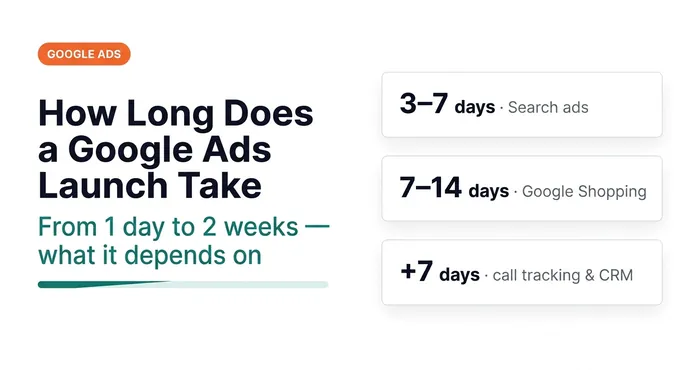 Google AdsHow Long Does a Google Ads Launch Take?From 1 to 14 days: what drives the launch speed of Google Ads, Search and Shopping campaigns. A typical day-by-day plan and where things usually stall.
Contents
First — the business numbers
The first questions aren’t about ads. What’s the margin? What’s the average order value? How much are you willing to pay for a lead or a sale to at least break even? How much do you pay contractors?
Without this, it’s unclear whether ads have any chance of paying off. Sometimes the answer “no” is visible before launch. Selling leather goods in the US with a $30 order value and a 50% margin at around $2 per click would require a conversion rate of about 15%, and online stores don’t get conversion rates like that. I told the client so at the start.
I take cost per click and demand volume from Keyword Planner, and calculate payback in a calculator. Both tools — keyword research and the payback calculator — I made free and published on the site.
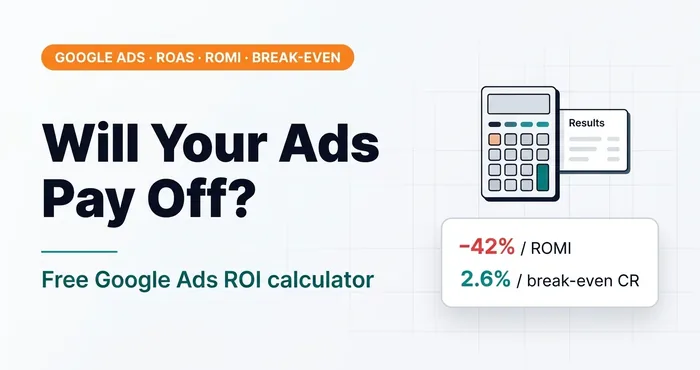 Google Ads · AnalyticsGoogle Ads ROI Calculator: Calculate Before Launch, Not AfterFree online Google Ads ROI calculator: ROAS, ROMI on margin, break-even conversion rate, cost per lead. Model scenarios before you launch ads.
For bigger projects I build a full media plan with several scenarios. I showed what it looks like using the example of sushi delivery in two cities.
Then — analytics and conversions
This is what gets most of my attention at the start. About 95% of the projects that come to me for an audit have tracking problems: it doesn’t work, duplicates conversions, or events fire on the wrong actions. And Google Ads learns from whatever you’ve called a conversion. If repeat calls or every click on a messenger button go in there, the ads will look for exactly those people.
So before launching campaigns I:
- set up Google Tag Manager and GA4 and check that events fire once and on the right actions;
- keep as primary in Google Ads only the conversions I’m sure of: a submitted form, a purchase, a qualified call from call tracking;
- if there’s a CRM, plan sending qualified leads or sales to Google Ads; if there’s no CRM, connect the option that works without one.
I showed how not to set up tracking in my breakdown of an agency that charged $750 a month for it. In a shoe store I worked with after an audit, cleaning up tracking revealed that half the data the ads were learning from was fake.
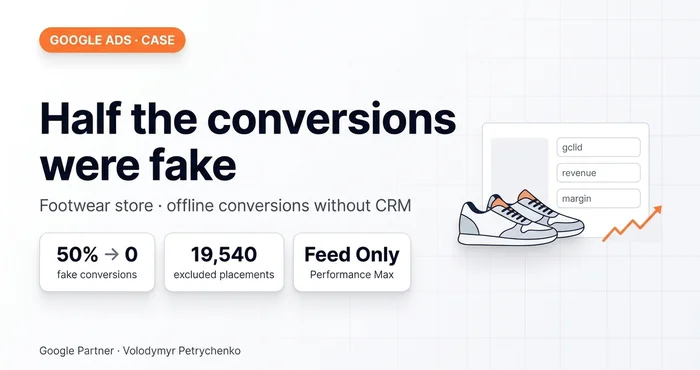 Google Ads case study · End-to-end analyticsTurnkey Google Ads for a Footwear Store: Offline Conversions Without a CRM and a Relaunch After an AuditRelaunching Google Ads for a footwear store after an audit: offline conversions without a CRM, cleaning 50% fake data, feed and PMax on a small budget.
I also look at the website separately: speed, the first screen, forms, product pages. Ads bring the person, but the page does the selling, and ads can’t pull a broken page.
Keywords
The process is standard: I collect keywords, cluster them by direction and group, collect negative keywords right away, and check demand seasonality. For seasonality I now use my own tool: it shows demand by month, quarter and year, and counts Ukrainian and Russian together.
I showed the full process — from collecting and clustering keywords to launching a campaign — in a video:
Collecting and Clustering Keywords, Building Negative Keywords and Launching a Google Ads Campaign

I don’t copy keywords from competitors. A list of someone else’s keywords doesn’t tell you which of them make money and which burn the budget.
Campaign structure
Brand queries are always separate from non-brand. Brand converts better and costs less, and mixed with generic queries it masks the real cost of a new customer. For lead generation the foundation is Search campaigns. Performance Max, where it fits, gets a smaller share of the budget and separate analysis. For an online store — Merchant Center and Shopping ads, which I also launch with their own logic.
I verify the ad account right away so I don’t have to come back to it later.
What about competitor analysis
Competitor analysis in Google Ads, the way agencies sell it, is a look at someone else’s shop window. You see a competitor’s ad, but you don’t see whether it pays off, what tracking they have or how much they’re wasting. That’s why I don’t do it as a separate service at the start.
What I do look at: competitors’ websites, to understand which offers and prices your product will be compared with. And after launch — Auction insights in your own account: who you actually overlap with in the auction and how that changes.
 Google Ads · MarketingGoogle Ads Competitor Analysis: a Service With Zero Practical Value95% of Google Ads “competitor analysis” is a look at someone else’s storefront with no performance numbers. Here’s where it actually makes sense.
What to prepare for the start
For a fast start, prepare answers to three questions — margin, average order value, target cost per lead or sale — and grant access to Google Ads, GA4, Tag Manager and Merchant Center. I explained how in the article how to grant access to Google services.
01 — LaunchTurnkey Google Ads launchOne-time setup + one week of support. Includes basic tracking setup, Google Merchant Center setup and launch (for online stores), Google Ads setup and launch.How I assess the website before launch — see whether you need a website or a landing page for Google Ads.
Where to find me
Message me on Telegram or by email — I respond quickly. Telegram channel and YouTube are for those who want to see real cases before reaching out and understand my approach.