
Marketer, analyst, ex-CMO focused on the Google ecosystem (Ads, Merchant Center, GA4, GTM). Google Partner. 150+ projects, 100+ positive reviews on Freelancehunt, 12+ countries.
- I work directly, with no account managers or subcontractors
- I measure results in sales, not in-platform conversions
- Maximum expertise in the Google ecosystem — instead of “PPC, social ads and SEO, all in one”
Before the start I’m often asked: “Do I need a website or is a landing page enough? And will my current one work?” In short: for lead generation with one service or one product, a landing page is usually enough. An online store needs a full website with product pages. And whether your current site will work depends not on how new it is, but on whether a person from an ad can quickly leave a request on it.
Contents
When a landing page is enough
A landing page is one page for one task: a service, a direction or a product. For Search ads in lead generation it’s often the best option. A person searches for a specific service, lands on a page about exactly that and sees how to order.
My best example is a metal structures manufacturer I’ve been working with for over three and a half years. The client had an old website, but even he didn’t have access to it. Working with that wasn’t an option, so in three days I built a one-page landing page on Wix. Its conversion rate held at 5–8%.
Then I rebuilt the landing page in plain HTML: faster, visually better, with conversion-focused edits. The conversion rate came to 15.79%, and these are unique phone inquiries. I didn’t change anything in the ad account, and I’m comparing comparable seasons. Leads simply got cheaper out of nowhere. From January 1, 2025 to September 12, 2026 — 757 inquiries at 288 UAH each.
Case Study: 2x More Leads Without a Single Change in Google Ads

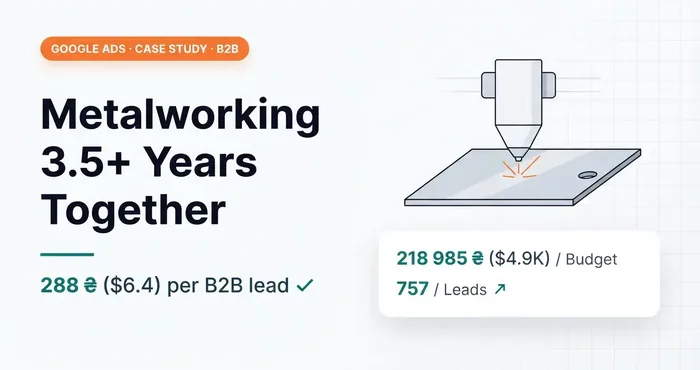 Google Ads case study · B2BGoogle Ads case study: B2B metal processing, 288 UAH ($6.4) per lead over 3.5 years of cooperation3.5 years with a B2B metal fabricator: HTML landing page, call tracking, Google Tag Gateway. 757 leads at 288 UAH ($6.4).
Another example is launching ads in one day. The client sold a single product, a separate WordPress landing page was made for it, I gave edits and the client made them right away. For one product, a separate website simply isn’t needed.
By the way, the site you’re reading this article on was also once a one-page landing page. That was enough to start, and the service pages, case studies and blog were added later, gradually.
When you need a full website
Online store. Shopping ads and Performance Max work through Merchant Center, and it needs product pages with price and availability, contacts, shipping and return terms. A single-product landing page doesn’t cover that. On top of that, Merchant Center checks the site itself, and even how it looks can become a reason for suspension. I wrote about this in the article about the “Website needs improvement” suspension.
Several directions. If you have a clinic with a dozen services or a company with different directions, each direction needs its own page. You can make separate landing pages, or a website with separate service pages. The key is that a person who searched for a specific service lands on a page about exactly that, not on the homepage where they still have to guess where to click.
Expensive or complex product. The more expensive the product, the more a person checks you before buying: reviews, case studies, company information. One screen with a form isn’t enough here.
Will your current site work
A new website isn’t always better than an old one, and an old one isn’t always bad. I check a few things.
Speed. A page that takes a few seconds to load loses some people before they see anything. The metal fabrication landing page in HTML loads instantly, and that’s one of the reasons for its conversion rate.
First screen. Does it answer what the person searched for? Can you see how to order or call without scrolling? In one of my reviews, the menu took up about 20% of the phone screen, and the order button was hidden further down.
Mobile version. In most of my Ukrainian projects mobile traffic dominates. An order button pinned to the screen and a short form on the phone give more than any edits in the ads.
Form. Every extra field means fewer requests. The manager will call back and clarify everything anyway, so for the user the form should be as simple as possible.
Access and tracking. You need to be able to install Google Tag Manager on the site, set up events and connect call tracking. If there’s no access, as was the case with the metal fabrication client, the site doesn’t work, whatever it’s like.
Trust. Reviews, real photos, prices, contacts, address. Especially if the product is premium. I had a client with expensive plumbing fixtures whose site hadn’t changed in six years. Conversion to orders was 0.2%, while I already consider 1% rock bottom. Competitors were cheaper, but their sites looked premium, and this one looked like an HTML site from 2005. For a year I held the numbers steady, but growing them without changes to the site was impossible.
I covered in detail separately why the website is half of the ad result.
 Google Ads · MarketingCRO for Google Ads: It's Not the Ads Wasting Your Budget. It's Your WebsiteCRO for Google Ads: why ads can't save a broken website. Two real teardowns — a landing page and a product page — plus a first-screen checklist.
Check your site in 5 minutes
Take your phone, find your service in Google and open your site the way a client from an ad would. Time how many seconds it took you to understand what’s being sold here and how many to leave a request or call. If it took more than 10 seconds and a few scrolls, start with the site, not the ads. If it’s hard to assess yourself, there’s a website CRO audit.
15 — WebsiteWebsite CRO auditConversion analysis of your website: what stops visitors from ads from leaving a request or placing an order. A list of specific fixes with priorities.
Where to find me
Message me on Telegram or by email — I respond quickly. Telegram channel and YouTube are for those who want to see real cases before reaching out and understand my approach.