
Marketer, analyst, ex-CMO focused on the Google ecosystem (Ads, Merchant Center, GA4, GTM). Google Partner. 150+ projects, 100+ positive reviews on Freelancehunt, 12+ countries.
- I work directly, with no account managers or subcontractors
- I measure results in sales, not in-platform conversions
- Maximum expertise in the Google ecosystem
In an audit of a shoe store the campaign ran on Target CPA, and its monthly spend was lower than the daily budget multiplied by 30. The money was set aside, but the campaign couldn’t spend it: the target simply wouldn’t let it into auctions. In an audit of a household chemicals store all campaigns were on Target ROAS, even though there weren’t enough conversions for that strategy.
A bidding strategy is often chosen on the principle “I’ll set my desired lead price and Google will adjust”. In reality a strategy reflects what the business wants to achieve. It is chosen for that goal and then tested.
Contents
How to choose a bidding strategy based on goals in Google Ads. Usage examples

A strategy is what you ask Google for
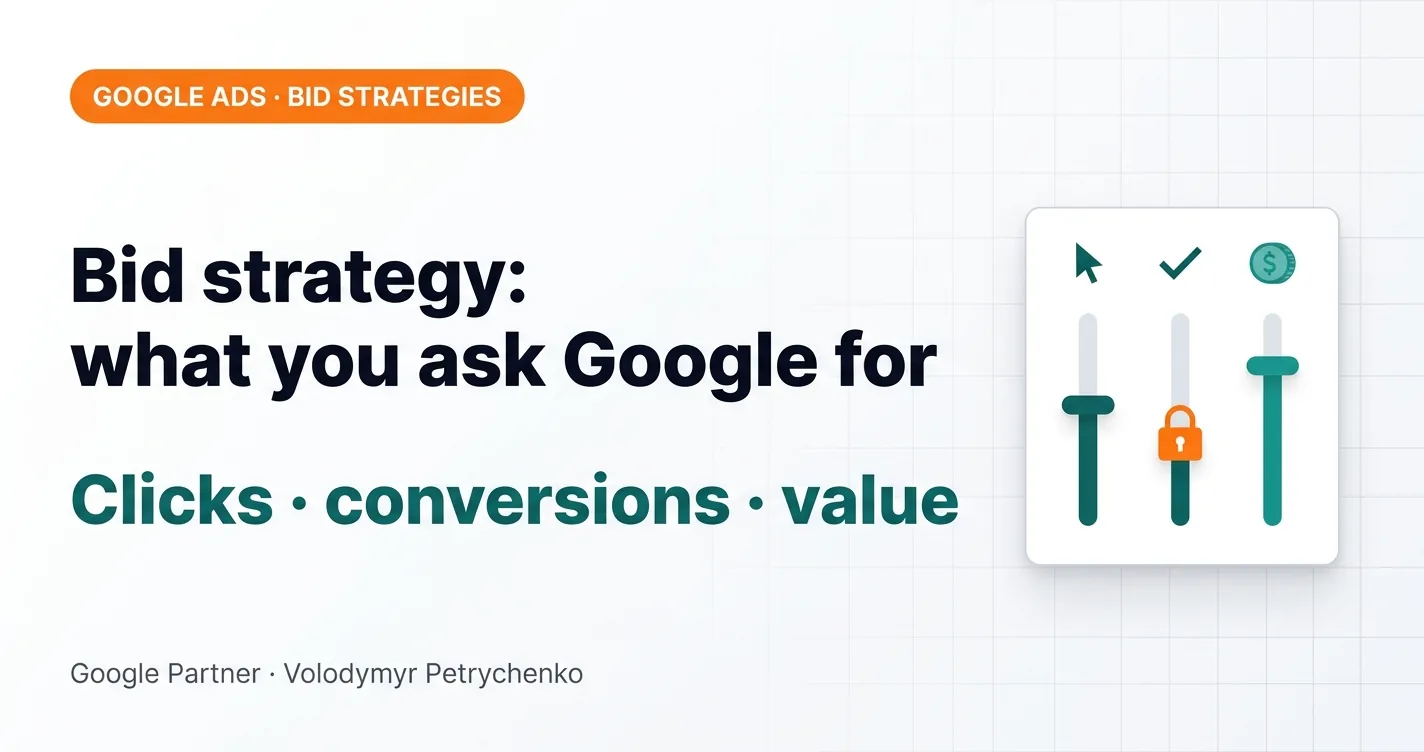
Put simply, a strategy tells Google what to maximize for your money: clicks, the number of conversions or their value. Accordingly, strategies fall into two groups.
Manual — setting the cost per click by hand and “Maximize clicks”. They are about traffic and aren’t much oriented to target actions.
Smart — “Maximize conversions” and “Maximize conversion value”. Each has its own sub-strategy with a target: the first has target cost per conversion (Target CPA), the second has target return on ad spend (Target ROAS).
“Maximize conversions” and “Maximize conversion value”: where I most often start
“Maximize conversions” means: Google, give me as many target actions as possible within the budget. I use it in lead generation, at the start of projects and in online stores where the margin is the same on all products. That happens: a small store with 10 products, 100 UAH (~$2.2) markup on each. Whether it sells a hat for 200 UAH (~$4.4) or trousers for 550 UAH (~$12.2), it earns the same, so there’s no point chasing more expensive sales.
“Maximize conversion value” means: Google, give me the maximum revenue within the budget. Not the number of conversions, but money itself. Most of my online stores run on it or on its sub-strategy Target ROAS.
What matters here is what exactly you pass as value. If revenue goes into Google Ads, the algorithm will chase expensive products even if they are low-profit. That’s exactly how Performance Max at a mobile accessories store started promoting expensive power banks with a 12% margin.
 Google Ads · AnalyticsWhat Is ROAS and How to Calculate It (+ Calculator)ROAS in plain words: the formula, examples, what ROAS counts as good and why a high ROAS doesn’t always mean profit. Online calculator.
“Maximize conversion value” can also be used in lead generation. Suppose the site has a free subscription form and an enquiry form that is already close to a sale. Each goal in the account can be assigned a static value: 1 UAH (~$0.02) for a subscription, 10 UAH (~$0.22) for an enquiry. Then you tell Google: look first of all for those closer to buying, and if that fails, at least subscribers, we’ll warm them up later.
Both strategies learn from what you called a conversion. What is worth passing there I covered in the article what a conversion in Google Ads is.
Target CPA and Target ROAS: restricting strategies
I classify “Maximize conversions” and “Maximize conversion value” as scaling strategies. Their sub-strategies with a target are restricting strategies. You tell Google: here’s the budget, but I need conversions at this price or with this return. And Google decides on its own whether it can manage.
A typical client logic: budget 500 UAH (~$11) a day, I want two leads, I set CPA at 250 UAH (~$5.6) — and Google brings leads at 250 UAH. It doesn’t work like that. If a lead in the niche costs 700 UAH (~$15.6) on average, with a 250 UAH target you may get no traffic at all. Why tight targets at the start choke impressions I explained in the article why there are no impressions in Google Ads.
The second limit is data volume. Google used to say that one conversion a day was enough for strategies with a target. On projects where I have personal Google consultants, I clarified: that’s no longer valid. For Target CPA or Target ROAS to work stably, one campaign should get at least 3–5 conversions a day. I check this on my own pool of projects, and it holds. At the same shoe store I advised first fixing tracking, switching to “Maximize conversion value” and moving to Target ROAS once at least 50 real conversions from offline conversions have accumulated.
The third is the type of business. Target CPA suits lead generation and stores where products cost roughly the same. In an audit of a lock store on Prom Target CPA was set on products with very different prices, and for the system a sale of a cheap and an expensive product was equally valuable.
I’m not a fan of Target ROAS myself. I use it on some projects, but I like “Maximize conversion value” more: it doesn’t restrict traffic.
Manual bids: when I go back to them
“Maximize clicks” is essentially a traffic strategy. The bid limit is set at the level of the whole campaign, and you can’t manage bids flexibly inside it. I use it at the start of a new account to ramp it up quickly, and in projects with a limited budget.
Manual cost per click is more flexible: bids can be adjusted at the ad group and individual keyword level. Enhanced CPC, which used to supplement manual bids, was removed by Google for Search and Display: from March 2025 campaigns on it were automatically moved to manual cost per click.
I have projects with a very limited budget that work successfully on manual bids. Over a long testing period I switched to smart strategies there more than once, they showed no results, and I rolled back. Here is what one such project looks like over 90 days, from July 23 to October 20, 2026: three search campaigns, two on “Maximize clicks”, one on manual bids, 33,387 UAH (~$742) spend and 127 conversions at 262.89 UAH (~$5.84). The task there is to get leads within the budget and not let the click price spike.
But manual bids aren’t a guarantee of cheaper leads. I ran an experiment: two search campaigns, traffic split 70/30, from January 8 to February 12, 2026. On manual bids a click cost 18.15 UAH (~$0.40), on Target CPA 31.37 UAH (~$0.70). Yet a conversion on Target CPA cost 182.71 UAH (~$4.06) versus 248.53 UAH (~$5.52) on manual, 26.5% cheaper.
 Google AdsCPC: What Drives Cost per Click and Why It Keeps RisingWhat drives CPC in Google Ads, why cost per click grows every year and why a pricier click often brings a cheaper lead. A real experiment breakdown.
And “Maximize clicks” without proper tracking is a common trap. At a VR club the search campaign was on it with a click price cap of about 15 UAH (~$0.33), meaning it optimized for traffic, not leads. I recommended switching to manual bidding with adjustments by groups and keywords until tracking was fixed, and then to “Maximize conversions”.
Conclusion
Open the settings of your campaigns and look at two things: which strategy is set and how many conversions a day each campaign gets. If Target CPA or Target ROAS is set and there are fewer than 3–5 conversions a day, remove the target and keep “Maximize conversions” or “Maximize conversion value”. If you’re torn between two strategies, run an experiment for a month and compare the cost of a lead or sale, not the click price.
03 — AuditGoogle Ads account auditI find where the budget leaks: structure, bidding, keywords, conversion tracking, website.
Where to find me
Message me on Telegram or by email — I respond quickly. Telegram channel and YouTube are for those who want to see real cases before reaching out and understand my approach.