
Marketer, analyst, ex-CMO focused on the Google ecosystem (Ads, Merchant Center, GA4, GTM). Google Partner. 150+ projects, 100+ positive reviews on Freelancehunt, 12+ countries.
- I work directly, with no account managers or subcontractors
- I measure results in sales, not in-platform conversions
- Maximum expertise in the Google ecosystem
“What’s better: SEO or search ads?” I get this question about as often as “how much does a click cost”. And the answer usually depends on whom you ask. An SEO specialist will say “SEO”, a PPC specialist “Google Ads”.
I’m a Google Ads specialist, so you’d expect the second from me. But I’m also a marketer and analyst, and my site ads-expert.online lives primarily on organic traffic and content, without any ads. So here’s an honest breakdown: how these channels differ, what they cost and why the question “which is better” isn’t quite the right one.
Contents
What they have in common and how they differ
Both channels work with the same demand. A person types “air conditioner repair kyiv” into Google and sees ads at the top and organic results below. The difference is how you get there.
| Google Ads | SEO | |
|---|---|---|
| How you get into the results | you pay per click in an auction | the site ranks by quality, content and links |
| Speed of results | days, sometimes hours | months |
| What happens if you stop | traffic disappears the same day | traffic holds for a while, then drops |
| Control | queries, location, time, budget, bids | you influence it indirectly |
| Measurability | every click and conversion | harder, a lot is attributed to direct |
| What you pay with | click budget + specialist’s work | content, technical improvements, links + specialist’s work |
Google Ads captures existing demand and does it fast. Launched today, first clicks today. How search ads work and what you pay for, I broke down in the article search ads and the cost per click.
SEO captures the same demand, only much more slowly. And here I disagree with the popular “SEO is free and forever”.
Free? No. You still pay for technical website improvements, link building and content. Forever? Also no. Look at what happens to organic traffic after the next Google ranking algorithm update. It doesn’t dip, it simply collapses.
What the numbers say: 9,171 leads and 425 deals
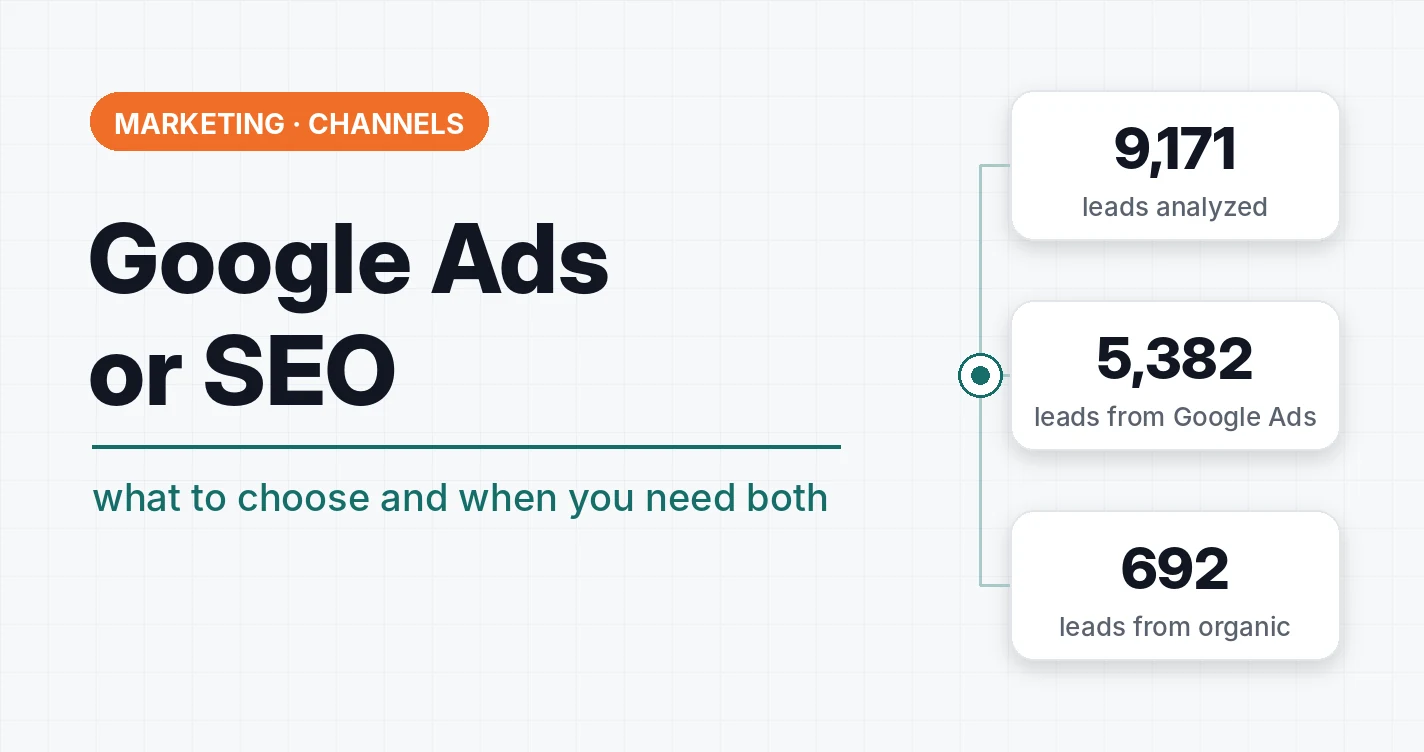
The most honest way to compare channels is by deals. Clicks and even leads say little here. On one multi-channel project I analyzed 9,171 leads and 425 deals from February to September 2026.
Organic together with YouTube and Instagram gave the lowest lead quality but the best lead-to-deal conversion: 10.5% vs 5.0% for Google Ads. You’d think you should put everything into organic.
But look at the volumes. Organic and other free sources brought 692 leads. Google Ads brought 5,382. Yes, organic converts great, there are just very few leads there. This project can’t be carried by organic alone.
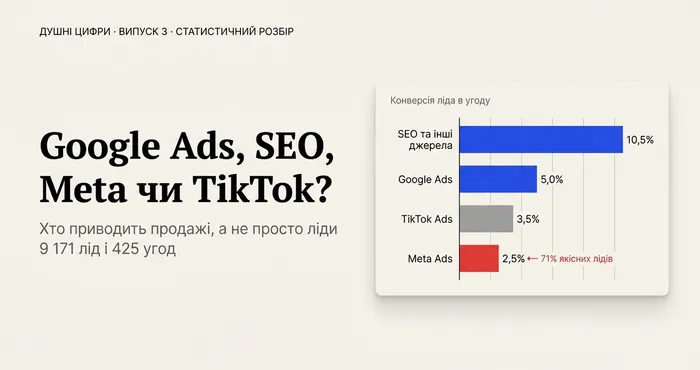 Analytics · MarketingWhich Is Better: Google Ads, SEO, Meta or TikTok Ads? A Breakdown of 9,171 Leads and 425 DealsA breakdown of 9,171 leads and 425 deals: which channel brings sales, not just leads, what a deal costs in Google Ads, Meta and TikTok, and where to start.
Another example is from another client’s end-to-end analytics. They worked on organic for a long time and actively, but mostly for traffic and rankings. The result: only 44% quality leads from organic vs 70% from search ads. That’s not a reason to turn off SEO. It’s a reason to reconsider which queries it targets. Without end-to-end analytics you’ll never see this.
When to start with Google Ads
- You need results now. A new business, a new line, a season that starts in a month. SEO won’t manage anything in a month.
- There is established demand. People already search for your product or service. If there are no searches, neither ads nor SEO will help.
- You need to test. Do people buy at this price, what’s the site’s conversion rate, which queries actually sell. Google Ads answers in a few weeks, and that data will later be useful for SEO.
- A competitive niche with expensive SEO. In some niches, reaching the top of organic results takes years and serious money for links. Ads give visibility right away.
When SEO matters more
- A long horizon. A business planning to work for years will overpay for every client without organic traffic.
- Informational demand. People first search how to choose, compare, read. For such queries ads are often ineffective, while an article works for years.
- Trust and expertise. A website that answers clients’ questions sells better. This applies to ads too: a person from an ad often goes to read who you are.
- AI search. ChatGPT, Gemini and AI Mode in Google answer based on content they find online. If your content isn’t there, you aren’t there either.
I develop my own site exactly this way: blog, case studies, YouTube videos, and no ads for self-promotion. But my situation is specific: my clients take a long time to come, they read and watch. For an online store with products in hot demand, this approach alone won’t work.
How they reinforce each other
The best answer to “SEO or Google Ads” is both, but in the right order and with an understanding of each one’s role.
Ads give data for SEO. The search terms report shows which queries people actually buy from. That’s ready-made keyword research for pages and articles, tested with money.
SEO lowers the cost of ads. A technically fast site with a sound structure converts better, and ads to it pay off better. When I did SEO and technical optimization for a food delivery website, most of the fixes worked for both organic traffic and the conversion of ad traffic at the same time.
Brand. The more people see you both in ads and in organic results, the more often they search for you by name. And branded traffic is the cheapest and best-converting there is.
What you definitely shouldn’t do is evaluate channels in separate reports and reward contractors for the same sales. Depending on the attribution model, the PPC specialist credits the sale to himself, the SEO specialist to himself, and you essentially have the same sale. Compare channels by cost per deal over time, and only in one system.
Key takeaway: Google Ads and SEO capture the same demand at different speeds. Ads deliver results and data now; organic lowers the cost per client over time.
My recommendation on the order
If the budget is limited and you need results fast, start with Google Ads. Then develop SEO and content in parallel, using data from the ads: which queries sell, which pages convert.
If you stop at one channel and your competitors don’t, their marketing will work harder than yours. On hot demand without trust and recognition, you’ll quickly become just another “store called store”.
Before choosing, calculate how much a client from ads will cost in your niche. That’s what the Google Ads payback calculator is for: cost per click, site conversion rate, average order value and margin. If the numbers don’t add up even in a good scenario, the problem isn’t the channel.
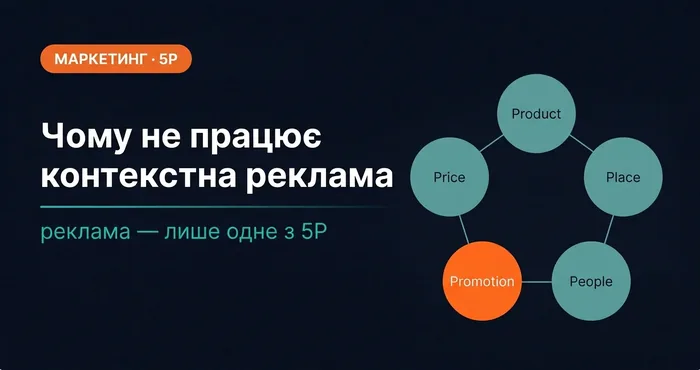 MarketingWhy PPC Isn't Working: The 5P Marketing Model for Business OwnersGoogle Ads is just one of five marketing elements. 5P explains where the business is responsible and where the specialist is.
Where to find me
Message me on Telegram or by email — I respond quickly. Telegram channel and YouTube are for those who want to see real cases before reaching out and understand my approach.