
Marketer, analyst, ex-CMO focused on the Google ecosystem (Ads, Merchant Center, GA4, GTM). Google Partner. 150+ projects, 100+ positive reviews on Freelancehunt, 12+ countries.
- I work directly, with no account managers or subcontractors
- I measure results in sales, not in-platform conversions
- Maximum expertise in the Google ecosystem — instead of “PPC, social ads and SEO, all in one”
Plenty of businesses, specialists and marketers don't understand what a marketing strategy is, and confuse it with anything and everything except the strategy itself.
Contents
In consultations and at the start of a project, to size up a client, understand how they think and where they're heading, I ask a simple question: “What's your marketing strategy?” If I hear “our strategy is to increase sales,” I know they don't have one. Growing sales by 10%, 15%, 20% or any other percentage isn't a strategy — it's a goal, a business target. A swap of concepts.
Key point. Businesses without a strategy always lose to businesses with one over the long run.
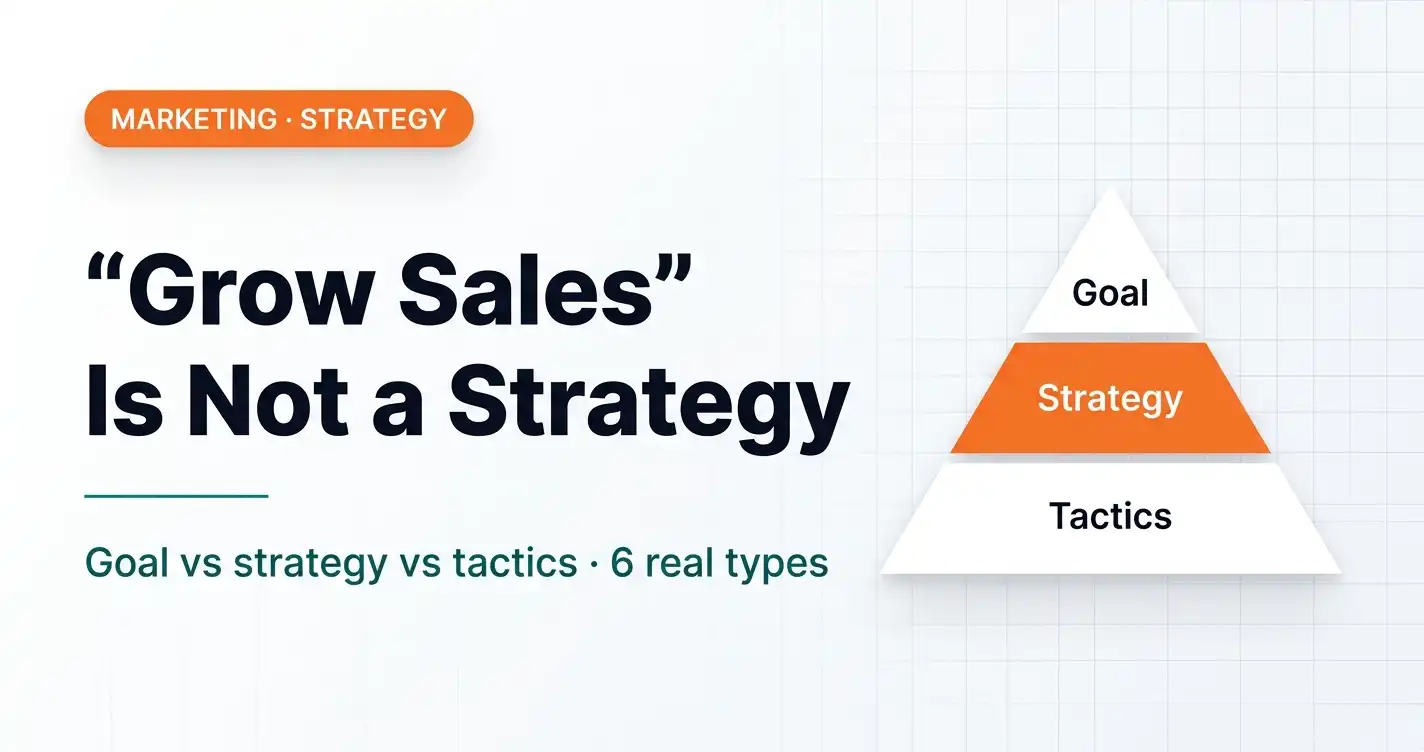
Strategy, tactics, goals — three different things
The goal is what you want to achieve. “Win the match.” “Increase sales.”
Strategy answers the question “where are we heading at all, and what will get us to the goal” — a long-term direction set well before the game itself, based on an analysis of your own strengths and weaknesses and those of your opponent.
Tactics are the specific actions that carry out the strategy during the game itself: substitutions, player formation, who takes corners, who takes penalties, betting on physical strength and pressure in the second half or playing defensively and on the counter — all of this is a choice of tactics for a specific opponent in a specific match, subordinate to the club's overall strategy.
Marketing works exactly the same way. The goal — say, to become the go-to expert in the Google Ads niche. The strategy — bet on showing real expertise instead of direct advertising. The tactics — the specific tools that implement this strategy: a blog, YouTube, a Telegram channel, specific articles and content formats.
Google Ads search advertising on its own is a tactical tool in a marketer's hands. It makes no sense without a strategy, which is set by business owners or top management: tactics always follow strategy, not the other way around.
Examples of real marketing strategies
Differentiation strategy
You create unique value in your product or service, so the client consciously chooses you and is willing to pay more, ignoring the other options.
The classic example is Apple. I love this brand myself, so I want to break it down in more detail. Technically, their devices' specs are often not the best on the market for the money compared with Android competitors. But the differentiation isn't about “more gigahertz” — it's about the ecosystem, design, status and user experience. And the customer knowingly pays more, ignoring objectively cheaper and sometimes technically stronger alternatives.
Cost leadership strategy
A focus on cutting production and operating costs as far as possible, which lets you keep the lowest price on the market and stay profitable through massive sales volume. The most striking examples in Ukraine are ATB and Avrora, two large discount retail chains. Small markup, profit from scale. This is the low-cost strategy.
Focus strategy (niche strategy)
This approach is about me. The point is to give up on trying to please everyone completely. Trying to reach everyone means meaningfully reaching no one.
Have you ever seen a Porsche for people on a budget? There's no such thing. The VAG group deliberately splits its brands across different target audiences — each brand has its own positioning, and none tries to be mass-market and premium at the same time:
| Brand | Target audience | Positioning |
|---|---|---|
| Škoda | Budget segment, practicality | Best value for money |
| Volkswagen | Mass mid-market | Reliability, the “people's car” |
| SEAT/Cupra | Young audience | Dynamics, design, affordable sportiness |
| Audi | Premium segment | Technology, status, understated luxury |
| Porsche | Luxury, enthusiasts | Performance, prestige, emotion |
| Bentley/Lamborghini | Ultra-luxury | Exclusivity, handcrafting, top-tier status |
One group, seven completely different strategies for seven different audiences. No brand tries to be Škoda and Porsche at the same time.
A real-life case. I recently wrote up a case about grills and barbecues in the upper-mid price segment. The client suggested adding cheap grills to the site to also reach the budget audience. I rejected the idea right away — you can't be a premium and a budget brand at once. That has to be split into two separate brands with different positioning, USPs and media tools, not mixed in a single catalog.
More than seven years ago I stopped doing all of marketing at once — I'd been doing paid social, SEO, email campaigns and offline advertising. I narrowed my focus to one tool: Google Ads and everything around it. At first I also had a “focus on everyone” phase — I took on anything that came along, no filter. Then I figured out what I don't want to work with: certain niches, a certain type of client, guys who want results within a month. For example, I don't work with niches that bring no value at all (gambling, betting, fortune tellers) or that are some form of fraud, even though they pay good money. All of that is part of the strategy too.
Inbound marketing and content strategy
The idea is to turn the company into a useful media resource. Instead of pushy direct advertising, potential clients come on their own, looking for answers in useful content.
In direct advertising (Google Ads, Meta), the cost of acquiring a client in the marketing niche is crazy money. Through my referral program I can pay up to 10,000 UAH ($222) for a client referral — and that's still cheaper than acquiring through search ads.
When I started building my YouTube channel two years ago, I knew it wasn't a “right now” thing. SEO and visibility in AI search are long-term investments too. I see no point in running ads for myself personally: the competition in this niche is incredible, there are tons of agencies and freelancers. This isn't a blue ocean — it's a crimson river full of hungry crocodiles.
My strategy is built on selling expertise. It's carried out through tactical tools — the blog, a Telegram channel, LinkedIn, YouTube and other channels.
Customer retention and lifetime value growth strategy
Instead of spending on acquiring new users, you maximize profit from existing clients. Lifetime value is how much a customer brings in over the entire relationship.
The cases about a pizzeria (6 years of work together), rolled metal (3.5 years) and metal processing (3.5 years) are exactly the proof that this strategy works for me. It comes from giving more than people expect from me: quality service, constantly bringing new things into the ads, clear communication with clients.
Market penetration strategy
An aggressive fight for share in an already established market through tactical moves. One of my favorite examples among Chinese companies is Temu: the strategy is to capture a certain market share, and then come price dumping, heavy affiliate marketing and a big media budget as tactical tools.
From practice: I get requests like “we want to enter the Moldovan or Romanian market, launch ads there.” Friends, I hope this sinks in: to enter a new market, just launching ads isn't enough. When you're a no-name brand in a foreign country, the first question is why anyone should come to you at all. Simply advertising isn't a strategy and has nothing to do with strategy. People run businesses without understanding what a marketing strategy is or how to enter a new market.
Branding and public relations strategy
A focus on building a long-term mental connection between the brand and its audience, shaping reputation, trust and a clear set of associations around the company.
In the case about premium whiskey from Ireland, this is exactly the strategy I recommended to the client. It fits best for premium and luxury segments, financial and medical institutions, where trust is critical. Soon I'll publish a case about promoting a multi-specialty clinic that has no branding strategy, yet wants people to come to them without established trust. Friends, it simply doesn't work that way.
It's achieved through regular public speaking, media coverage, participation in rankings (mostly bought and re-bought), social initiatives, charity and work with influencers.
Strategies can be combined
As it grows, a company can change or combine strategies. I have one global strategy and several sub-strategies that work together and complement each other: retention and lifetime value growth for existing clients, a niche strategy to focus on one specific area, and inbound marketing plus content strategy to attract new clients.
Strategy isn't for one year
Key point. Strategy is a compass, not a calculator: it sets the long-term direction of the business and outlines its global potential, leaving the detailed metric-counting to tactics.
Strategy is a vision several years ahead, usually 3–5 years, not the “here and now.” The term “one-year marketing strategy” is the same swap of concepts. There's one global strategy for 5 years that you can adjust or completely change — but then you're developing a new strategy, not making a “strategy for the year.”
What goes into annual planning is, to return to the football analogy, tactics: which tools you use and which goals you want to reach this year — but within the global strategy.
Four books every business owner and C-level manager should read
I've personally read all four books — some of them several times — and can recommend them with confidence.
1. Good to Great — Jim Collins. A study of why some companies make a long-term breakthrough and become great, while others stay merely good or decline.
2. Managing Corporate Lifecycles — Ichak Adizes. The anatomy of a business's life, from birth (“courtship”) to aging and bureaucracy.
3. Blue Ocean Strategy — W. Chan Kim, Renée Mauborgne. How to escape exhausting competition (the “red ocean,” where everyone fights over the same audience and undercuts prices) and create a new, uncontested market.
4. Achieving Excellence Through Customer Service — John Tschohl. How service can be not just a support function but a standalone strategic advantage — and why customers pay more and stay for years because of the quality of service, not only the product.
Where to find me
Message me on Telegram or by email — I respond quickly. Telegram channel and YouTube are for those who want to see real cases before reaching out and understand my approach.