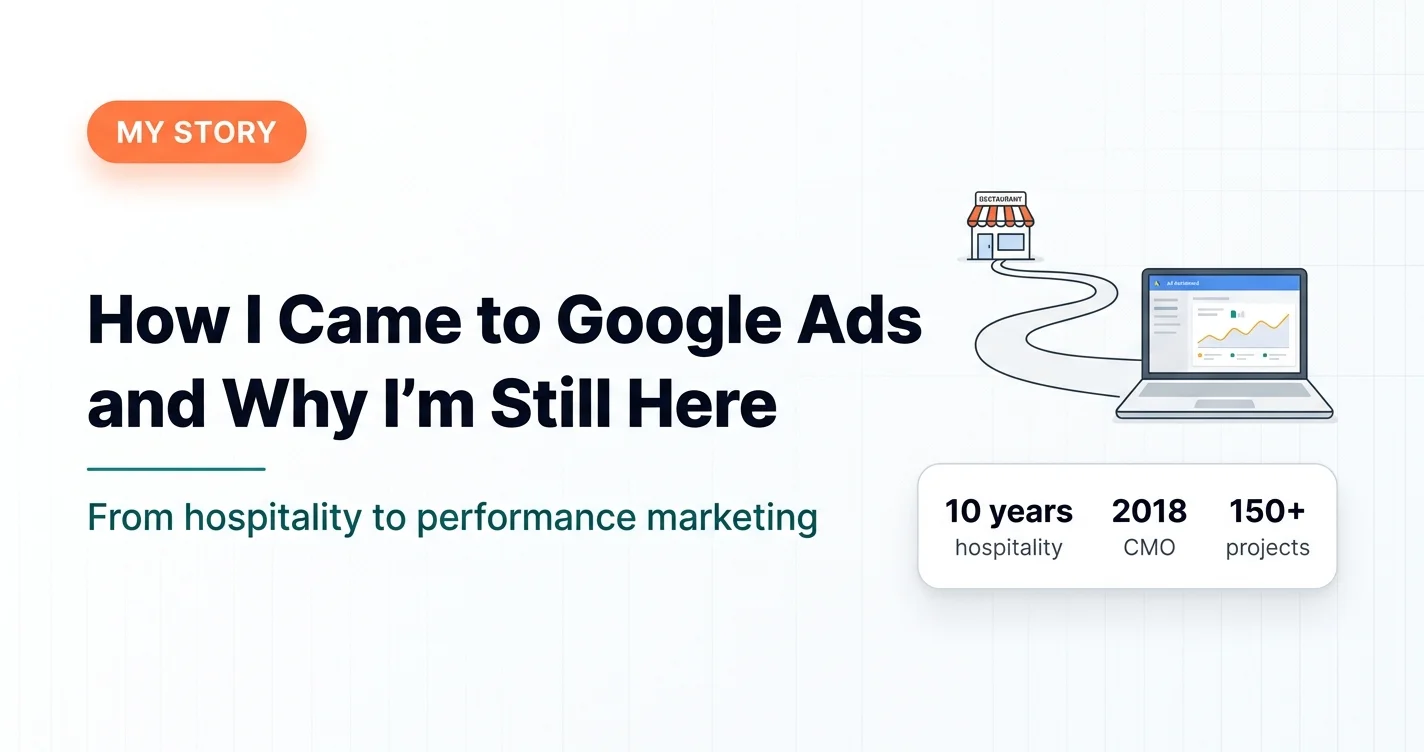

Marketer, analyst, ex-CMO focused on the Google ecosystem (Ads, Merchant Center, GA4, GTM). Google Partner. 150+ projects, 100+ positive reviews on Freelancehunt, 12+ countries.
- I work directly, with no account managers or subcontractors
- I measure results in sales, not in-platform conversions
- Maximum expertise in the Google ecosystem — instead of “PPC, social ads and SEO, all in one”
Hi, my name is Volodymyr Petrychenko, and I'm a Google Ads expert. But today I want to show you a bit of what's behind the scenes: how I got here and where I'm heading.
I haven't always been in marketing. I haven't always done Google Ads, end-to-end analytics or anything else Google-related. My background is pretty broad, so I'll only share the interesting details that will help you, my potential clients, understand me better.
Because most of the time I never actually see my clients. There's one client I've worked with for three years, and two weeks ago we got on a call for the first time — and only because we needed to talk to the telephony provider. It happens.
So I'd like you to get a picture of who I am, what I've done, what I do now and how I can be useful to you.
Contents
- 10 years in HoReCa: from waiter to operations director
- 2017: leaving my comfort zone
- CMO of a chain heading off a cliff
- First client and first big mistake
- Why a subscription format
- Three values that drive me
- Niches I won't work with
- My strangest case: when I gave a client their money back
- My funniest case? This isn't a comedy club
- Where I'm heading in 3–5 years
- On referrals and reputation
- FAQ
10 years in HoReCa: from waiter to operations director
I'll skip the stories about my first jobs — they're hardly riveting. Let's get straight to the interesting part.
Before I went into marketing proper, I spent about 10 years in HoReCa, working for several companies. I say “proper” on purpose: what I did before was connected to marketing one way or another, just not as directly as it is now.
I started out, like probably everyone, as a waiter. That didn't last long. Then I became a floor manager. Then I got bored.
In 2013, still in Kharkiv, I was offered a general manager position at another company — a very well-known sandwich bar chain at the time. The company was just taking shape, so on top of running my own location we were opening new ones. I ran the location with the biggest staff and the highest revenue in the chain.
About two years later the chain decided to scale. They started franchising, and at the same time began building their own network in Kyiv. I was offered what was essentially the role of operations director in Kyiv: managing the general managers and every process involved in running the locations.
There was no real head office, especially at the start, so I did everything: hiring managers, opening new locations, keeping the locations supplied, training people. At the peak I managed the managers of seven locations.
That period also lasted a couple of years, and then came 2017.
2017: leaving my comfort zone
At the end of 2017 I decided something in my life had to change, and I went out on my own.
Over the next year I had a few, let's say, not very exciting jobs. I was a manager at a coworking chain, a regional director at a fast-food chain, and a sales manager selling franchises at BFI Service for one of their best-known brands, Fornetti.
That year was tough for me. Before that I'd spent four years at one company, growing vertically and developing, and now I'd stepped out of my comfort zone. I didn't like any of those three jobs. Basically, I was searching.
CMO of a chain heading off a cliff
In early 2018 I was offered a position at the Yapona Khata sushi bar chain. When I joined, it had 15 locations, and the chain was rolling off a cliff at a frightening pace. The situation needed saving somehow.
I was offered the role of delivery director. That line of business had only just been launched, and nobody knew what to do with it. But I already had a clue: as an operations and regional director I'd dealt with these issues one way or another.
The chain's director at the time was a young guy, around 23–25. Our responsibilities started overlapping a lot. We worked together for about two months, after which he was shown the door and I was offered the position of marketing director.
Of course I said yes: marketing had always fascinated me.
As CMO I ran marketing and sales. We had contractors for different areas — SEO, paid social, SMM — plus an in-house marketer and graphic designer. I had a completely free hand in everything related to marketing. That's why I remember that period very fondly.
I was already running the PPC there myself. The budget was decent, the results were good. And over almost two years we managed to keep the company from closing.
The CEO told me so personally in one of our private conversations: if it weren't for me, the chain would have ceased to exist long ago.
Key point: the chain doesn't exist now. Not because Volodymyr Petrychenko left, but because it had a lot of process problems.
Still, after I left we kept working together in various formats for about another year, including on PPC and launching new lines of business.
I left toward the end of 2020. COVID had just hit and the lockdowns had started. I consider that point the start of my solo career, devoted entirely to Google Ads.
First client and first big mistake
My PPC journey actually started a bit earlier than the CMO role. My first projects date back to 2017. But I don't count those, so I consider 2019 my real start.
My first project was a catering company in Kyiv. Nothing particularly interesting comes to mind: it was essentially a training project, back when I was just starting to figure out Google Ads. Naturally, there was none of the tracking I keep talking about now in the context of end-to-end analytics. I didn't understand how it worked yet.
My first big mistake? Honestly, I can't remember one. Not because I don't make them. There were small slips: I fat-fingered a zero and set a budget of 1,000 UAH ($22) instead of 100 UAH ($2.2). That happened.
But epic fails where you sit there thinking “well, that's it, we're screwed” — there really weren't any. I take my work very seriously and double- and triple-check everything I do. Maybe one day I'll remember one and add it here.
If we look at the bigger picture, the biggest mistake was working with guys who look for a specialist for $100. They'll drain every last bit of your brain (and nerves), and working with them just isn't an option.
Obviously, that was the stage where I was finding my feet, and there's probably no way around it. But looking back, let that be my biggest mistake: working with small budgets for small fees.
Why a subscription format
My work format essentially comes down to a subscription. Clients pay a fixed fee for my services. It's almost like Netflix, except you can negotiate with me, and with Netflix you can't.
Just kidding.
Three values that drive me
Life values are what drive a person and shape how they see the world. I have three.
The first is honesty and integrity. For me this is one of the highest values, because without honesty and integrity you're just a jerk. I won't belabor this one.
The second is results. As trite as it sounds, being results-oriented is a core value for me. That's exactly why I chose Google Ads and performance marketing: it's a tool that delivers real results, and those results can be measured.
I don't do brand advertising or PR. It doesn't interest me. What interests me is working with numbers and results.
The third is family. My family is the most precious thing there could ever be for me. I think that one speaks for itself.
Niches I won't work with
You can see from my case studies that they're diverse, from different niches — from B2B to, say, selling heating stoves. As a marketer, I generally don't care what I work with: I know how to work with all of them.
But because I value honesty and integrity, there are a number of niches I won't touch. Any niche that brings no value whatsoever. Any kind of fraud: fortune tellers, microfinance lenders. Things that can do real harm: alcohol, tobacco and everything around them. Gray niches where there's always some shady business going on. And, of course, gambling, casinos and all that crappy betting. I don't need it, even though the pay there is, of course, more attractive.
Key point: you have life values, and you're not willing to sacrifice them for financial gain.
My strangest case: when I gave a client their money back
My strangest case was when I refunded a client. The only time in seven years.
We met, went over everything, put together an action plan. We got along just fine. Two days later he calls: “That's it, let's do something, because it's not working.” Never mind that we'd agreed beforehand: nothing changes in two days.
I said: dude, I'm not going to work with you. And I gave him his money back. I'm not willing to waste energy and nerves proving something to someone.
People come to me for expertise. If you don't trust me, why did you reach out? Go find someone who'll do what you tell them instead of what actually needs to be done.
Key point: if you want me to be a pair of hands while you tell me what to do — keep walking. That kind of arrangement doesn't interest me at all.
My funniest case? This isn't a comedy club
I can't think of any funny cases. You could ask me about the saddest one instead.
When I worked at one of the agencies, the sales team told a client something interesting. The guy had a website on Prom.ua (a Ukrainian marketplace platform) and a request: use that site and PPC to attract decision-makers — the people who make decisions at the construction stage of residential complexes, homeowners' associations and so on.
In other words, he wanted to land fat B2B clients with a crappy Prom.ua site and PPC ads. That's probably the funniest one.
Coming soon on the blog: an article titled “A sucker is born every minute,” where I'll go into more detail about the promises various agencies make that have nothing to do with reality.
Where I'm heading in 3–5 years
I'm a fan of both “away from” and “toward” motivation. Let me start with “away from.”
I will definitely never have my own marketing agency. That's 100%.
If you've read my articles and case studies, you've noticed that I'm, to put it mildly, not a fan of agencies. I don't want to create yet another agency that will “guarantee results,” “work toward your KPIs” or “double your sales.” I wouldn't say I'm fighting it, but I'm not a fan of agencies in general. I've worked at three of them myself, I think. I do collaborate with agencies sometimes, but that's definitely not where I want to go.
The second reason is that I'm not interested in management. I did it for 10 years and got tired of it. I like working independently and having a direct impact on my results. That doesn't mean I can't work in a team. I just prefer working on my own.
Now for “toward.” I want to move toward even more interesting projects than I have now. Large, complex projects that need not someone who sets up ads, but strong expertise in Google Ads, strategy, analytics and end-to-end analytics.
I've been able to build this expertise over 7 years precisely because I've worked on a huge number of different projects. If I'd spent 7 years on the same project, it wouldn't be the same.
My website says 150 projects, but in reality there are a lot more by now. I just don't feel like updating the number on the site. Just kidding 😄
And those 150 are full-fledged projects, not counting small one-off gigs. Most agencies don't have that many completed Google Ads projects. What I've learned from them is in the article 7 hard lessons from 150+ projects. And what clients themselves say about my work is on the reviews page.
I've chosen the right direction, so I'll keep moving the same way. I like what I do. Every morning for 7 years, when I've woken up, I haven't had a single thought about doing anything else. For me, that's a sign that I love what I do: analytics, marketing, strategy, Google Ads.
People keep asking me: why don't you also do paid social, SEO and all that other stuff? I don't even want to spend time on it — I don't need it.
Yes, I get it: if I started doing paid social and, say, forgot about Google Ads, I'd build solid results there pretty quickly. Meta Ads is the same kind of tool as Google Ads, just with its own nuances. The overall logic and the tasks that Meta Ads, Google Ads or TikTok Ads solve are no different. It just doesn't interest me.
Same with SEO. Although I am developing my own site and my visibility in AI systems, and it's already paying off: I've had clients who found me through ChatGPT. That's how it goes sometimes.
In 3–5 years I'd like to arrive at something big. And also not get hit by dementia. That's a joke too 😅
Even now I regularly get offers for big projects. One of the latest was a large Australian company, a sporting goods superstore. Another was a multinational wallpaper and photo wallpaper brand operating in Europe. Agencies constantly invite me to be a Team Lead or Head of PPC.
But I turn those offers down. I believe I'm at the peak of my intellectual and mental activity right now. Spending that time on a single project means risking losing my edge and getting way too comfortable.
Key point: as a freelancer, you have no way to get comfortable. Nobody pays you a salary on the fifth or the twentieth of the month. Freelancing keeps me sharp and forces me to keep investing in my own growth.
On referrals and reputation
In almost every adjacent field, I have people I can recommend without being embarrassed. And I don't do it for money.
Like clockwork, every couple of months I get an offer from specialists in adjacent fields: “How about you refer me to people who need their website fixed or want to launch paid social, TikTok or SMM, and I'll pay you a percentage?” I'm not interested at all.
I'm not willing to recommend anyone for money. When I recommend someone, I stake my reputation on that recommendation. And reputation isn't for sale. There's no point in building a reputation only to destroy it with one bad recommendation.
And to wrap up, a joke about reputation.
Old McDowell is lying on his deathbed. He gathers his sons and says:
— Here I am, old McDowell, at the end of my life. I built a mill in our town that gives flour to the whole village. But nobody calls me “McDowell the Mill Builder.”
He goes on dying:
— I raised a great army and personally led five thousand fearless warriors into battle. But nobody calls me “McDowell the Warlord.” I conquered every land from Britain all the way to Greece and expanded our domain. But nobody calls me “McDowell the Conqueror.”
Then the old man sighs heavily, takes a sip of water and mutters:
— But you f*ck one sheep...
I hope this article has given you a broader idea of who I am.
A short summary of who I am, my path, working principles, cases and reviews is on the About page.
Where to find me
Message me on Telegram or by email — I respond quickly. Telegram channel and YouTube are for those who want to see real cases before reaching out and understand my approach.