
Marketer, analyst, ex-CMO focused on the Google ecosystem (Ads, Merchant Center, GA4, GTM). Google Partner. 150+ projects, 100+ positive reviews on Freelancehunt, 12+ countries.
- I work directly, with no account managers or subcontractors
- I measure results in sales, not in-platform conversions
- Maximum expertise in the Google ecosystem — instead of “PPC, social ads and SEO, all in one”
If you look at all my case studies, you will notice they are very different: online stores, lead generation, B2C, B2B, mixed audiences. A fair question: can one specialist work with so many different niches and deliver results? As you can see, yes: a pizza delivery case, 6+ years of cooperation, CPL 42 UAH ($0.93) or a B2B metal processing case, CPL 288 UAH ($6.4).
Contents
Here is the key point: there are two types of Google Ads specialists. The first are people who know the interface well, can press the right buttons, build a campaign structure, set up conversions and play with bidding strategies. I call them “button pushers” — better than someone who cannot use the interface at all, but nothing more.
The second type are marketers who understand both the interface and marketing. I have over 10 years of experience in marketing, 7 of them exclusively in the Google Ads ecosystem. I have worked in different niches and positions, including management roles, so I understand how marketing works regardless of the niche.
When choosing a contractor, there are two options: someone who has already worked in your niche, or someone who understands marketing first and foremost. For a good marketer, entering a new niche takes 2–3 weeks — that is how long it takes me to fully understand the audience in a niche I have not worked with before.
Compared with a specialist who has already worked in a specific niche, they only win the first 2–3 weeks thanks to ready-made approaches from a previous project. Over time I always win, because I work with the unit economics of the business, not just the ad account.
Key takeaway: a Google Ads account is a tactical tool in the hands of a marketer. For a button pusher it is pseudo-strategic: they think they are managing strategy, but in fact they are managing tactics. Advertising is only part of marketing, and marketing is a large, complex system.
About the project
A heating stove manufacturer. Mostly a B2C audience; there is also a B2B segment, but it is a small share of revenue.
The numbers
The period is September 1 to January 31 — the whole season: historically, almost nobody buys stoves from February on.
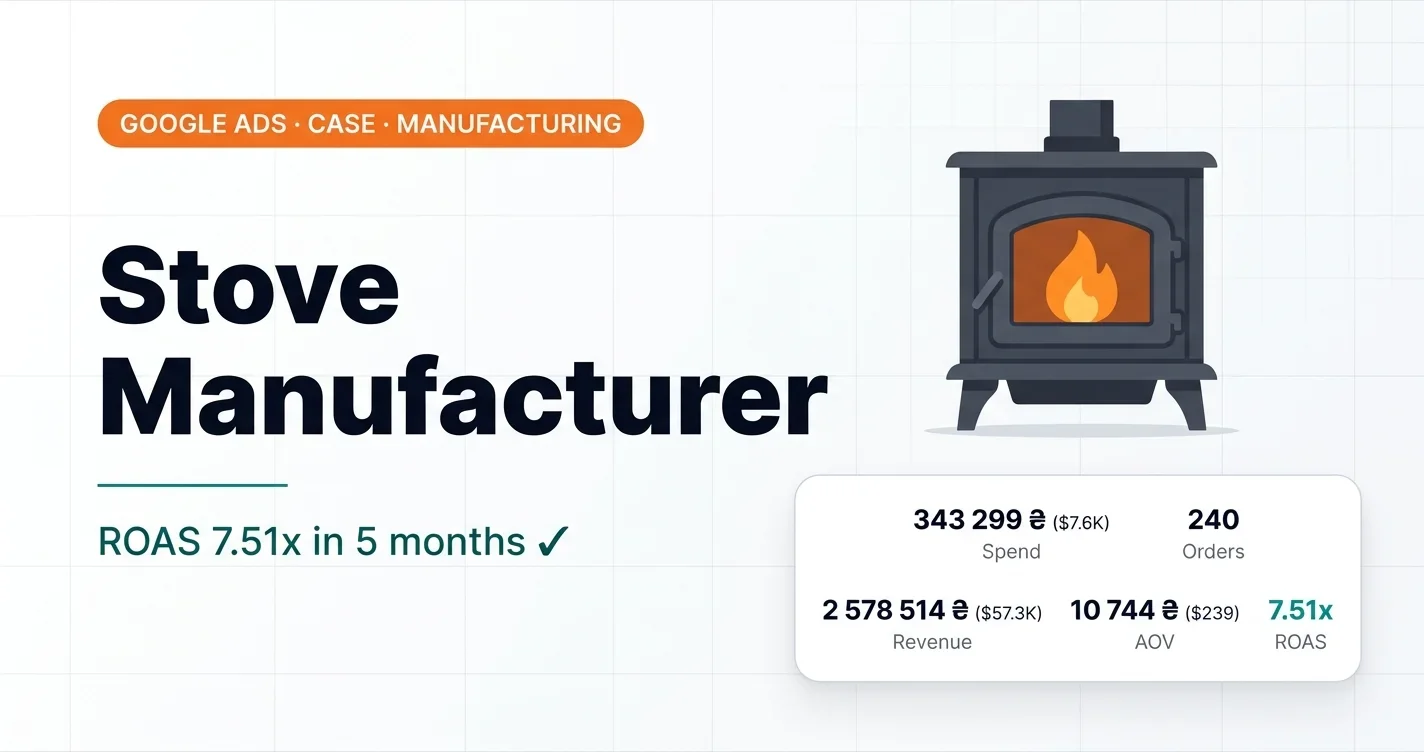
The first dashboard shows only orders from Google Ads plus orders from an unknown source (less than 10% here; in my experience, 10–15% of data never reaches the CRM, depending on the project). For this period: 240 orders worth 2,578,514 UAH ($57.3K), ad spend of 343,299 UAH ($7.6K), average order value of 10,744 UAH ($239), ROAS of 7.51x.
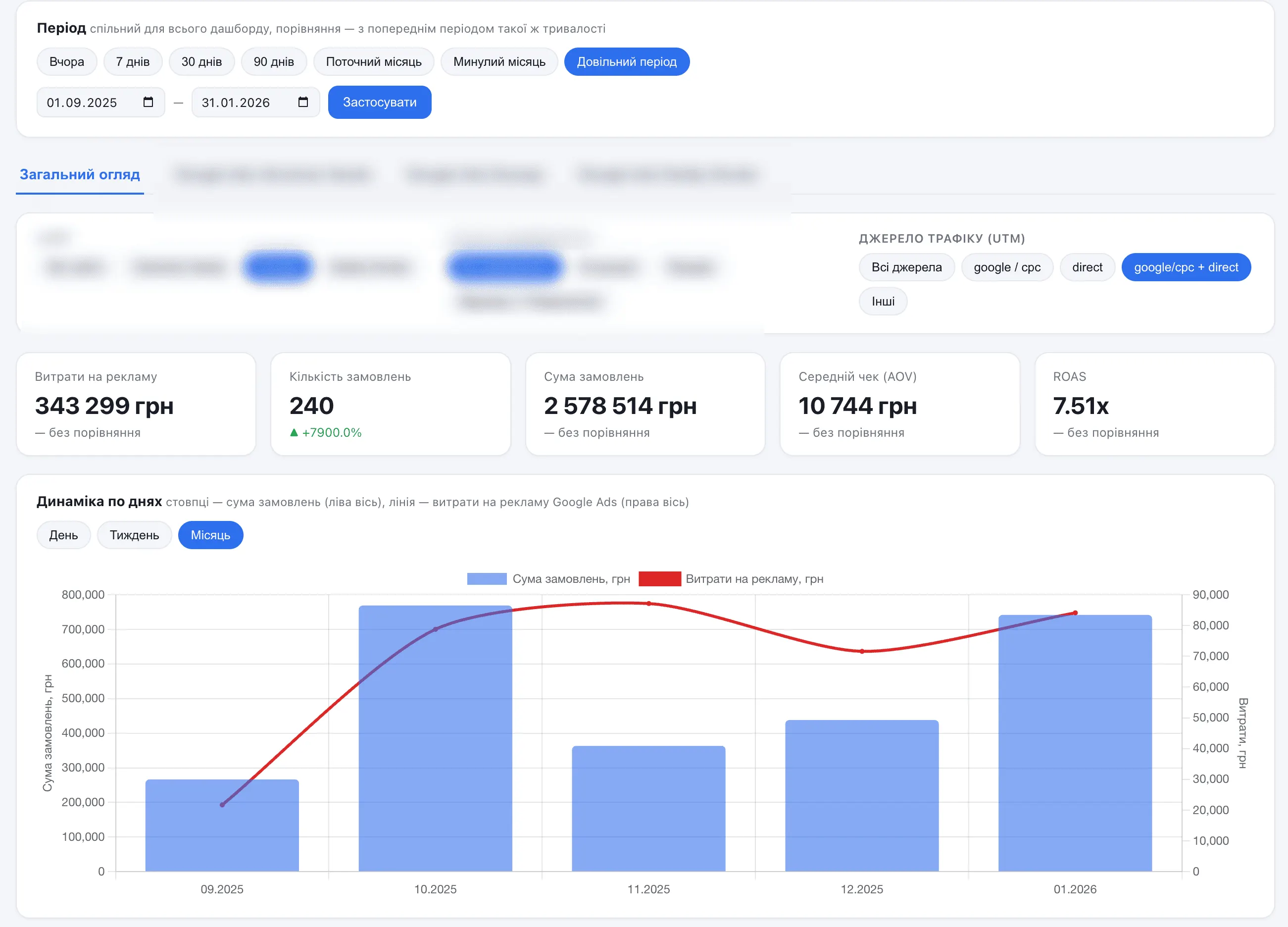
A good result, because the company is a manufacturer, not a reseller or dropshipper, so the margin is higher. The ROAS is not a record, but it is good for in-house production. It could have been higher: in the peak months we could have pushed more budget, and we will take that into account next season.
Demand peaks
The dashboard shows two peaks — October and January. A fair question: November and December are also in season, so why are there no peaks?
The business depends heavily on the news: the October and January peaks coincide exactly with the periods of the harshest power outages.
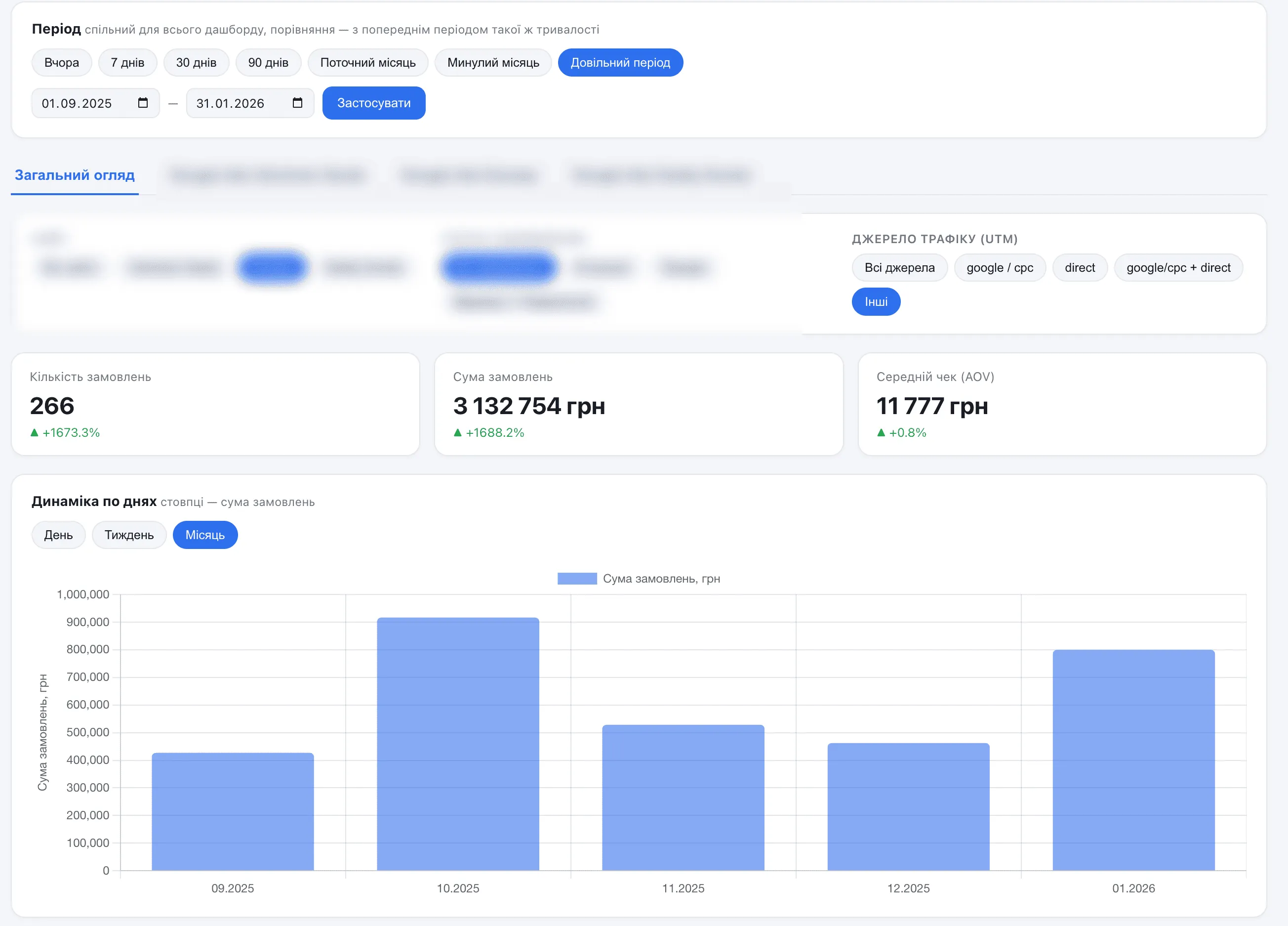
To confirm this (rather than just saying “October worked well, November–December underperformed”), here is a second dashboard — orders from other traffic sources: social ads and a small share of SEO. The pattern is practically identical (with a small deviation in January). This confirms that there are demand peaks and dips driven not by the quality of the advertising but by external conditions. During the dips the results are not peak, but still good.
Technical foundation
A well-built OpenCart website with everything in place: product ratings connected, the CRM integrated with Google Ads, and a management dashboard with fully transparent data. This makes advertising much easier. Nothing supernatural — a very pragmatic story: there is a season, and in season you need to make money.
Strategy for next season
After the season ended this year, we paused the cooperation — nobody buys stoves in May, and the audience switches to other products.
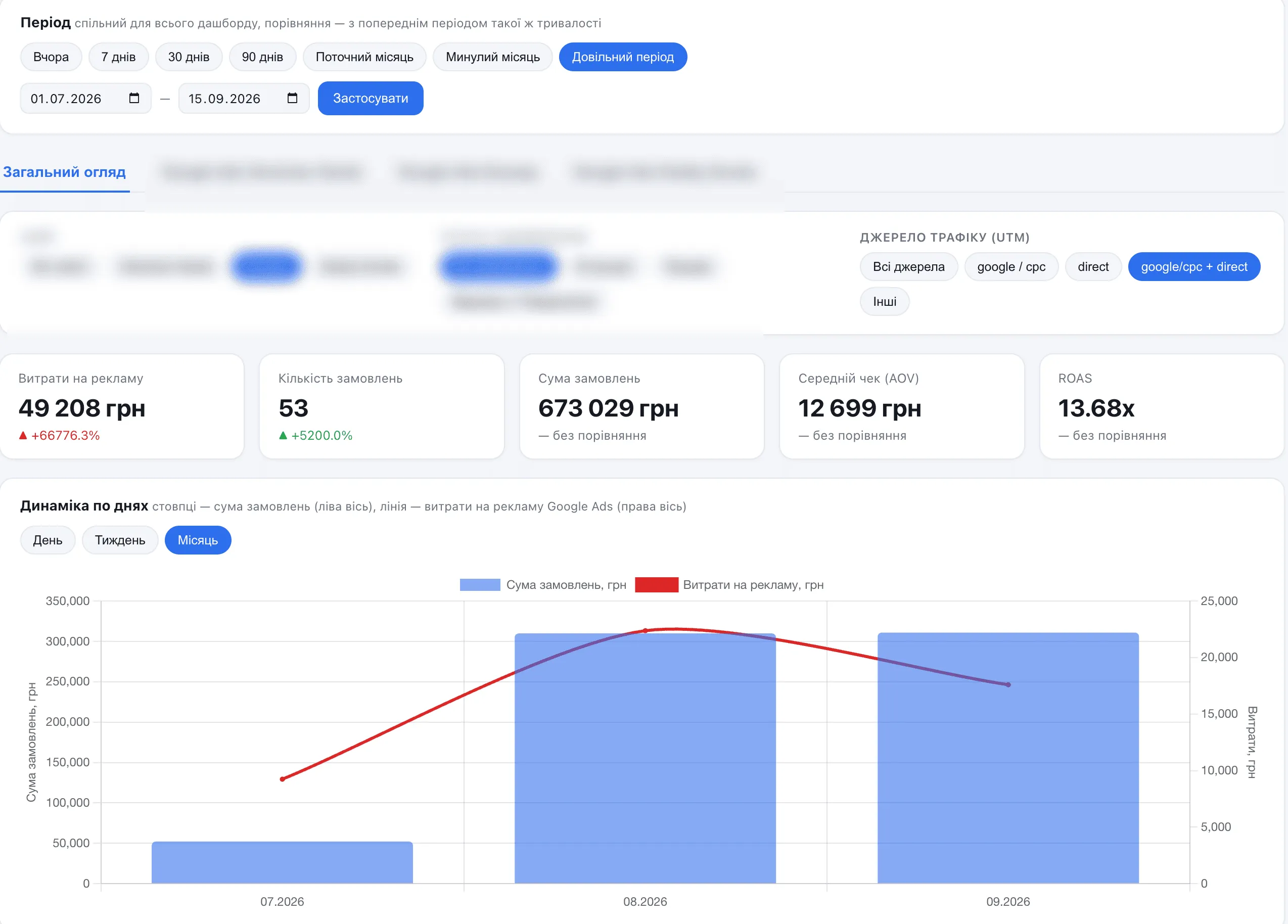
This year we started much earlier: we saw spikes in other channels as early as July. The logic is simple: given the news about power and gas outages, the audience, especially owners of private houses, already understands that a solid-fuel stove is the only option, and some are ready to buy right now.
We started promotion in July with small budgets. Half of the campaigns are focused on sales, and half of the budget goes to building demand — an investment that converts at future peaks. That is marketing strategy in a simplified form.
Now we cover two stages of the funnel: the bottom — those already ready to buy — and the top — introducing the brand and product and building future demand. The approach is already working: on the current budget we get a good number of deals with a higher average order value and more consistent ad performance.
Conclusion
It always starts not with the ad account but with strategy. The right strategy skims the cream; the wrong one burns money. If there is no strategy, or it is wrong, tactics cannot fix the situation — Jim Collins wrote about this in “Good to Great”: you cannot fix a strategy problem with tactics. This applies to both management and marketing.
After this season ends, we expect better results — early next year I will probably publish an update to this case with the results of the current strategy.
Where to find me
Message me on Telegram or by email — I respond quickly. Telegram channel and YouTube are for those who want to see real cases before reaching out and understand my approach.