
Marketer, analyst, ex-CMO focused on the Google ecosystem (Ads, Merchant Center, GA4, GTM). Google Partner. 150+ projects, 100+ positive reviews on Freelancehunt, 12+ countries.
- I work directly, with no account managers or subcontractors
- I measure results in sales, not in-platform conversions
- Maximum expertise in the Google ecosystem
“The campaign is learning, we need to wait.” Everyone who has ever launched Google Ads has heard this phrase. Then a week passes, then a second one, the “Learning” status disappeared long ago, and there are still no results. And the question arises: what exactly did it learn?
I’ll break down what the learning period is, how long it really lasts, which actions restart it, and most importantly, what exactly the campaign learns from.
Contents
What the learning period is
When you turn on a smart bidding strategy — Maximize conversions, Maximize conversion value, Target CPA or Target ROAS — Google first collects data: which queries, audiences, devices and hours lead to conversions. During this time the strategy shows the “Learning” status.
While the system is learning, results can jump around: the cost per conversion is sometimes higher, sometimes lower, spend is uneven. That’s normal.
How long learning lasts
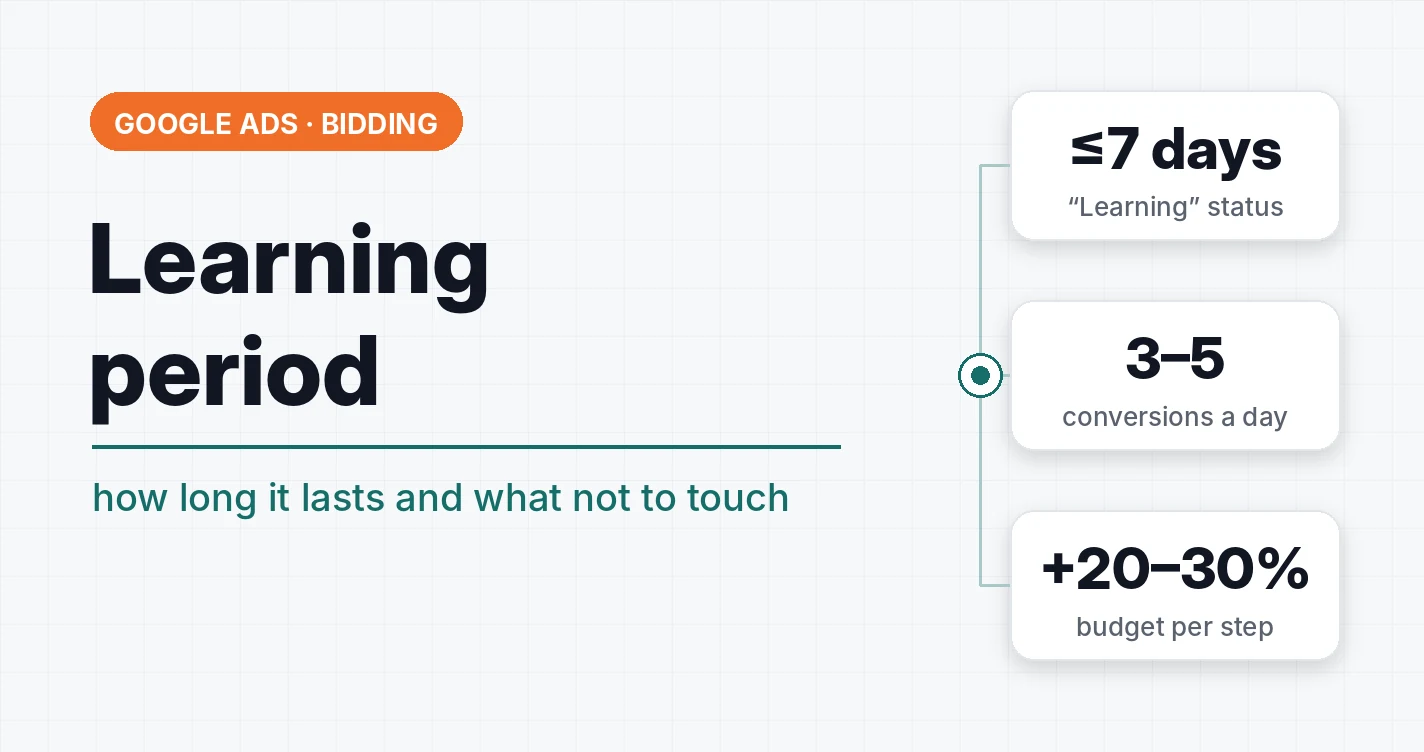
According to Google, the “Learning” status itself lasts no longer than 7 days. But that doesn’t mean the strategy reaches a stable result after a week. Google says a strategy usually converges to a new target within 1–2 conversion cycles, and advises evaluating results after 2 conversion cycles or 2 weeks, whichever is longer.
A conversion cycle is the time between a click and a conversion. For food delivery it’s minutes. For B2B equipment it’s weeks, or even months. So in B2B “two weeks” may be too short.
What the learning speed depends on:
- Number of conversions. The more, the faster. Here my observation matches what Google’s personal consultants say: for stable operation of strategies with a target, one campaign should get at least 3–5 conversions a day.
- Conversion cycle length. A long path from click to purchase means slower learning.
- Settings. Tight targets, a small daily budget and narrow targeting slow down the ramp-up.
What restarts learning
This is where most myths live. Many people are afraid to change the budget or ads because “learning will be reset”. According to Google, the “Learning” status is triggered by:
- creating or re-enabling a strategy, including applying a new portfolio strategy;
- adding or removing campaigns, ad groups or keywords in the strategy;
- a significant change to conversion goals or to the actions the campaign optimizes for.
Changes to the budget, target CPA and ROAS, ads and targeting do not trigger the “Learning” status — they take effect from the next auction.
But there is an important “but”. The status not appearing doesn’t mean the change broke nothing. A sharp jump in budget or target means different conditions that the system has to readjust to. Google recommends raising the budget gradually, by 20–30% once every week or two. If you raise it at once by 50–100%, there’s a high chance the campaign will break.
And one more thing: dropping out of payment. Campaigns stopped because of non-payment may go into relearning, and nobody guarantees the previous results will return.
What not to touch during learning
- Don’t change the strategy every few days. Every new strategy means learning from scratch.
- Don’t stack several target changes within one conversion cycle. You changed Target CPA — give the system time to react.
- Don’t shake up the structure. Added groups, removed keywords, moved a campaign into a portfolio — and so on every day. The system doesn’t have time to understand what works.
- Don’t draw conclusions by day. In the breakdown of a dental equipment store daily ROAS over seven months ranged from 0.16 to 83. With such a spread, “yesterday was bad” means nothing.
The main thing: what the campaign learns from
You can sit through the learning period perfectly and end up with a campaign that has learned excellently how to find junk. The strategy optimizes for what you called a conversion.
A fresh example from practice. A project ran on offline conversions from the CRM. Many enquiries from messengers started to drop, and the client set up passing leads from messengers, but without validation. “Leads” that simply tapped through to a messenger and wrote nothing started to get into Google Ads. Performance Max, which had worked stably for three months, quickly picked up this signal. In two days the campaign crashed completely and went into the Display Network, where such “leads” are the easiest to find.
Another case is a tutor aggregator. There was one general goal, “tutor request”, and Google didn’t understand what a lead for maths specifically looks like. It was solved by splitting into separate goals by subject and passing those who had already paid for the first lesson. Plus, over three months the client classified all historical leads and passed them into the system, so the new goals started learning not from zero. For a separate campaign or a portfolio strategy to work, the system needs at least 30–50 quality data points.
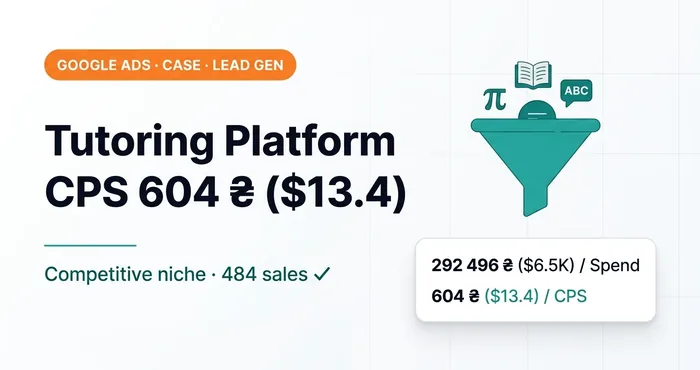 Google Ads case study · End-to-end analyticsGoogle Ads case study: tutoring platform, CPS 604 UAH ($13.4) in a competitive niche292,496 UAH ($6.5K) spent, 484 paid lessons, CPS 604 UAH ($13.4) in a competitive niche. Splitting leads by subject saved the campaign.
Key idea: the learning period is not time you have to sit out. It’s the time when the system memorizes whom to look for. If conversions are dirty, it will memorize wrongly.
When learning never ends
Sometimes a campaign doesn’t reach a stable result for weeks. The most common reasons:
- Too few conversions. 20 sales a month, and a smart strategy learns by feel.
- A tight target. Target CPA lower than the real cost of a conversion in the niche. The system simply doesn’t enter auctions and doesn’t collect data.
- A small budget. The campaign doesn’t have time to gather statistics.
- Changing conversions. Today we count leads, tomorrow calls, the day after also messenger taps.
In such cases I remove the target and keep Maximize conversions or Maximize conversion value, or go back to manual bidding. I have projects with a limited budget that work successfully precisely on manual bids.
 Google AdsCPC: What Drives Cost per Click and Why It Keeps RisingWhat drives CPC in Google Ads, why cost per click grows every year and why a pricier click often brings a cheaper lead. A real experiment breakdown.
Check your campaigns
Open the “Bid strategy status” column in the campaign list. Look at how many conversions per day each campaign on a smart strategy gets, and what exactly counts as a conversion in the “Goals” section. If a campaign on Target CPA or Target ROAS gets fewer than 3–5 conversions a day, and the conversions include phone clicks and messenger taps, the problem isn’t learning. What is worth counting as a conversion is in the article what a conversion in Google Ads is.
Where to find me
Message me on Telegram or by email — I respond quickly. Telegram channel and YouTube are for those who want to see real cases before reaching out and understand my approach.