
Marketer, analyst, ex-CMO focused on the Google ecosystem (Ads, Merchant Center, GA4, GTM). Google Partner. 150+ projects, 100+ positive reviews on Freelancehunt, 12+ countries.
- I work directly, with no account managers or subcontractors
- I measure results in sales, not in-platform conversions
- Maximum expertise in the Google ecosystem — instead of “PPC, social ads and SEO, all in one”
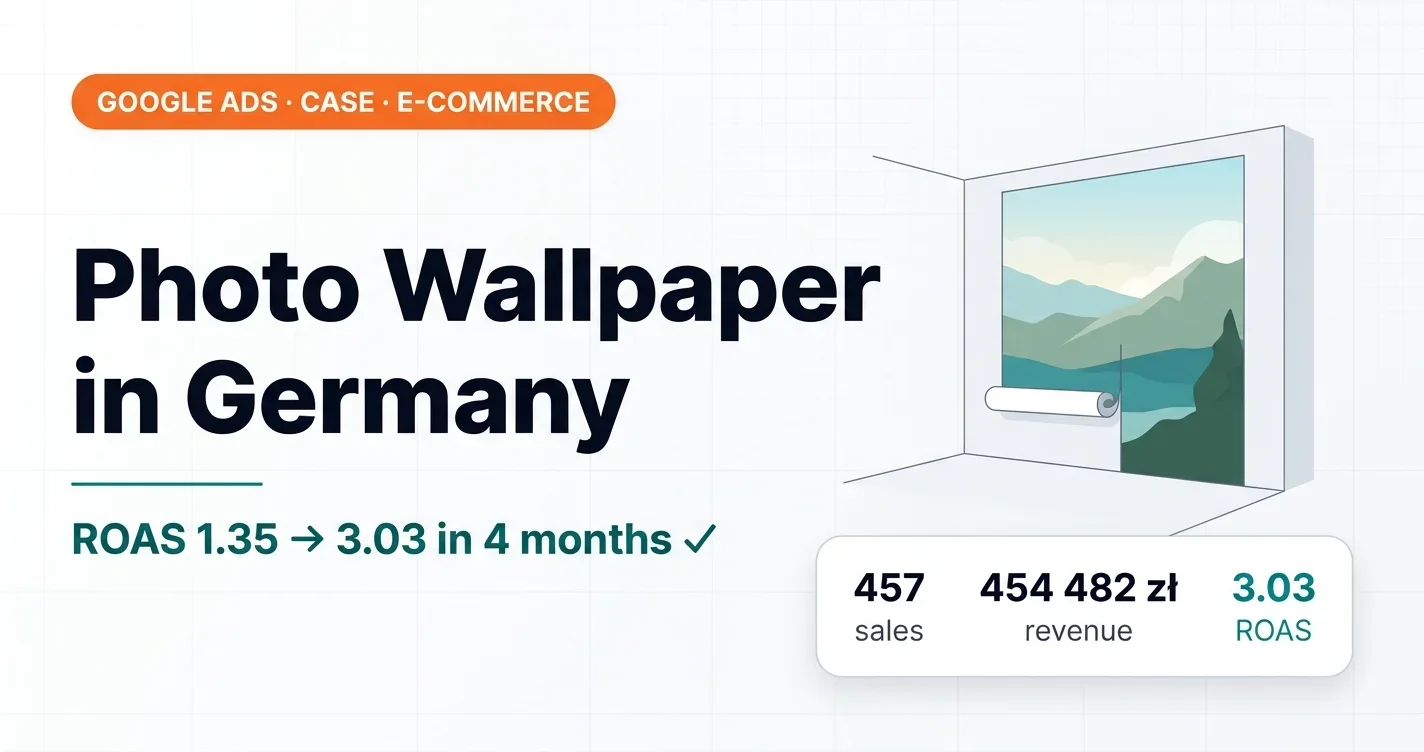
A case of promoting photo wallpaper in the German market. When the client came, the ads were running at a loss: ROAS 1.35, then 1.21. By his own calculations, he needed ROAS 2 to break even and 2.5 to make money.
Contents
I reviewed the account and said: getting from 1.35 to 2 here is not hard, even with purely technical changes. Over 4 months the average ROAS reached 3.03 — above both the break-even point and the client’s baseline KPI. That is already profit.
Starting point
The market is Germany. The account data is in Polish zloty: the company and payment profile are registered in Poland, so the account currency is zloty.
- starting ROAS 1.35, then 1.21: the ads were losing money;
- break-even point: ROAS 2;
- for the business to make money: ROAS 2.5.
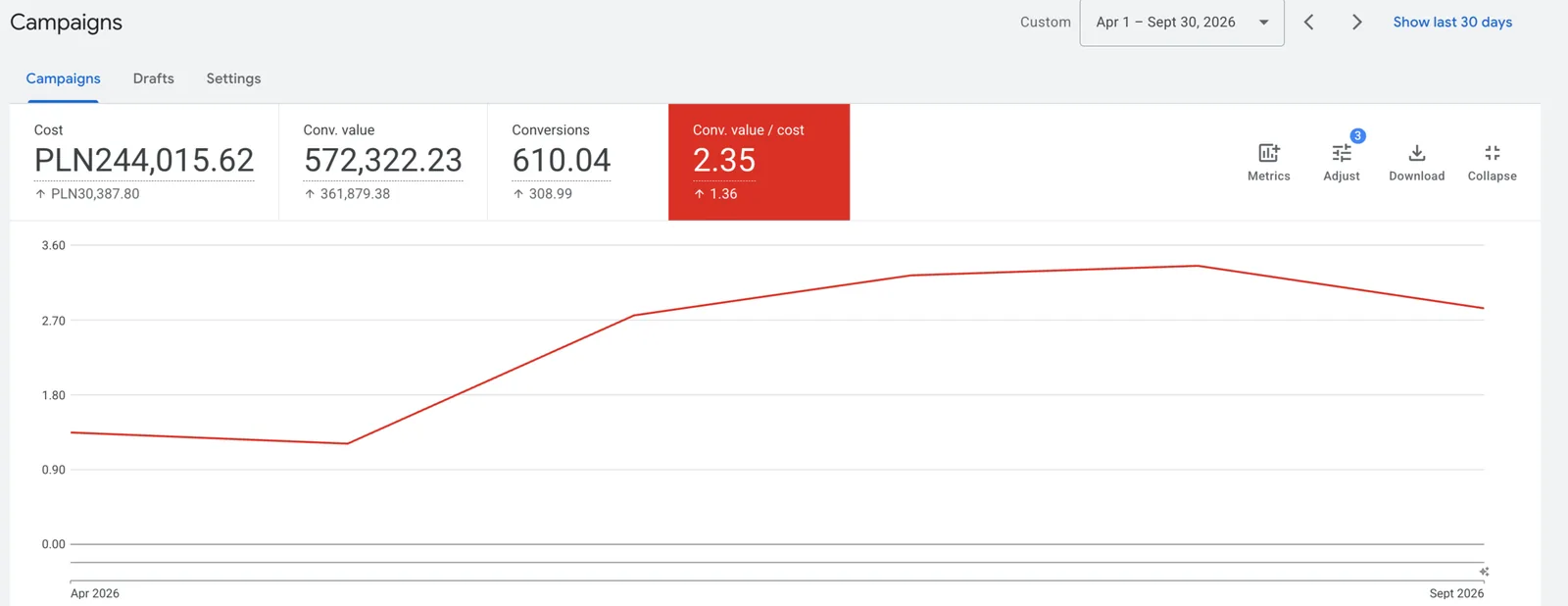
The half-year chart clearly shows the turning point: April and May at a loss, profit from June on.
Results over 4 months
The period in this case is June 1 to September 30, 2026.
| Metric | June 1 – September 30 |
|---|---|
| Spend | 149 836 zł |
| Revenue | 454 482 zł |
| Sales | 457 |
| ROAS | 3.03 (was 1.35) |
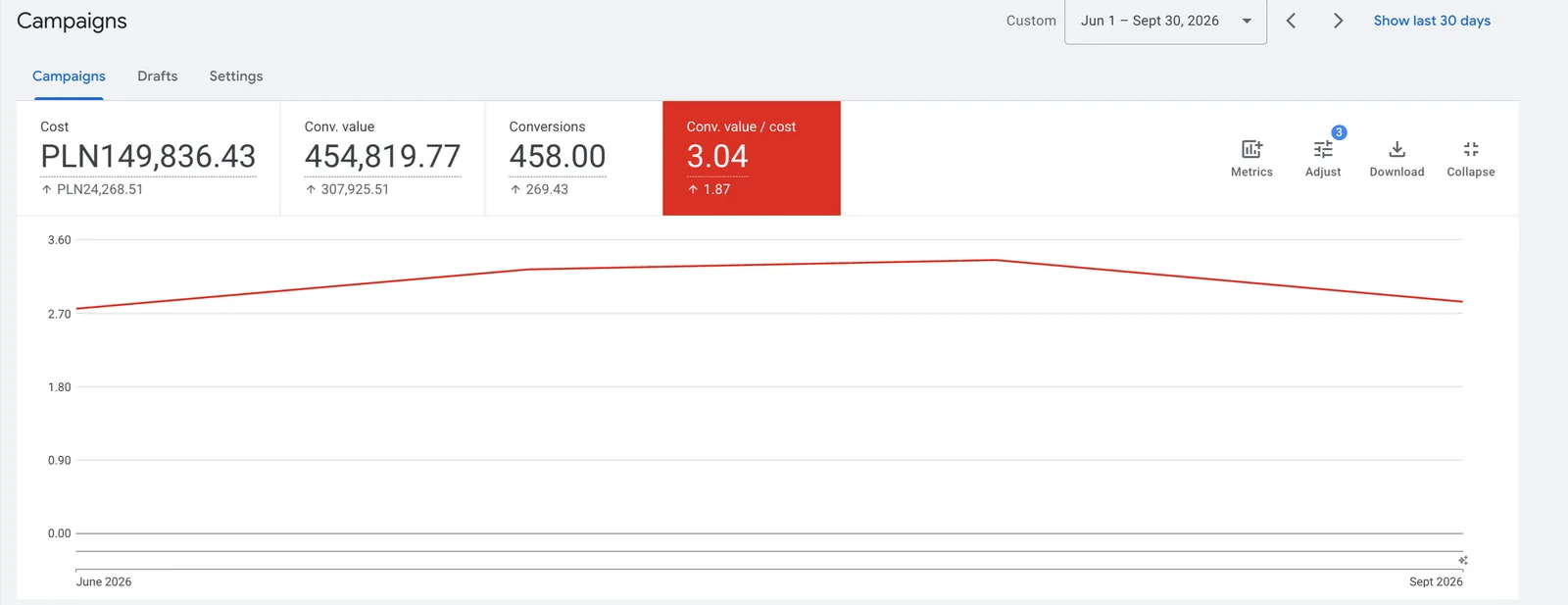
Conversions record actual sales with actual value, not carts or checkout starts. In other words, this is real money paid by customers.
ROAS has more than doubled since the start of our cooperation. It looks like a good case. But, as always, there are nuances.
Key takeaway: getting from ROAS 1.35 to 2 is often possible with technical settings alone. Beyond that, you run into the website, the brand and the business’s own decisions.
Nuance #1. A custom-built website
The website is custom-built, and that causes constant problems. This is not my first client like this, and they all feel roughly the same pain.
At least there is a developer who constantly works on the website. But he has about ten websites and cannot keep up. He changes something here, and something breaks there. And all of it hits the ads: constant fixes, things working poorly, pages loading slowly.
If you are building a custom website, first answer the question: why? There are plenty of ready-made solutions. For the Ukrainian market — Khoroshop, OpenCart, WordPress. For other markets — Shopify and a number of lesser-known CMSs.
A fresh example. A new client tells me he has already invested $30,000 in his website and keeps investing, with no result. Before that he had a website on Khoroshop, and it worked no worse. The custom one is constantly being patched and never finished. I understand the developers: what is their incentive to make the website perfect? I looked at it and still could not understand why a custom solution was needed at all. Now the client is moving to Khoroshop, and in terms of features it fully covers everything the current $30,000 website has.
Key takeaway: a custom-built website for an online store is almost always more expensive, slower and less stable than a ready-made platform. And advertising is among the things that pay for it.
Nuance #2. The client does not want to invest in the brand
The client seems to want to grow, but everything keeps getting put off. The German market is fairly conservative, yet the client does not want to invest in brand awareness and development at all: “we only need sales”.
This works in the short term. If you do not build a brand in the German market, you will work for another year, and then the numbers will start to stagnate.
By the way, he has another website — a Polish one. And what I am describing is already happening there. He once gave it to me for an audit, and I even ran it for a couple of months. Then an agency did its own audit and told fairy tales about how they would fix everything and it would all be great. In reality, over three months they changed little more than the campaign names and gradually raised budgets. As the saying goes, big talk, little action.
Now the client says the numbers there get worse year after year, and he keeps looking for a contractor who can sustain the growth of the early years. But in no market can this be fixed with technical settings alone, and he is not willing to invest in the brand. I think next year he will see declining numbers on the German website too.
On top of that, competition in the niche is huge, and the cost per click grows by about 30% year over year. And yet he wants everything to somehow work out.
I looked at competitors’ websites: in this niche they all look the same and copy each other, most likely without much thought. And the client keeps telling me the grass is greener on the competitors’ side.
I gave him a list of what needed to be done. Of course, nobody did anything. Not even the basics: for the conservative German audience, there are no reviews on the website. A visitor comes in — a no-name brand, no social proof at all, just selling wallpaper. And then we wonder why the results are not what we wanted. I wrote about how exactly a website burns the budget in the article about CRO for Google Ads.
Key takeaway: ads can bring a person to the website, but they cannot make them trust a nameless brand with no reviews. Especially in a conservative market.
Nuance #3. Restrictions in the ad account
The client does not allow everything in the account. Here is what it looks like. There is a search term that brought a thousand visits to the website and not a single purchase. I suggest excluding it. The client: “But it’s a relevant keyword.” I say: the keyword is relevant, but people do not buy from it. “No, don’t exclude it, we will lose traffic.”
I ask: do you need traffic or sales? — Sales. — Then why are we discussing traffic?
This happens a lot: they want one thing, look at another and do something else entirely.
Why hire an expert if you don’t listen to them
Despite a positive case with a good result, I find the client’s approach completely puzzling. If you think you know better, go ahead and do it yourself. Why hire people then?
I am used to working like this. Either we do what I say, and then we talk about results in concrete terms. Or we do what you say: I simply act as the hands, but I warn you about the result upfront.
For example, the client has a hypothesis. I have more than 150 projects behind me, and I have already tested most hypotheses that can be tested at all. I say: it will not work here. “Well, let’s try.” We try — it does not work. I told you so. I am not saying I am super smart: it has all simply been tested already. Exceptions happen, in roughly 10% of cases. But when something obviously will not work, there is no point testing it with the client’s money.
When you hire an expert, you should not tell them what to do. You should listen to what they tell you to do. Otherwise you hire a person who will do mid-level tasks while paying them as an expert. There is no economic sense in that. How to choose a contractor so you do not end up in this situation — in the checklist for choosing a Google Ads freelancer.
Key takeaway: if you hire an expert and make the decisions for them, you pay an expert’s price for an executor’s work.
Conclusion
I consider the result excellent: ROAS more than doubled, from 1.35 to 3.03, and the ads went from a loss to a profit. But the ceiling of this project is defined not by the ad account but by the website, the brand and the business’s willingness to follow recommendations. Technically, a lot can be achieved. Compensating for the lack of a brand and trust — no.
If you want to know how much technical headroom your ads have, start with a Google Ads audit. A similar e-commerce case with a small average order — furniture covers, ROAS 4.07.
How I set up ads for other countries — on the Google Ads for international markets page.
Where to find me
Message me on Telegram or by email — I respond quickly. Telegram channel and YouTube are for those who want to see real cases before reaching out and understand my approach.