
Marketer, analyst, ex-CMO focused on the Google ecosystem (Ads, Merchant Center, GA4, GTM). Google Partner. 150+ projects, 100+ positive reviews on Freelancehunt, 12+ countries.
- I work directly, with no account managers or subcontractors
- I measure results in sales, not in-platform conversions
- Maximum expertise in the Google ecosystem — instead of “PPC, social ads and SEO, all in one”
Every now and then — quite often, actually — I see requests from businesses so detached from reality that you just wonder how you even operate.
Contents
Recently a job appeared on Freelancehunt. Here's the screenshot: “Setup and management of PPC ads for a short-term apartment rental website.”

What the person wants
There's an ad campaign created by a freelance “Direct specialist” that has been running without management for several years, but its results are very weak. At a cost per click of 1 UAH ($0.02) — a few clicks a day. What's needed: create a new campaign or modify the current one so that for every 1 UAH ($0.02) invested in ads, including the fee for campaign management, we get at least 5 UAH ($0.11) in revenue.
What's wrong with this brief
The first thing that jumps out — the person says right away “make it so that every hryvnia invested brings at least 5 hryvnias of revenue”. That's very different from discussing with a client what cost is acceptable at the forecasting stage. I recently published an article about calculating and launching ads for a sushi delivery in Kyiv and Dnipro — take a look at how it actually works.
It's one thing when you explain to a client: we need to understand your economics and the ads' break-even point, so they first break even and then go into profit. But not here. People imagine advertising as if the ad account has some magic or secret settings: give the system one hryvnia and it returns five. No regard for the market or the competition. They just want 5 out of 1.
Checking the numbers
Here's a screenshot from Google Ads Keyword Planner for the city of Dnipro (that's where the client is). The top-of-page bid for the broad query “apartment by the day” is 92 UAH ($2). In cases like this I calculate a scenario between the minimum and maximum bid, and separately — a scenario with the maximum cost per click.
Will Your Google Ads Launch Be Profitable? A Feasibility Calculation Example

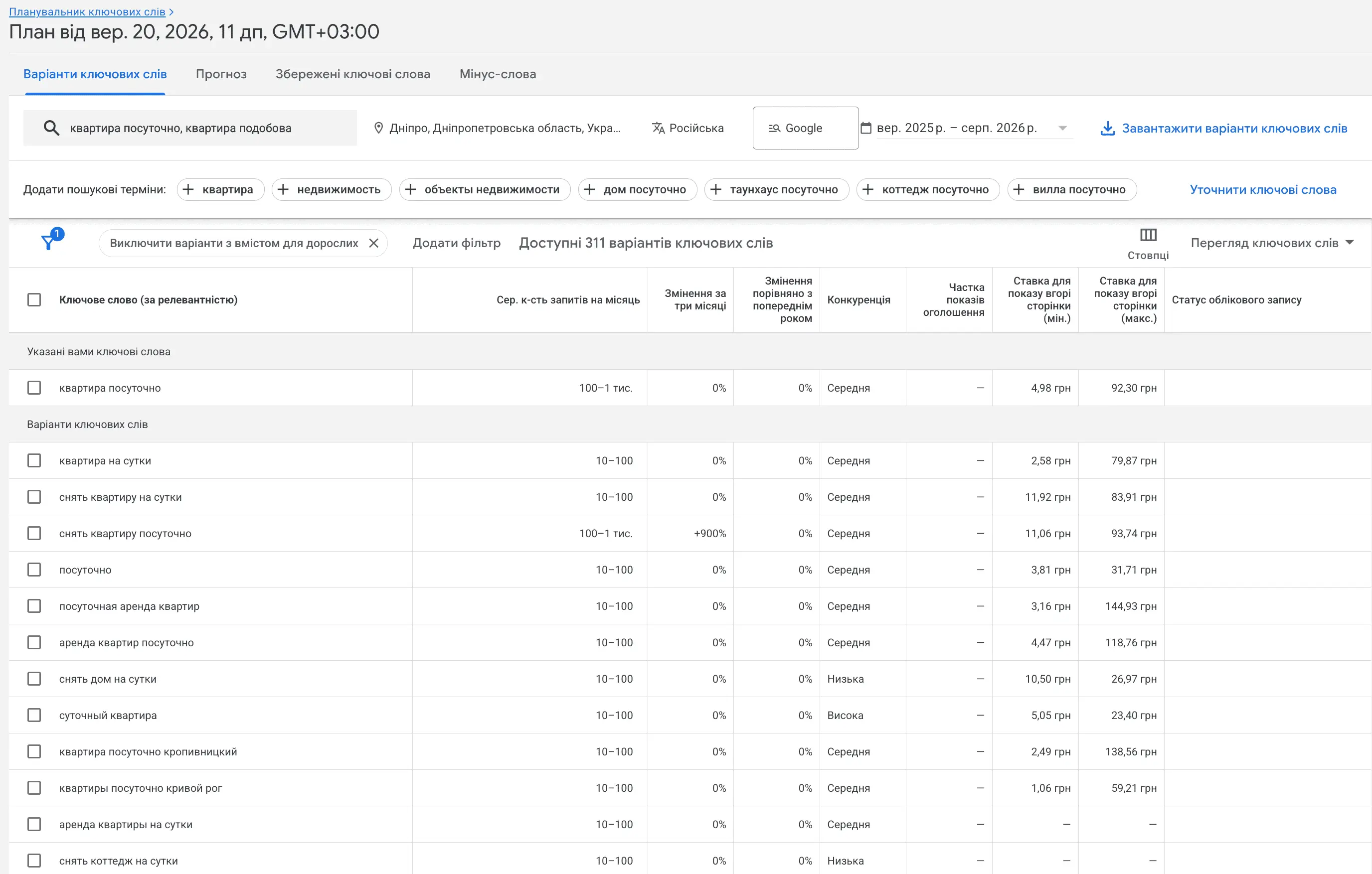
Why? If you work with smart bidding strategies (Maximize conversions or Target CPA), the top-of-page bid can turn out even higher than what Keyword Planner shows. This happens quite often, so this scenario also has to be shown to the client up front.
Another nuance — there aren't many keywords in this topic. And separately: honestly, I like the website. I don't see any blockers there, everything is clearly laid out.
What narrows the market
They offer premium real estate, premium-class rentals. That already narrows the market a lot.
The website says prices start from 1,760 UAH ($39) per night, but that's for stays of 15 nights or more. Without real data you can only guess — but most likely the main flow of bookings is 1–5 days, not 14. Let's take an average order of roughly 2,000 UAH ($44) per night.
The client wants 5 UAH ($0.11) from every hryvnia invested — which means we need to fit into a cost per lead of about 400 UAH ($8.9) excluding the management fee, and closer to 300 UAH ($6.7) including it.
How realistic is that
With an average click around 50 UAH ($1.1) (I'm taking a fairly optimistic scenario), to fit into 300 UAH ($6.7) per lead the website conversion rate would have to be 17%.
Is that realistic? I have a case of a website I built myself and have been running ads for over three and a half years — it's a metalworking website, and it converts at 17%. But for a lead generation project I would never plan for that scenario. The most I could put into a forecast is 10%, and only if it's something mass-market. For premium rental housing I'd lower the conversion rate to 2–3%, 5% at most — and 5% is already the ceiling.
Let's take the optimistic scenario: 5% conversion rate, 50 UAH ($1.1) per click — the cost per lead comes out at 1,000 UAH ($22). With a 2,000 UAH ($44) order, that means every hryvnia invested earns you 2, not 5 as the client wants. And that's the most optimistic scenario possible.
Key point. The most interesting part is that someone will turn up and take this job. Of course, they won't hit the targets. A month later the client will go looking for a new contractor. A month after that — another one. And so on in a circle, until they face reality: with this goal it's impossible to deliver the cost per lead they want.
About “Direct specialists” and doctors
I probably last heard the word “Direct specialist” (a Russian-era term for a Yandex.Direct ad manager) about 12 years ago, when Yandex.Direct still existed for us. Yandex has been blocked in Ukraine for years — where did that word even come from in a job description?
An ad campaign that “has been running for several years, but the results are weak” — by all appearances, it was created a very long time ago and never updated once. It's the same story as a person going to a doctor and saying: “Cure me so I never get sick again.” Going to a car repair shop and telling the mechanic: “Fix the car so it never breaks down again.” Going to a barber: “Cut my hair so I never need another haircut.”
Set up my ads so they work and nothing ever needs to be done. Folks, you don't operate in an isolated environment. You operate in a dynamic environment where something is constantly changing.
Another recent example
The day before yesterday I had a two-hour Google Ads consultation. The client's first question: “My ROAS has been dropping for 4 months in a row, how do I fix it?” Meanwhile, Google recommended he raise his ROAS from 600% to 811%.
My first recommendation — don't follow this Google recommendation, because Google contradicts itself: it states that when working with ROAS you should raise it by 10%, 15% at most, at a time, yet here it advised a jump of 40% at once.
I tell the client: ROAS isn't a single setting. I won't show you a “manage ROAS” button. I can show and explain what to do to raise it — there are quick actions based on a Google Ads account audit that will genuinely help — but ROAS itself doesn't go up at the push of a button.
There are no simple solutions. There's systematic work. If you're looking for simple solutions, Google Ads doesn't work that way. Ever. I've already described the “make me a profit in 7 days” case — it's about the same thing, a complete detachment from reality.
One more detail from the job
“At a cost per click of 1 UAH ($0.02) — a few clicks a day.” We can't see what's currently happening inside the campaign itself. But let me remind you: the real market cost per click in Keyword Planner is 50 to 90 UAH ($1.1–2).
1 UAH ($0.02) per click is probably somewhere around page 30 of the search results. I found a single query with a minimum bid of 1.74 UAH ($0.04) — and even that was for property rentals in Khmelnytskyi, not Dnipro. Again the same thing — a complete detachment from reality.
What I would actually test
There isn't much work here — two hypotheses are worth checking:
Direct — Dnipro, short-term rental keywords, people looking for housing within the city itself.
Reverse — all other locations except Dnipro, with keywords for short-term rentals specifically in Dnipro — because people often look for a rental in Dnipro before they arrive: someone travels on business from Khmelnytskyi to Dnipro and looks for an apartment in advance.
Conclusion
The client's request is unrealistic from an execution standpoint. Mathematically, the numbers just don't add up. The brief itself is understandable — the person wants a specific return — but that return simply won't happen.
Where to find me
Message me on Telegram or by email — I respond quickly. Telegram channel and YouTube are for those who want to see real cases before reaching out and understand my approach.